
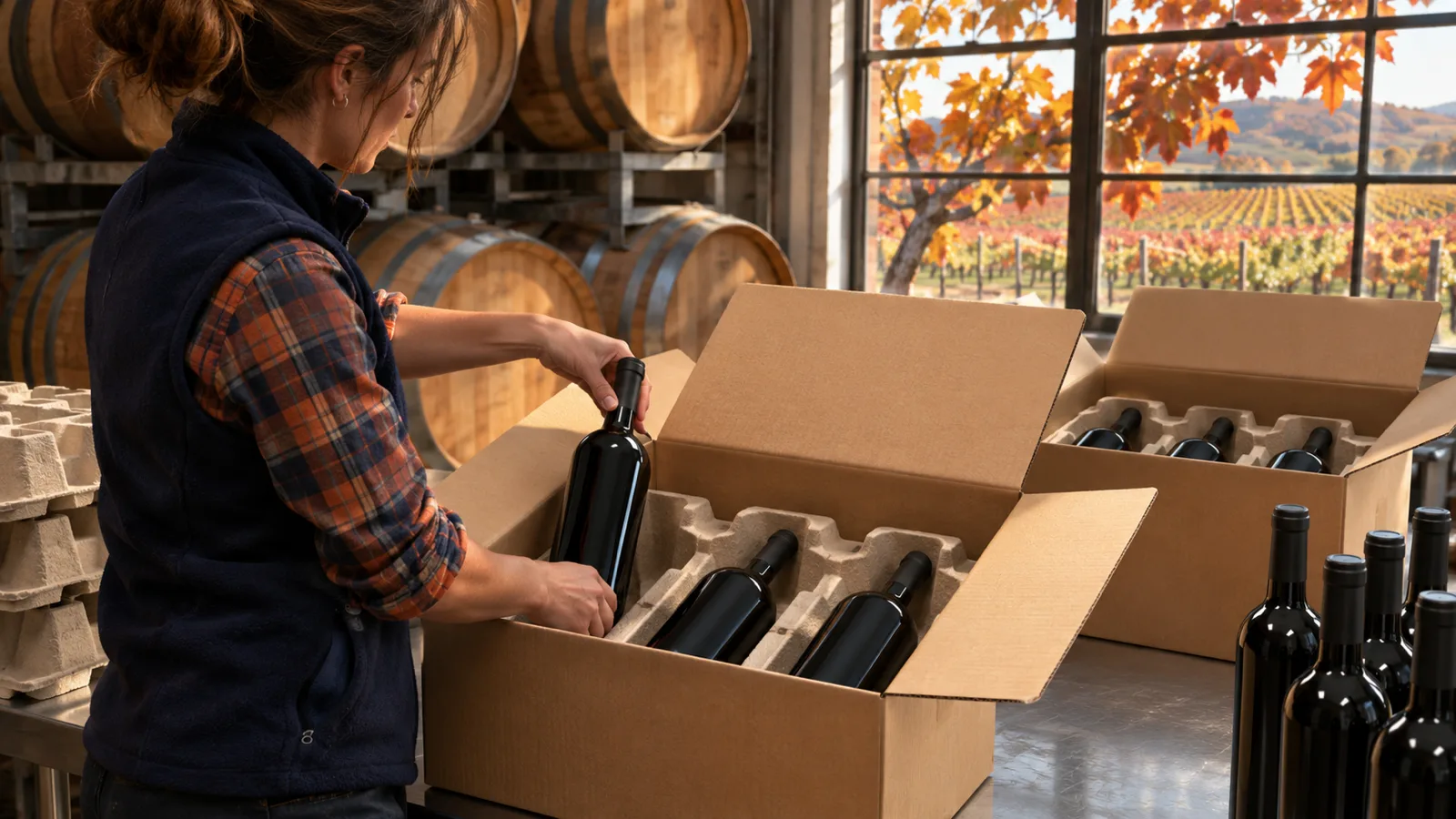
A winery in the Okanagan Valley finishes its autumn wine club release: three hundred cases to members spread from Victoria to Halifax. A few weeks later, a Niagara winery ships its icewine to customers who visited the tasting room in the summer and want a bottle for the holidays. In both cases, the winery has already done the hard part by making wine people love. What happens between the cellar door and the customer's door decides whether that wine arrives the way the winemaker intended.
Shipping wine in Canada brings together three problems that rarely appear together in other products. Wine is fragile, so glass breaks. Wine is sensitive to temperature, so a hot truck in July or a frozen depot in January can ruin it. And wine is alcohol, so where you can ship it, who can receive it and how depends on the rules of each province and territory.
This guide works through each of those problems in turn and finishes with a practical shipping calendar for Canadian wineries.
Problem one: temperature
Wine is happiest at stable, cool temperatures. Brief exposure to warmth or cold is usually survivable, but extended heat can "cook" a wine, flattening its fruit and pushing corks out as the liquid expands. Freezing is also a risk: wine freezes at a lower temperature than water, but Canadian winters can easily reach that point, especially in Prairie and northern depots. A frozen bottle can push its cork, crack, or leak, and the wine may not recover its original character.
The challenge is that parcels spend much of their journey in places you cannot control: delivery vans, sortation centres, trailers waiting to be unloaded, and front porches. A few strategies help:
- Watch the forecast on both ends. A shipment from a temperate cellar can still meet a heat wave in Southern Ontario or a cold snap in Edmonton. Check origin, destination and the main route in between.
- Use ground service carefully in extreme seasons. Longer transit means more exposure. In peak summer heat and deep winter cold, consider pausing shipments to the hardest regions or upgrading service.
- Ship early in the week. Shipping on Monday or Tuesday reduces the chance of a parcel sitting in a depot over a weekend.
- Insulate when it is worth it. Insulated liners or foam shippers add cost and weight, but for premium bottles or icewine sent during extreme temperatures they can be worth it.
- Avoid porch drop-offs. Adult signature on delivery, which is often required for alcohol anyway, means the parcel is handed to someone rather than left in the sun or snow.
For wineries holding stock away from the cellar, a temperature-controlled warehouse keeps bottles at stable conditions until orders are released. That matters if the winery's own storage is limited or not climate-controlled.
Problem two: breakage
Glass bottles in a cardboard box are a familiar sight at every courier depot, and carriers know they are fragile. That does not mean they will be handled gently. Sortation equipment, conveyors and loading are rough on parcels, and wine is heavy enough that a drop from waist height can break a poorly protected bottle.
Packaging options compared
- Molded pulp shippers: recyclable, increasingly popular, and effective at holding bottles apart. They are bulkier than some alternatives but are generally well accepted by carriers. Make sure the inserts fit your bottle shape, as icewine and sparkling bottles differ from standard Bordeaux shapes.
- Expanded polystyrene (foam) shippers: excellent protection and some insulation, but harder for customers to recycle and increasingly unpopular with environmentally conscious buyers.
- Corrugated cell dividers: fine for case shipments by freight on pallets, but generally not enough protection on their own for individual parcels.
- Air cushion or inflatable sleeves: light and protective for one or two bottles, though they need careful sizing.
Whatever you choose, test it. Drop-testing a packed shipper from a few different angles before committing to a new packaging supply will tell you more than any specification sheet. Our posts on choosing a courier for fragile items and packing fragile items cover the basics.
Handling breakage when it happens
Even with good packaging, a small number of bottles will break. A broken bottle soaks the box, sometimes damages neighbouring parcels, and may lead the carrier to return or dispose of the shipment. Have a process ready: a clear policy on replacements, photos requested from the customer, a record of claims by carrier and route, and enough spare stock of each wine to send replacements quickly. Tracking damage by route often reveals that one lane or one depot causes most of the problems.
Problem three: provincial limits
Alcohol is regulated provincially in Canada, and that makes interprovincial wine shipping more complicated than shipping most other goods. A federal change in 2012 removed the federal prohibition on individuals bringing wine across provincial borders for personal use, but each province and territory still decides whether and how wine can be shipped to its residents, and in what quantities.
In broad terms, as of this writing:
- A few provinces, including British Columbia, Manitoba and Nova Scotia, have opened the door to some form of direct shipping of Canadian wine to their residents, subject to conditions.
- Other provinces, including Ontario and Quebec, generally require wine coming from outside the province to be sold through the provincial liquor authority, though rules and pilot programs evolve.
- Within your own province, direct delivery to consumers is usually allowed for licensed wineries, but conditions on licences, delivery methods and age verification apply.
- Carriers have their own alcohol shipping policies, often requiring a specific account agreement and adult signature.
Because these rules change and are interpreted differently by different authorities, wineries should check with the liquor regulator in each destination province before shipping, and keep records of what was shipped where. Shipping to the United States or overseas involves federal and destination-country requirements on top of that, and generally requires a licensed importer at the destination.
Wine clubs and release days
Wine clubs are one of the most valuable channels for Canadian wineries, but club releases create intense, short bursts of shipping. Hundreds of orders need to be picked, packed and shipped in a few days, often with mixed cases, tasting notes, and personalised inserts.
A few practices make release days smoother:
- Confirm member addresses and payment details a couple of weeks before release, so failed charges and outdated addresses are fixed early.
- Pre-build standard club packs in advance, leaving only the personalised elements for the release itself. A partner with kitting and assembly services can handle this in batches.
- Group shipments by region and temperature risk. Ship the farthest or most weather-exposed regions first, or hold them for better conditions.
- Send tracking numbers to members as soon as labels are created, and remind them that an adult signature is required.
- Plan for failed deliveries. Parcels that cannot be delivered often go to a carrier depot for pickup, where temperature exposure can be a concern.
Many of the same principles apply to subscription box fulfillment in other industries, where shipments go out in coordinated waves.
Shipping to restaurants and retailers
Business-to-business wine shipping is a different exercise. Orders go to licensed restaurants, wine bars and stores (where permitted) or to liquor board warehouses. These are usually case-level or pallet-level shipments that move by LTL freight or dedicated delivery. Liquor board warehouses tend to require delivery appointments and strict pallet specifications. Getting those details right avoids refused deliveries and costly rebooking.
A shipping calendar for Canadian wineries
- Late winter to early spring: generally a quieter shipping time, but cold remains a risk in much of the country. Ship to milder regions, hold or insulate shipments to the coldest areas.
- Spring: often the best window for shipping across Canada. Moderate temperatures and lower carrier volumes. A good time for spring club releases.
- Summer: heat is the main risk. Ship early in the week, use faster services for long routes, and consider pausing shipments during heat waves.
- Autumn: harvest is busy in the cellar, but autumn is also a strong sales season. Moderate weather makes it another good shipping window.
- Holiday season: high demand for gifts and icewine, with carriers at capacity and winter arriving. Publish order-by dates for each region and allow extra time.
Common questions from winery owners
Should we insure every wine shipment?
Carriers include limited liability by default, and their terms for alcohol and glass can be restrictive. For high-value orders such as library vintages or large icewine gifts, extra coverage may be worth the cost. Read the exclusions closely, since breakage from inadequate packaging is often excluded. Our guide on getting shipping insurance explains what to look for.
What happens when nobody is home to sign?
Carriers usually attempt delivery again or hold the parcel at a depot or pickup point. That adds days in conditions you cannot control. Encourage club members to ship to a workplace where that is allowed, or to choose a pickup location, and send reminders before release day.
Is it cheaper to ship six or twelve bottles?
Per bottle, larger shipments are usually cheaper, because the base cost of a parcel is spread over more product. Twelve-bottle cases are heavy, though, and break more often if the shipper is not designed for that weight. Many wineries find that six-bottle shippers strike a good balance between cost and damage rates, but test both on your own lanes.
Can we keep stock somewhere other than the winery?
Often yes, but storing alcohol off-site can require approval from your provincial regulator and may affect how excise and provincial reporting work. Confirm the rules before moving stock to a third-party warehouse.
Let ShipCarte help with your wine shipping
ShipCarte works with food and beverage businesses across Canada on temperature-controlled storage, small parcel shipping and freight. If you want help planning club releases, packaging and carrier choices around the seasons, schedule a consultation with our team.