
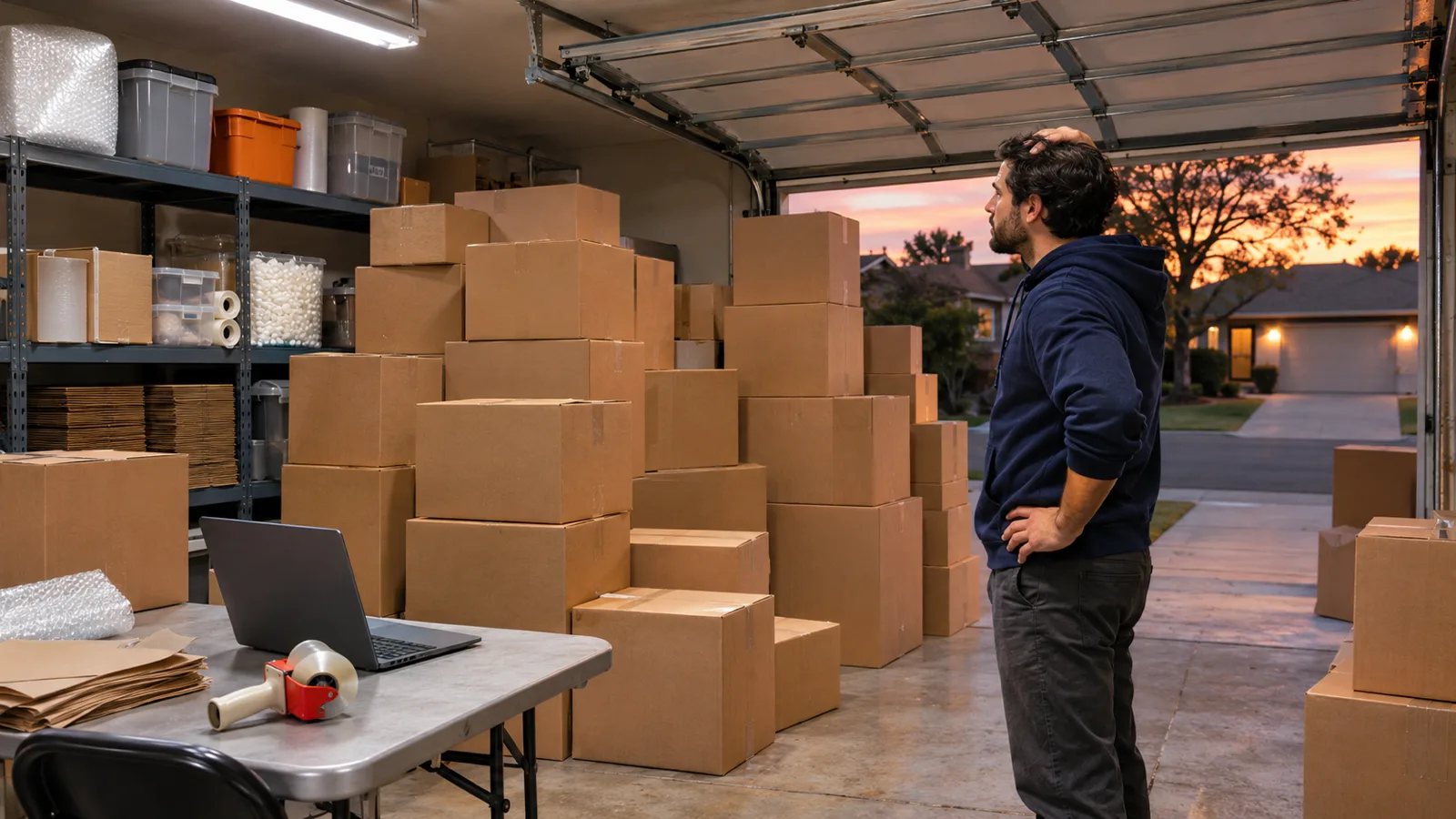
It usually starts with a few shelves. You launch a skincare line or a pet accessories brand from your home in Churchill Meadows or Streetsville, and the spare bedroom handles the first few months. Then the stock moves into the garage. Then the car moves into the driveway. Then your evenings disappear into taping boxes, printing labels and driving to the post office before it closes.
Plenty of successful Canadian brands began exactly this way, and self-fulfillment is often the right call at the start. You learn your product, your packaging and your customers up close. But there is a point where the garage stops being a smart, scrappy advantage and starts quietly costing you growth. The trick is recognizing that point before a bad holiday season makes it obvious.
Below are the signs we see most often among small brands in Mississauga that are ready to hand fulfillment to a third-party logistics provider (3PL), followed by an honest look at when it is better to wait, and answers to the questions owners ask most.
Sign 1: Packing is eating the hours you should spend growing
Track your time for two weeks. Count every minute spent receiving stock, picking, packing, printing labels, booking pickups, answering "where is my order?" emails and dealing with returns. Many founders are surprised to find it is a part-time job or more.
The question is not whether you can do it. It is whether that is the best use of your time. If those hours went into product development, wholesale accounts, content or customer relationships instead, what would that be worth? When the answer is "more than the cost of outsourcing," you have your first sign.
Sign 2: You are out of space, or your space is unsafe
Garages were not designed for inventory. Stacks of cartons block exits. Winter cold can damage liquids, candles, cosmetics and anything with adhesive. Summer heat and humidity can warp packaging and melt products. Mice and moisture are real risks. And many home insurance policies do not cover business inventory, or cover it only up to a low limit, so it is worth checking your own policy.
If you are turning down bulk purchases from suppliers because there is nowhere to put the stock, you are probably paying more per unit than you need to, which is a growth constraint in disguise.
Sign 3: Mistakes are creeping in
Wrong variants, missing items, duplicate shipments, orders that slip through the cracks: they happen to everyone working out of a garage, and they get more frequent as volume grows and fatigue sets in. Each one costs you the replacement item, the reshipping cost and some customer trust. A 3PL uses barcode scanning and a warehouse management system to verify what goes into each box, which is hard to replicate at home.
Sign 4: Shipping rates are hurting your margins
As a small shipper, you are typically paying retail or near-retail courier rates. 3PLs ship on volume across many clients, which usually gives them access to better rates and more carrier choices. They can also help you choose packaging that reduces dimensional weight charges. If your shipping costs are forcing you to either raise free-shipping thresholds or eat losses, outsourcing is worth pricing out. Our guide to reducing shipping costs covers other levers too.
Sign 5: You cannot offer the delivery speed customers expect
If you only get to the post office every other day, your customers in Ottawa or Vancouver are waiting longer than they would with a competitor. A 3PL in Mississauga typically ships same day for orders received before a daily cut-off, with carrier pickups at the dock. That alone can lift conversion and cut "where's my order" emails.
Sign 6: New channels are on the horizon
Are you about to start selling on Amazon, land a retailer, or launch a subscription box? Each adds its own requirements: FBA prep and labelling rules, retailer routing guides and pallet specs, recurring kitting cycles. Doing all of that from a garage is a recipe for chargebacks and missed launches. A 3PL that already handles Amazon FBA prep and retail fulfillment can absorb those channels without you reinventing your operation.
Sign 7: You dread every sale and every holiday
When a successful promotion feels like a threat rather than a win, operations are holding the business back. Peak season, from Black Friday through December, is where self-fulfillment most often breaks. If last year's November meant all-nighters and delayed orders, plan the move to a 3PL well before this year's peak, not during it. Our post on preparing for peak season includes a timeline.
When you should probably wait
Outsourcing is not always the right next step. It may be too early if:
- You ship only a handful of orders a week and have room to grow at home.
- Your product is still changing quickly, with packaging and SKUs in flux every month.
- Your margins cannot yet absorb per-order fulfillment fees, even with better shipping rates.
- Hand-finishing or personalization is central to the product and you cannot yet document it as a repeatable process.
Even then, it is worth having an initial conversation with a 3PL so you know your threshold. Some brands use a middle path, such as storing bulk inventory with a 3PL and pulling small replenishments home, or sending only one channel out first.
Doing the maths: garage vs 3PL
A fair comparison includes more than the 3PL's invoice. On the garage side, add up:
- Your time (and any family or part-time help), valued honestly.
- Packaging supplies bought in small quantities.
- Shipping at your current rates.
- Errors, reshipments and damaged stock.
- Trips to drop-off points, fuel and parking.
- Sales lost to slow shipping or stockouts.
On the 3PL side, expect fees for receiving, storage, pick and pack, packaging (if supplied by the 3PL), shipping and any value-added services. Pricing structures vary, so ask for a quote based on your real order profile: average units per order, product dimensions, monthly volume and storage needs. Our explainer on what a 3PL does for an online business breaks down the typical fee categories.
What the move actually looks like
Owners often imagine the switch as a big, risky event. With planning, it is closer to a few weeks of structured work:
- Discovery: the 3PL learns your products, order volumes, packaging and channels.
- Integration: your store, whether Shopify, WooCommerce or another platform, is connected so orders flow to the warehouse automatically. ShipCarte's integrations cover the common ecommerce platforms and marketplaces.
- Product setup: each SKU gets dimensions, weights, barcodes and packing instructions.
- Inbound: you send your inventory, typically by booking a pallet or van from your garage to the warehouse. In Mississauga that is often a short local trip.
- Testing: a few test orders flow through end to end.
- Go-live: you switch fulfillment over, ideally in a quieter week.
Questions to ask any 3PL before you sign
Not every warehouse is a good fit for a small, growing brand. Before you commit, ask each provider you are considering:
- What is your daily order cut-off time, and what share of orders ship the same day?
- How do you handle a mis-pick, and who pays for the reshipment?
- Which carriers pick up from your dock, and can I see rates for my typical parcel?
- How are storage fees calculated: per pallet, per bin, per cubic foot?
- Can you store products that need protection from freezing in winter?
- How much notice do you need before a big promotion or product launch?
- What does it take to leave, if it ever comes to that?
Clear, specific answers are a good sign. Vague ones are worth probing.
Frequently asked questions
Will I lose control of my brand experience?
Not if you set it up properly. Custom boxes, tissue paper, inserts, thank-you cards and gift notes can all be specified as packing instructions. Many 3PLs, ShipCarte included, offer value-added services such as kitting and custom inserts. The key is documenting what "on brand" looks like with photos.
Can I still see my inventory?
Yes. A modern 3PL gives you a dashboard with stock levels, inbound shipments, order status and tracking. You should be able to see more, not less, than you could in your garage.
What happens with returns?
Returns go to the warehouse, where they are inspected and either restocked, refurbished or written off according to your rules. See our returns management service for how that works.
Is there a minimum order volume?
It depends on the 3PL. Some are built for large enterprise clients only; others, like ShipCarte, work with growing brands. Ask directly rather than assuming.
Why choose a 3PL in Mississauga specifically?
Location affects speed and cost. A warehouse in Mississauga sits close to Highways 401, 403, 407 and 427, within easy reach of Toronto, Brampton and Oakville, and near Toronto Pearson for air freight. Most of Ontario's population can be reached quickly by ground, and US border crossings at Niagara and Windsor are within a few hours' drive. It is also convenient if you are local and want to visit the warehouse or drop off new stock yourself.
Ready to get your garage back?
If several of these signs sound familiar, the next step is a simple conversation about your orders, products and goals. ShipCarte's ecommerce fulfillment is designed to grow with small brands, and we can show you what your costs would look like before you commit. Request a quote or schedule a consultation, and let us take the tape gun off your hands.