
Drive along Highway 407 past the big distribution centres on Mississauga's northern edge and it is easy to come away thinking that warehouse automation means acres of conveyor, robotic shuttles in tall racking and sorters the size of a hockey rink. Those systems exist, and some of the largest retailers in Canada run them. But they were built by companies with enormous, predictable volumes and capital budgets to match.
Plenty of warehouses in Mississauga are not like that. They are mid-size buildings in Meadowvale, Gateway or along Dixie Road, running a single or double shift, handling a few thousand SKUs, and trying to keep up with growing order counts while finding and keeping good warehouse staff. For these operations, the question is not "should we build a robotic warehouse?" It is "which pieces of automation would actually pay back in our building, with our volumes, within a reasonable time?"
This guide works through that question tier by tier, starting with the basics most operations should already have and moving toward the technology that only makes sense at higher volumes.
Start With the Problem, Not the Technology
Before looking at any equipment, write down what is actually hurting. Automation is a tool for solving specific problems, and the same machine can be brilliant in one building and a costly mistake in another. Common pain points in mid-size warehouses include:
- Pickers walking long distances for each order
- Mis-picks and mis-ships that lead to returns and complaints
- Inventory counts that never match the system
- Packing stations that become a bottleneck at peak
- Difficulty hiring and training enough people for seasonal surges
- Too much time spent keying data between systems
Rank these by cost to the business. The top one or two are where automation money should go first.
Tier 1: The Foundations Everyone Should Have
These are low-cost, high-impact tools. If your operation is missing any of them, fix that before spending on anything more ambitious, because every higher tier depends on them.
A real warehouse management system
Spreadsheets and the inventory module of an accounting package can carry a small operation for a while, but they cannot direct work. A warehouse management system (WMS) tracks every location, tells pickers where to go and in what order, records every move by scan, and feeds accurate stock levels to your sales channels. Almost every form of automation below relies on a WMS to tell it what to do.
Barcode scanning at every touch
Scanning at receiving, put-away, picking, packing and shipping is the single most effective accuracy tool available to a warehouse. It is not glamorous, and the hardware is relatively affordable. Rugged handheld scanners or ring scanners that keep hands free are both common. When every move is scanned, the system knows where stock is, and mis-picks get caught at the packing station rather than at the customer's door.
Integrations instead of retyping
Connecting your e-commerce platforms, marketplaces, ERP and carriers directly to the WMS eliminates a lot of manual data entry. Orders drop into the system automatically and tracking numbers flow back out. Integrations are a form of automation that many operations overlook because there is no machine to look at, but they often free up more hours than any piece of equipment.
Tier 2: Smarter Processes With Modest Hardware
Once the foundations are in place, the next tier uses software logic and light equipment to cut walking and speed up packing.
Batch, zone and wave picking
Instead of one picker walking the whole building for one order, the WMS can group orders into batches so a picker collects items for several orders in one trip, or assign pickers to zones. Pick carts with multiple totes, one per order, are a simple way to support batch picking. This kind of change often yields noticeable productivity gains with very little capital.
Slotting optimization
Placing your fastest-moving SKUs closest to the packing area and at waist height reduces travel and strain. Many WMS platforms can analyse order history and suggest re-slotting. It is worth revisiting slotting every season, because what sells in November is not what sells in June.
Automated packing station tools
Scales integrated with the shipping system, printers that produce labels the moment an order is verified, and software that recommends the right carton size all shave seconds off each order. Cartonization also reduces dimensional weight charges by avoiding oversized boxes. For a busy pack line, seconds per order add up to hours per day.
Pick-to-light and put-to-light
Lights mounted on shelving or on put walls show workers exactly where to pick from or place items. These systems can boost speed and accuracy in high-velocity zones and are much easier to install than conveyor. They also shorten training time, which helps when you bring on temporary staff for peak season.
Tier 3: Mobile Robots and Flexible Automation
This is where many mid-size operations are now looking, and where the market has changed most in recent years.
Autonomous mobile robots (AMRs)
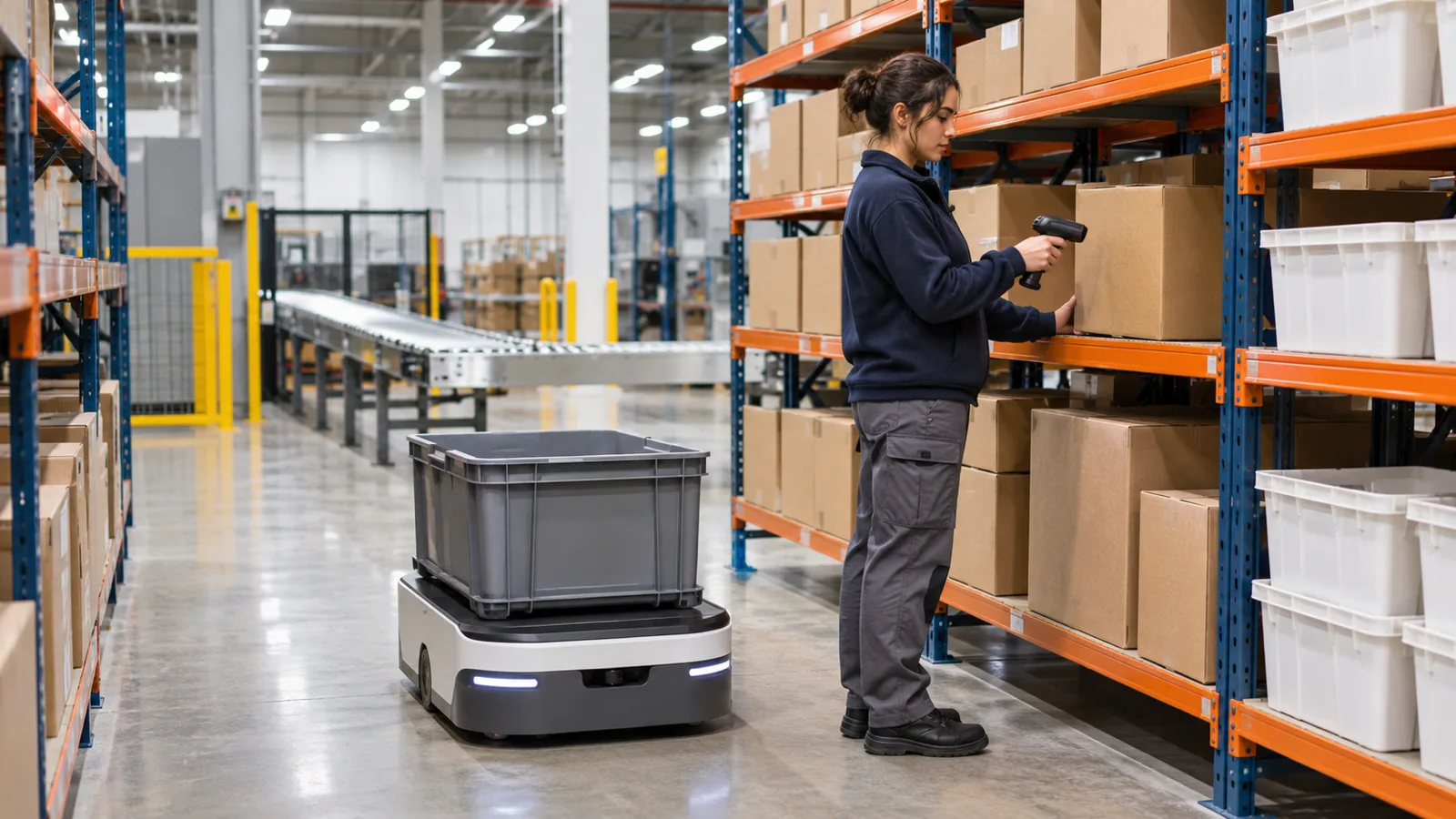
AMRs navigate the warehouse on their own and carry totes or cases between pickers and packing stations. In a common setup, the picker stays in a zone and the robot comes to them, so walking drops sharply. Unlike fixed conveyor, AMRs can be added a few at a time and reconfigured if the layout changes, and many vendors offer them on subscription or lease models rather than as a large up-front purchase. That flexibility makes them more approachable for a business that leases its building and may move in a few years.
They are not a fit everywhere. AMRs need reasonably flat, clean floors, good Wi-Fi coverage, and enough order volume to keep them busy. In a building with narrow aisles crowded with pallets, they may spend more time waiting than moving.
Short conveyor runs
Full conveyor networks are expensive and permanent, but a short powered or gravity conveyor linking packing stations to the shipping dock can remove a lot of carrying. This is often a good first step into conveyor because the investment is limited and the benefit is easy to measure.
Automated label application and print-and-apply
For operations shipping large numbers of similar parcels, print-and-apply labellers on a conveyor line can label cartons without a person touching each one. These make most sense once order volumes are consistently high.
Tier 4: Heavy Automation (Usually Not Yet)
Goods-to-person storage systems, robotic each-picking arms, high-speed sortation and automated storage and retrieval systems can be transformative at very high, steady volumes. For most mid-size Mississauga warehouses, they are hard to justify. They typically require long-term facility commitments, specialist maintenance, and order profiles that are stable enough to keep the equipment busy year-round. If you are seriously considering this tier, a detailed engineering study is essential, and it is worth asking whether a 3PL that has already invested in shared technology could give you similar benefits without the capital outlay.
How to Build the Business Case
A simple payback analysis keeps automation decisions grounded. For any proposed investment, estimate:
- Total cost: equipment or subscription fees, installation, integration with your WMS, training, maintenance and any facility changes such as floor repairs or electrical work.
- Labour hours saved: measured, not guessed. Time your current process for a week before deciding.
- Error reduction: the cost of each mis-ship (reshipping, return postage, customer service time, lost customers) multiplied by the expected drop in errors.
- Capacity gained: extra orders you could handle without adding a shift or another building.
- Flexibility: what happens if your lease ends or your volumes shift? Equipment you can move or scale down carries less risk.
Be conservative. Vendors naturally present best-case numbers. Ask for references from operations of a similar size and product type, and if possible visit one in Mississauga or elsewhere in the GTA to see the system running on a normal day.
Questions Mid-Size Operators Often Ask
Will automation replace our warehouse staff?
For mid-size operations, automation usually changes jobs more than it eliminates them. Robots carry, scanners check, and software plans, while people still handle receiving exceptions, picking irregular items, packing, quality checks and problem-solving. Many operators find automation helps them grow without needing to hire as quickly, which matters when warehouse operators across Mississauga, Brampton and the rest of Peel are all competing for the same pool of workers.
We lease our building. Does that rule out automation?
Not at all. Software, scanners, pick carts, pick-to-light and many mobile robot systems can move with you. It mainly rules out heavily fixed infrastructure unless your lease is long enough to recover the cost.
How long does implementation take?
It varies widely. A WMS change or new scanning process can take weeks to months depending on integrations and data cleanup. Mobile robots can sometimes be piloted in a single zone relatively quickly. Larger systems take longer. Avoid going live in the weeks before Black Friday or any other peak.
What if our volumes are too small to justify any of this?
Then the smartest form of automation may be outsourcing. A 3PL spreads its systems and equipment across many clients, so a smaller brand can benefit from a full WMS, scanning, cartonization and integrated carrier selection without buying any of it. Our article on the pros of a warehouse inventory management system goes deeper on the software side, and steps to modernizing warehousing and distribution covers a broader roadmap.
Where ShipCarte Fits
ShipCarte runs warehousing and fulfillment in Mississauga on its own technology stack, including a WMS, an integrated shipping platform and inventory management tools that connect to common e-commerce and ERP systems. If you are deciding whether to automate your own operation or to plug into one that is already built, we are happy to compare the options with you honestly. Schedule a consultation and bring your order profile; we will help you work out what makes sense at your scale.