
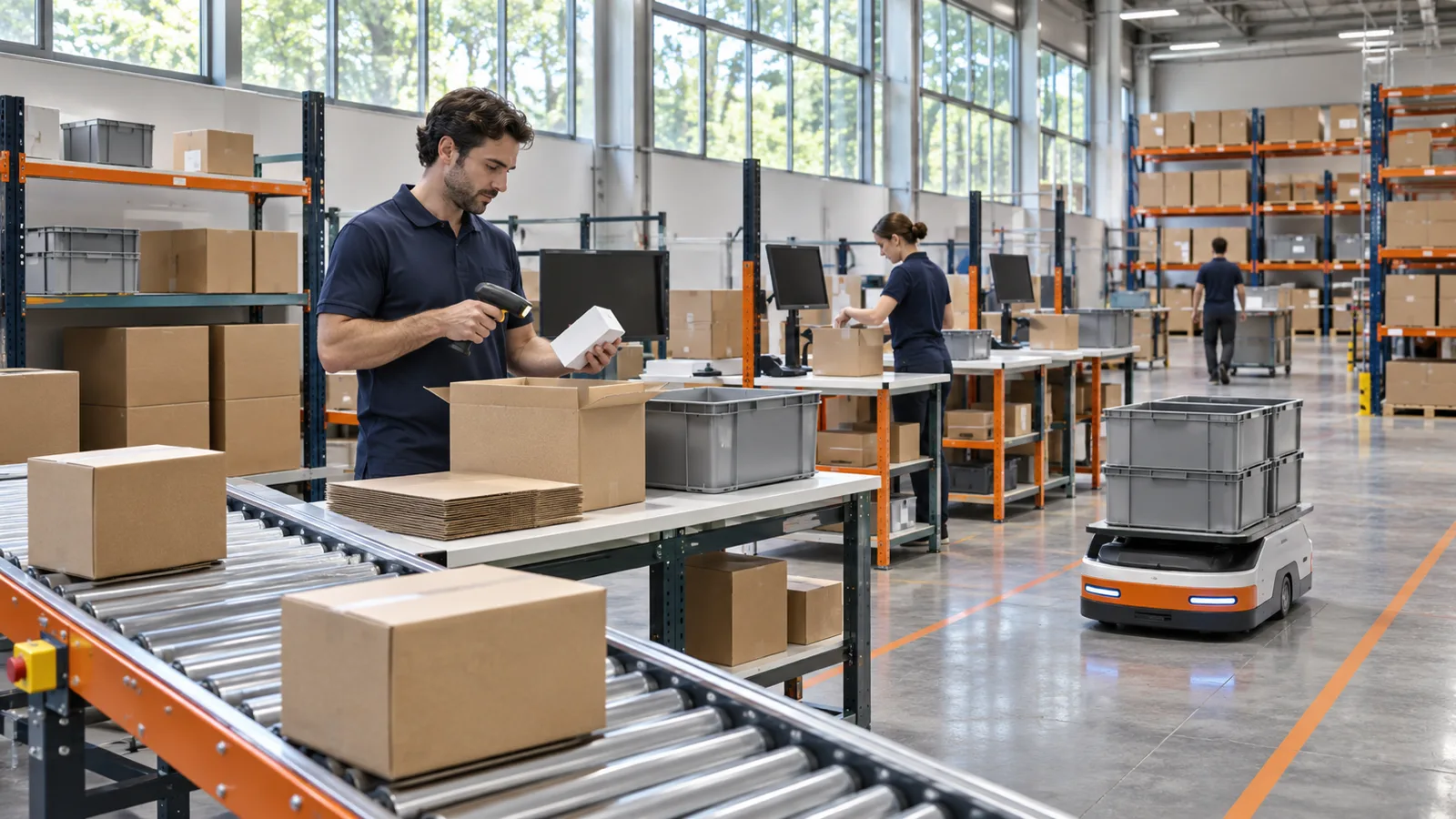
Read enough logistics news and you might think every warehouse is about to be run by robots. Videos of huge fulfillment centres with thousands of mobile robots and miles of conveyor make it look as though automation is the only way to compete. For a business shipping a few hundred orders a day out of a 20,000-square-foot building in Winnipeg, Laval or Surrey, that picture can feel either intimidating or irrelevant.
The truth sits somewhere in between. Automation for small and mid-sized businesses is real, and some of it pays for itself quickly. But the most valuable automation for most growing warehouses is not a fleet of robots. It is a series of smaller, practical steps, starting with software and simple equipment, that remove the slowest and most error-prone parts of the work.
The past few years have pushed the topic up many agendas. Ecommerce volumes have grown, wages and other labour costs have risen, and finding reliable warehouse staff for peak season remains a challenge in many Canadian markets. This article offers a grounded way to think about automation for Canadian small and mid-sized businesses: what to automate first, what to wait on, and how to tell whether an investment makes sense.
Start by Asking What Problem You Are Solving
Automation is a tool, not a goal. Before looking at equipment, identify the specific problem. Common ones include:
- Order errors: wrong items, wrong quantities, wrong addresses.
- Labour shortages or high turnover, especially at peak.
- Pickers spending most of their time walking.
- Packing stations that cannot keep up with picking.
- Inventory records that do not match the shelves.
- Shipping labels created by hand or rate shopping done one order at a time.
Each problem has different solutions, and some of them are not automation at all. A better layout, clearer processes or a different slotting strategy can sometimes achieve as much as a piece of equipment, at a fraction of the cost.
The Automation Ladder: Five Rungs for Growing Warehouses
It helps to think of automation as a ladder. Most businesses get the best return by climbing it one rung at a time rather than jumping to the top.
Rung 1: A real warehouse management system
If your warehouse runs on spreadsheets, paper pick lists and memory, the single biggest step you can take is implementing a proper warehouse management system. A WMS tracks inventory by location, directs receiving and put-away, generates efficient pick lists, and records every movement. It is the foundation every other form of automation builds on. Without accurate location data, robots and conveyors have nothing reliable to work with.
Rung 2: Barcode scanning everywhere
Handheld or wearable scanners that verify every receipt, put-away, pick and pack step dramatically cut errors. They also make it possible to train new workers faster, since the system tells them where to go and confirms they picked the right item. For most small warehouses, scanning delivers more benefit per dollar than any piece of mechanical equipment.
Rung 3: Shipping automation
Connecting your order sources to a shipping platform that automatically selects carriers, prints labels and sends tracking information removes hours of manual work each day. Add scales and dimensioners at pack stations to capture weights and sizes accurately, which matters more as carriers bill on dimensional weight. Automated cartonization, which suggests the right box for each order, cuts packaging waste and shipping costs.
Rung 4: Simple mechanical aids
Gravity conveyors, powered conveyor sections between pick and pack, pick carts designed for multiple orders, put walls for sorting batch picks, and label print-and-apply units are relatively affordable and flexible. They reduce walking and handling without requiring the building to be redesigned. Many can be moved or reconfigured if your layout changes.
Rung 5: Robotics and advanced systems
Autonomous mobile robots that carry totes between pickers and pack stations, goods-to-person systems, vertical lift modules and automated storage systems sit at the top of the ladder. They can deliver big productivity gains, but they need high and consistent volumes, stable processes and clean data to pay off. Some robotics vendors now offer subscription or robots-as-a-service models, which lower the upfront cost and make this rung more accessible than it used to be.
How to Judge Whether an Investment Pays Off
A proper business case for automation looks beyond the purchase price. Consider:
- Labour savings: hours saved per day, multiplied by your fully loaded labour cost, including payroll taxes and benefits.
- Error reduction: fewer mis-shipments means lower return shipping, replacement and customer service costs.
- Capacity: the ability to handle more orders in the same space and shifts, delaying a move to a larger building.
- Peak flexibility: less reliance on hard-to-find temporary staff.
- Running costs: maintenance, software subscriptions, spare parts, power and support.
- Implementation costs: installation, integration, training and lost productivity during the transition.
- Flexibility risk: what happens if volumes drop, your product mix changes or you need to move buildings.
Payback periods vary widely depending on the technology and how well it fits your operation. Software and scanning often pay back quickly. Fixed mechanical systems usually take longer and carry more risk if the business changes direction.
Canadian Considerations
A few points are specific to businesses automating in Canada:
- Electrical certification. Electrical equipment used in Canadian workplaces generally needs to be certified by an accredited certification body for the Canadian market. Equipment imported from overseas without that certification may need field evaluation before it can be used.
- Health and safety reviews. New machinery and changes to layouts may trigger provincial requirements, such as guarding reviews or, in Ontario, pre-start health and safety reviews for certain equipment. Build that time into your plan.
- Language. If your workforce is in Quebec or includes many French-speaking workers, check that software interfaces and training materials are available in French.
- Currency and support. Much warehouse automation is priced in US dollars, so exchange rates affect cost. Ask where service technicians and spare parts are based; a supplier with no Canadian support can leave you waiting when something breaks.
- Funding. Federal and provincial programmes and regional development agencies sometimes support technology adoption by small and mid-sized businesses. Eligibility changes, so it is worth asking an advisor before you buy.
A Quick Scenario: Robots or Re-Slotting?
Imagine a supplements brand in Alberta shipping around 400 orders a day from its own building. Pickers complain about long walks, and the owner gets a quote for mobile robots. Before signing, the operations manager pulls a velocity report and finds that the 50 fastest-moving SKUs account for most order lines but are scattered across the back half of the warehouse. Moving them into a compact zone near the pack stations, and switching to multi-order pick carts, cuts walking sharply within a few weeks at almost no cost.
The robots might still make sense later, once volume grows. But by fixing the layout first, the brand now has a much clearer baseline to measure them against, and a smaller problem for them to solve.
Mistakes to Avoid
- Automating a broken process. If your current workflow is messy, automation will make the mess happen faster. Fix the process first.
- Buying for today's volume only. Consider where you expect to be in three to five years, and choose systems that can scale or be redeployed.
- Underestimating integration. Equipment must talk to your WMS, order management and shipping systems. Budget time and money for integrations.
- Ignoring the people. Workers need training and a voice in how new systems are introduced. Automation projects succeed when staff understand how it helps them.
- Locking into a fixed layout too early. Fast-growing businesses often outgrow buildings. Flexible, mobile automation reduces the risk of being stuck.
A Practical Path for the Next 12 Months
For a typical small or mid-sized warehouse in Canada, a sensible sequence might look like this:
- Measure your current performance: orders per labour hour, error rate, inventory accuracy, and time spent on each task.
- Implement or upgrade your WMS and introduce scanning for all inventory movements.
- Connect your sales channels and carriers through an automated shipping platform.
- Re-slot inventory based on velocity and redesign pick paths.
- Add simple equipment such as multi-order pick carts, scales and dimensioners at pack stations.
- Measure again. Only then evaluate whether robotics or conveyors would add enough value to justify the next step.
The Alternative: Borrow Someone Else's Automation
For many brands, the smartest way to access warehouse automation is not to buy it at all. A 3PL that has already invested in a WMS, scanning, shipping software and efficient workflows lets you benefit from that investment on a per-order basis. You avoid the capital cost, the integration project and the risk that your needs change. That is one reason more growing brands are moving fulfillment to specialist providers, a trend we discussed in steps to modernizing warehousing and distribution services.
ShipCarte combines its warehouse management system, shipping platform and fulfillment teams to provide ecommerce fulfillment and warehousing for businesses across Canada, so you can get the benefits of modern warehouse technology without building it yourself.
Explore Your Options With ShipCarte
Whether you want to automate your own building or outsource to a partner that already has, it helps to talk through the numbers. Schedule a consultation with ShipCarte to compare the paths and find the one that fits your volumes and growth plans.