
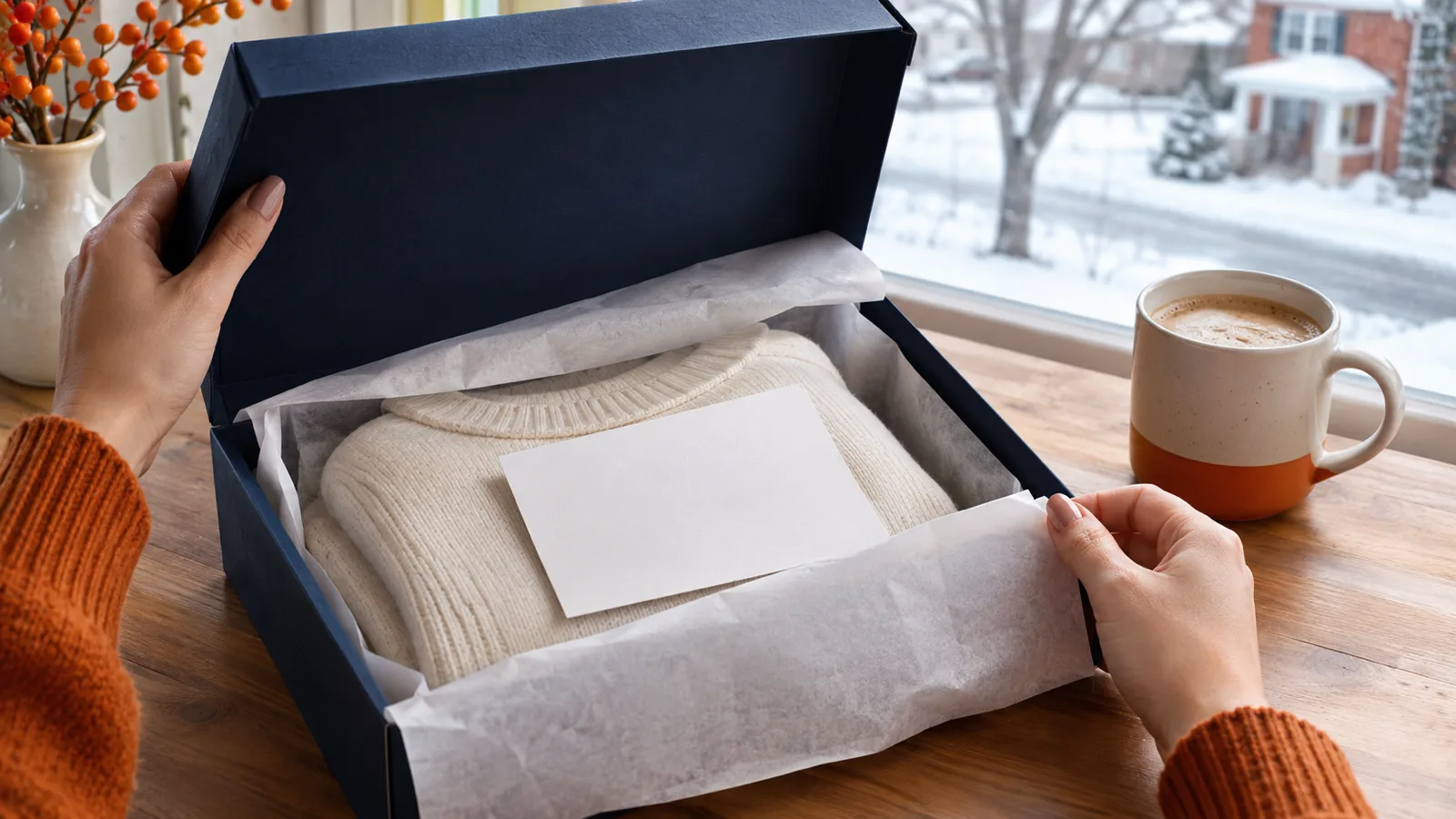
The parcel sits on a front step in Winnipeg for an hour on a minus-twenty afternoon. It has travelled through two sortation centres, a linehaul trailer and a delivery van. When the customer finally brings it inside and opens it, the next thirty seconds will shape how they feel about the brand far more than any ad they saw before buying. Is the product intact? Does the packaging feel considered or careless? Is there anything that makes them want to post a photo, tell a friend or order again?
For online brands, the unboxing is the only physical moment in the whole customer relationship. Everything else happens on a screen. That makes packaging one of the few marketing channels that every customer is guaranteed to see. But unboxing design for Canadian customers has to balance a few realities that glossy inspiration boards ignore: long and cold transit routes, two official languages, provincial recycling systems that differ from one another, and shipping costs that rise with every centimetre of box.
This article breaks the unboxing experience into its layers, explains the practical constraints of shipping across Canada, and offers options at different budgets so you can design something memorable that also works at scale.
Start With Protection, Then Add Personality
No amount of tissue paper makes up for a broken product. The foundation of a good unboxing is that everything arrives in the condition the customer expects. Canadian shipping routes put packages through a lot: long distances between hubs, multiple handoffs, and in winter, freezing temperatures that make some plastics brittle and can damage liquids, creams and batteries.
Before you design anything decorative, confirm that your packaging:
- Holds the product snugly so it cannot shift.
- Survives a drop test and stacking under heavier parcels.
- Protects against moisture from snow, slush and rain on doorsteps.
- Accounts for freezing if your product is temperature-sensitive.
Our guide to packing fragile items properly covers the fundamentals.
The Five Layers of an Unboxing
It helps to think of the experience as a series of layers, each one a chance to make an impression.
Layer 1: The outside of the parcel
The shipper box or mailer is the first thing your customer sees and also the one exposed to every hazard in transit. Many brands keep the exterior simple, plain kraft or a single colour with a small logo, both to reduce cost and to avoid advertising valuable contents to anyone passing the doorstep. A printed message on the inside flap is a popular compromise: the outside stays discreet, the reveal comes when the box opens.
Layer 2: The first view
What does the customer see when the flaps open? A neatly folded sheet of tissue, a branded sticker, a card sitting on top? This is where perceived care is formed. Even a simple arrangement, consistently executed, signals attention to detail.
Layer 3: The product presentation
How the product itself is presented: in its retail box, wrapped, in a pouch or nested in an insert. For multi-item orders, consider the order in which items are revealed and whether they are grouped logically.
Layer 4: The message
A thank-you card, care instructions, a note from the founder, a discount on the next order or a prompt to leave a review. Keep the message short and purposeful. Our article on package insert ideas for ecommerce has plenty of examples.
Layer 5: The afterlife of the packaging
What happens to the box next? Can it be recycled easily, reused for returns or repurposed? Increasingly, customers judge brands on this final layer as much as the first.
Canadian Considerations
Speak both languages where it counts
Regulatory bilingual labelling applies to the product's own packaging, not your thank-you card. But if you ship many orders to Quebec or to francophone communities in New Brunswick, Ontario and Manitoba, a bilingual or French version of your inserts is a thoughtful touch. Some brands print bilingual cards; others print separate English and French versions and have the warehouse select the right one based on the shipping province. If you are selling into Quebec, also check whether any inserts that form part of the product offering need to be in French.
Mind the box size
Canadian carriers commonly bill based on the greater of actual weight or dimensional weight, so a bigger box can cost more to ship even if it weighs very little. Elaborate presentation boxes with lots of empty space are expensive to ship from coast to coast. Design the unboxing around a box that is right-sized for the product. Learn more about how package dimensions impact shipping costs, and how cartonization tools choose the smallest suitable box for each order.
Design for local recycling
Recycling programmes in Canada are run at the provincial and municipal level, and what is accepted in a blue box in one city may not be accepted in another. Paper-based packaging such as corrugated boxes, kraft paper and paper tape is widely accepted. Mixed materials, such as paper laminated with plastic, are harder to recycle anywhere. Several provinces also run stewardship or producer responsibility programmes for packaging, so check whether your business has obligations where you sell. A short line on the insert explaining how to recycle the packaging is appreciated by many customers.
Plan for winter
Tissue and cards can get damp if a box sits in snow. Paper void fill can soak up moisture. If your products are sensitive to cold, consider insulated packaging or temporarily holding shipments to colder regions during extreme weather, and say so on your site.
Unboxing Options at Different Budgets
You do not need a large budget to create a good experience. Here are approaches from simplest to most elaborate.
Minimal: consistent and clean
A plain, right-sized box, a branded sticker sealing tissue paper, and a printed card. Low cost, quick to pack, and still noticeably better than a product tossed in a box with crumpled paper.
Moderate: printed interior
A custom-printed box or mailer with a message inside the lid, tissue, a card and occasionally a sample. Printed packaging usually carries minimum order quantities and longer lead times, so plan inventory accordingly.
Elevated: segmented experiences
Different packaging for first-time customers, repeat customers and high-value orders. For example, first orders receive a welcome card and a sample, while loyal customers receive a handwritten note. This requires rules that your fulfillment partner can follow reliably, usually driven by order tags from your store.
Premium: gift-ready
Rigid boxes, ribbon, magnetic closures and fully bespoke inserts. Best suited for high-value products and gift orders. Expect higher packaging costs, slower packing and higher shipping costs because of size and weight.
Counting the Real Cost Per Order
Before committing to a packaging design, add up what it actually costs on every order. The figure is usually higher than the price of the box alone. Include:
- The shipper box or mailer, and any inner box.
- Tissue, stickers, cards, ribbon and samples.
- Extra packing time for each additional step, whether your own staff or a fulfillment partner charges for it.
- Any change in shipping cost because of a larger or heavier package.
- Storage space for packaging stock, which can be considerable for rigid boxes.
- Minimum order quantities and the risk of leftover printed stock if you rebrand.
Then weigh that against what you hope the experience will deliver: repeat purchases, reviews, social sharing or the ability to charge a premium price. A modest experience applied to every order often produces better results than an elaborate one that is too costly to sustain. Some brands reserve their richest packaging for first orders and gift purchases, where the impression matters most.
Making It Work With a 3PL
Many brands worry that outsourcing fulfillment means giving up on a great unboxing. It does not, provided the experience is designed to be repeatable. To make it work:
- Create a one-page packing standard with photos of each layer.
- Limit the number of variations so packers can follow them consistently.
- Use order tags or rules in your store to trigger special inserts automatically.
- Keep packaging stock levels monitored like any other inventory.
- Agree on pricing for any extra steps, such as tissue wrapping or handwritten notes.
- Review photos of packed orders occasionally to check quality.
ShipCarte supports custom packaging and inserts as part of ecommerce fulfillment, and handles more involved projects such as gift set assembly through kitting and assembly. Subscription brands, whose boxes are often the product itself, will find more on our subscription box fulfillment page.
Common Unboxing Mistakes
- Oversized boxes that look premium but cost too much to ship across Canada.
- Glitter, confetti or loose fillers that make a mess and frustrate customers.
- Inserts that try to say too much.
- Packaging that is impossible to open without a knife or scissors.
- Mixed-material packaging customers cannot recycle.
- Variations so complex that packers cannot apply them consistently.
- Forgetting the return journey: if returns are common, packaging that can be reused for a return is a plus.
Measuring Whether It Works
Unboxing is hard to measure precisely, but there are signals. Watch for social posts and tags showing your packaging, mentions in reviews, repeat purchase rates after a packaging change, damage-related returns and customer service comments. If you introduce a discount card, track redemptions. Change one thing at a time so you can tell what made the difference.
Build a Better Unboxing With ShipCarte
As the holiday season gets underway, the unboxing is your chance to turn a first order into a loyal customer anywhere in Canada. If you want a fulfillment partner that can deliver your packaging standards consistently at scale, schedule a consultation with ShipCarte and bring a sample of how you would like your orders to arrive.