
An importer of home appliances brings in several forty-foot containers a month from Asia. The containers arrive by rail into the Toronto area, are drayed to a Mississauga facility, and most of the freight is destined for retail distribution centres in Ontario, Quebec and Western Canada. For a while, each container travelled straight to its final destination still sealed. That meant long drives with an ocean carrier's box, mounting per diem charges while the container was away from the rail terminal, and retail customers receiving floor-loaded containers they had to unload by hand.
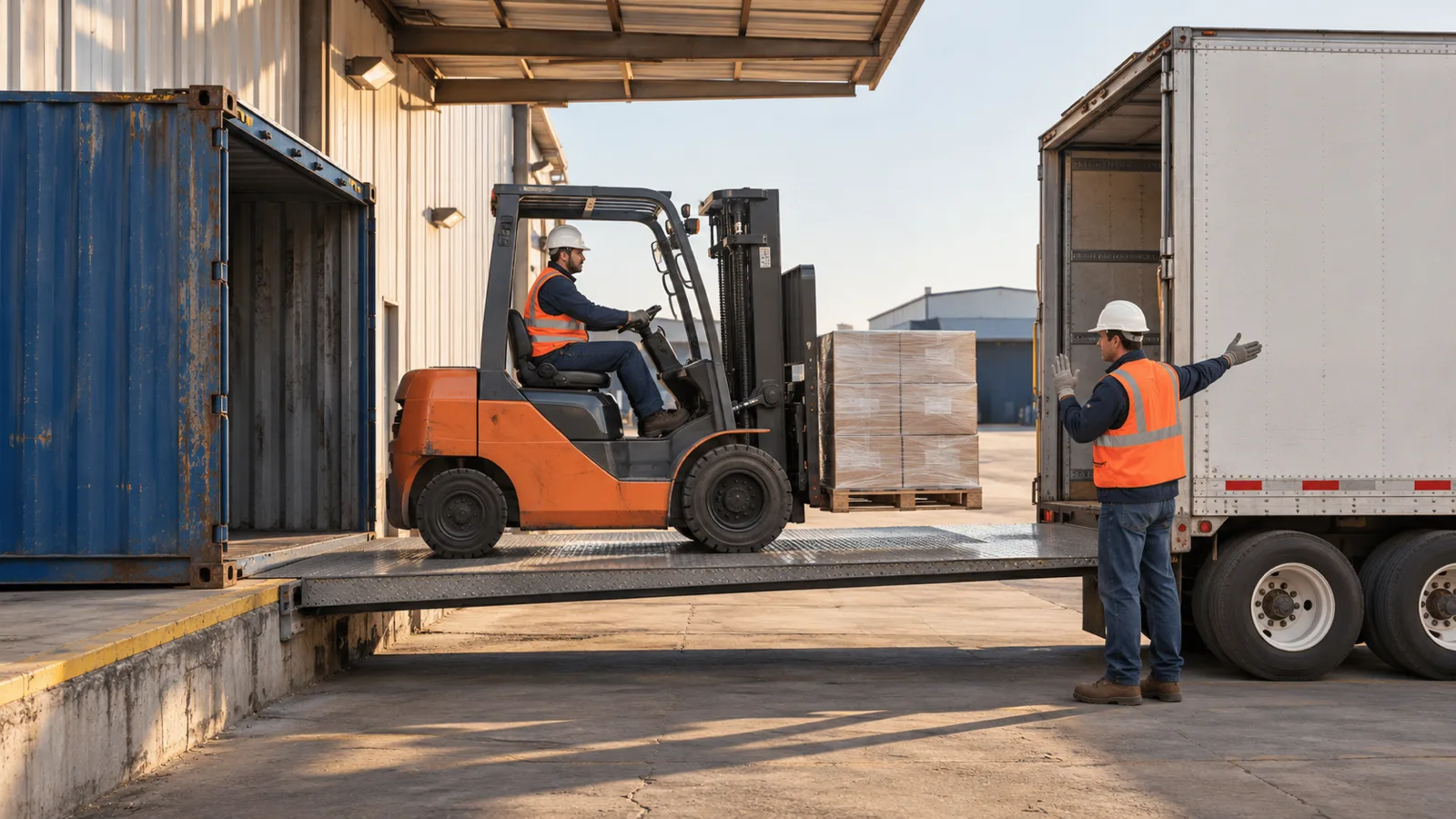
Switching to transloading changed the picture. Containers were emptied at a dock in Mississauga soon after arrival, the freight was sorted and loaded into 53-foot domestic trailers by destination, and the empty containers went back quickly. Retailers received the palletised loads they wanted, and the importer stopped paying to keep ocean equipment on the road.
Transloading is not right for every shipment, but for importers moving volume through the Greater Toronto Area it can be one of the most useful tools available. This guide explains how it works, when it pays off and what to prepare.
What transloading means
Transloading is the transfer of freight from one mode or piece of equipment to another. In the GTA, it most often means unloading an international ocean container and reloading the cargo into a domestic trailer, but it can also mean moving freight from a rail car to a truck, from a flatbed to a dry van or from one trailer to another.
It differs from cross-docking in emphasis, though the two overlap. Cross-docking usually means receiving freight and shipping it out quickly with minimal storage, often combining it with other inbound loads. Transloading focuses on changing the equipment. In practice, many transload operations also sort, palletise, label and sometimes briefly store freight before it moves on.
Why Mississauga is a natural transload location
Mississauga sits at the centre of the GTA's freight network. Ocean containers bound for Ontario usually come by rail from the Ports of Vancouver, Prince Rupert, Montreal or Halifax to intermodal terminals in the region, including major terminals in Brampton and Vaughan, and then move by dray to warehouses. Some arrive by truck from US ports. Mississauga's industrial areas near Pearson, along the 401 and 407 corridors and around Gateway, are a short dray from those terminals.
From Mississauga, domestic trailers can head west on the 401 toward Windsor and the Ambassador Bridge, east toward Montreal, or south on the QEW toward the Niagara crossings. That makes it a practical point to break down international freight and redistribute it across Canada and into the US.
Transloading versus moving the container intact
The decision usually comes down to a comparison like this.
When keeping the container intact makes sense
- The whole container is going to a single consignee nearby.
- The consignee can unload floor-loaded cartons efficiently.
- The trip is short enough that container per diem and chassis charges are minor.
- The freight needs no sorting, labelling or palletising.
When transloading usually makes sense
- Freight in one container is destined for several customers or regions.
- Final destinations are far away, so keeping an ocean container on the road would rack up equipment charges.
- Customers require palletised, labelled deliveries or specific appointment windows.
- You want to combine the contents of several containers into fewer, fuller domestic loads.
- Some freight needs to go into storage while the rest moves on immediately.
That last point is about cube. A 53-foot dry van has noticeably more internal space than a 40-foot high-cube container, so the contents of several ocean containers can often be consolidated into fewer domestic trailers. A common rule of thumb in the industry is that the freight from roughly three 40-foot containers can fit into about two 53-foot trailers, depending on the cargo, weight and how it is palletised. Fewer trailers on the road means lower linehaul costs per unit for long-distance moves.
The equipment charges transloading helps avoid
When you import a container, the steamship line owns or controls the box. You are typically given a limited number of free days before charges begin. Two terms come up often:
- Demurrage generally applies when a container sits at the port or rail terminal beyond its free time.
- Detention or per diem generally applies when a container is outside the terminal beyond its free time and has not been returned.
Definitions and rates vary by carrier and contract, but the principle is simple: the longer the container is in your hands, the more it can cost. Chassis rental may add to this. Transloading lets you empty the container soon after it is picked up and return it promptly, so the freight continues on domestic equipment that you or your carrier control. For more background on how containers move from terminals to warehouses, see our explainer on what drayage is in shipping.
How a typical transload works
- Pre-alert. The importer or forwarder sends the container number, bill of lading, packing list and the outbound plan to the transload facility.
- Customs release. The customs broker confirms the goods are released by CBSA, or the container is moved in-bond to an appropriate facility.
- Dray and appointment. A drayage carrier picks up the container at the terminal and delivers it to the facility at a booked dock time.
- Unload and inspect. The seal is checked and recorded, and cartons are unloaded, counted and inspected for damage.
- Sort, palletise and label. Cartons are sorted by destination or purchase order, built onto pallets, wrapped and labelled to each customer's requirements.
- Load out. Pallets are loaded into domestic trailers, either as full truckloads to large customers or as LTL shipments for smaller drops.
- Return empty. The empty container is returned to the terminal or a designated depot.
- Reporting. The importer receives a report showing what was received, any discrepancies and what shipped where.
Value-added work during the transload
Because the freight is already being handled, transloading is a good moment to do other work that would otherwise happen later:
- Applying retailer-compliant carton labels and pallet labels
- Re-palletising floor-loaded cartons onto standard pallets
- Splitting a portion of the freight into storage for e-commerce fulfillment
- Inspecting or counting for quality control
- Adding bilingual labels or stickers where required for Canadian retail
ShipCarte's value-added services and distribution warehousing make it possible to hold part of a shipment in Mississauga while the rest moves on immediately.
Questions to settle before your first transload
- Is the container floor-loaded or palletised, and how many SKUs are inside?
- What are the outbound destinations, and what appointment or labelling requirements do those consignees have?
- How many free days do you have on the container, and when does the clock start?
- Will any of the freight be stored, and for how long?
- Who is the customs broker, and how will release be communicated?
- Are any goods regulated, such as dangerous goods, food or health products, requiring special handling?
- What reports and photos do you need?
If you are new to container types and sizes, our guide on the different types of shipping containers is a useful primer.
Transloading for cross-border freight
Mississauga is also a common transload point for freight crossing between Canada and the US. A shipment might arrive from Asia through a US West Coast port and travel north, or a Canadian manufacturer might transload goods into a carrier's trailer for delivery to US customers. Cross-border transloads need extra care with paperwork: the right customs documentation for each direction, CUSMA certification of origin where the goods qualify and coordination with brokers on both sides. Our cross-border shipping team can coordinate the move.
What drives the cost of a transload
Every facility prices transloading a little differently, but the same factors show up again and again. Knowing them helps you compare quotes fairly and spot where your own preparation can lower the bill.
- Loading method. Palletised containers are quicker to unload than floor-loaded ones, which take a crew and more time.
- SKU count. A container holding one product is simple. One holding dozens of SKUs that must be sorted by destination takes longer.
- Pallets and materials. If freight needs to be built onto new pallets, the pallets, stretch wrap and labels are part of the cost.
- Labelling requirements. Retailer-compliant labels and documentation add handling time.
- Storage. Freight that stays at the facility beyond a short window is usually charged storage.
- Timing. Rush, after-hours or weekend work may be priced at a premium.
Against those costs, weigh the savings: fewer equipment charges, more efficient domestic linehaul and simpler deliveries for your customers.
Common transloading pitfalls
- Late pre-alerts. Without details ahead of time, the facility cannot plan labour or doors.
- Underestimating floor-loaded containers. Hand-unloading a full container with many SKUs takes time.
- Missing customs release. A container picked up before release can create serious problems.
- No outbound plan. If you do not know where the freight is going, it sits.
- Ignoring weight limits. Heavy cargo can hit road weight limits before a trailer is full. Plan loads by weight as well as cube.
Move freight from the port to the shelf faster
For importers bringing containers into the GTA, transloading in Mississauga can cut equipment charges, consolidate freight into fewer domestic loads and deliver the palletised, labelled shipments that retailers expect. It works best when the container, customs, dray and outbound plan are all lined up in advance. If you would like to explore whether transloading fits your import program, request a quote or book a consultation with ShipCarte.