
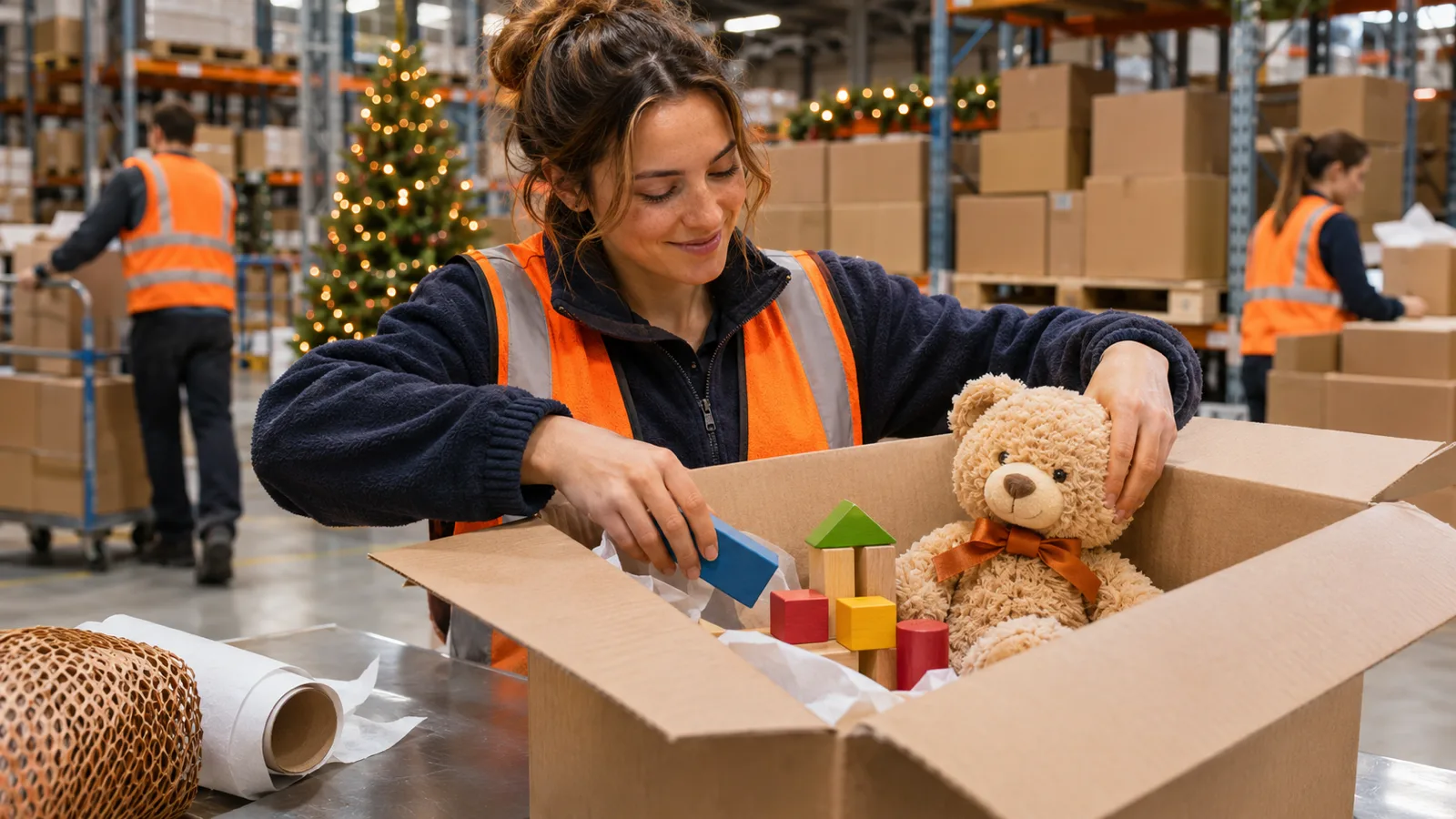
For most online toy brands, the year has two seasons: the ten months when orders tick along, and the six weeks when they don't. A small company selling wooden puzzles and plush animals out of a unit in Streetsville can ship a manageable number of orders a day in spring, then watch the volume multiply once Black Friday arrives. If the stock isn't in the building, the packing stations aren't staffed and the carrier pickups aren't booked, the best sales weeks of the year become the worst customer-service weeks.
Toys also carry a compliance burden that many other consumer products don't. Health Canada regulates toy safety closely, with specific rules on small parts, chemical content, labelling and incident reporting. A fulfillment operation that can't trace which lot went to which customer makes a recall far more painful than it needs to be.
This guide walks through a toy brand's fulfillment year in Mississauga, season by season, with the safety and compliance work that belongs at each stage.
January to March: Learn From the Last Peak
The quiet months right after the holidays are the best time to plan the next ones. Start with the data from the season you just finished:
- Which SKUs sold out, and when? Which sat on the shelf?
- What was the daily order peak, and on which days?
- Which carrier services were late, and in which regions?
- What share of orders came back, and why?
Returns are especially revealing for toys. Items returned as "damaged" often point to packaging problems, such as boxed sets crushed in transit or window packaging punctured by a corner. Returns flagged as "not as described" may signal an age-grading or sizing issue in the product listing. Fixing these before the next peak is cheaper than absorbing them again. A dedicated returns management process captures these reasons consistently so you aren't relying on memory.
This is also when to audit your product compliance file, which is covered in the next section.
The Compliance File Every Toy SKU Needs
Toys sold in Canada fall under the Canada Consumer Product Safety Act and the Toys Regulations made under it. Your manufacturer may be overseas, but if you import or sell the product in Canada, you share the responsibility for meeting those rules. For each SKU, keep a file that includes:
- Test reports from a qualified laboratory showing the product meets the Canadian requirements that apply to it, which can include small parts, sharp points and edges, flammability, chemical limits such as lead in surface coatings, and requirements for magnets and batteries.
- Age grading. Toys intended for children under three face stricter rules, especially on small parts. The intended age should be clear from the product, its packaging and your marketing.
- Labelling. Required warnings and cautionary statements must appear in both English and French. Packaging designed only for the US market often lacks French text or uses warning wording that doesn't match Canadian requirements.
- Traceability records. The CCPSA requires businesses to keep documents that identify who they got a product from and who they sold it to (other than consumers), so a problem can be traced through the supply chain.
Your fulfillment partner can't certify that a toy is safe, but it can make sure the compliance work isn't undone in the warehouse, for example by storing different production lots separately and recording which lot each order shipped from.
April to June: Book Production and Inbound Freight
Many toy brands manufacture overseas, and the inbound supply chain is long. Containers arriving at the Port of Vancouver, Prince Rupert or Montreal typically travel by rail to intermodal terminals in the GTA, such as the rail yards in Brampton and Vaughan, before being drayed to a warehouse in Mississauga. Add ocean transit, port dwell time, rail and customs clearance, and the gap between "goods ready at the factory" and "goods on the shelf in Mississauga" is measured in weeks.
Practical planning points:
- Aim to have the bulk of holiday stock received, counted and put away well before November. Freight capacity tightens in the autumn as every retailer brings in peak inventory at the same time.
- Confirm the importer of record, HS classifications and any duties before the first container ships. Since CARM became the system for accounting for imports, make sure your account and financial security are in order. Our guide to duties and taxes in cross-border e-commerce is a useful refresher.
- Ask the factory to mark lot or batch codes on both the product and the master carton, so the warehouse can capture them at receiving.
- Send the warehouse an advance shipment notice with carton counts and SKU breakdowns so receiving can be scheduled and staffed.
July to September: Set Up the Warehouse for Speed
Once stock arrives, the way it's stored determines how fast it can be picked in December. A few setups make a real difference for toy brands:
Slot by velocity
The ten SKUs that will make up most of your holiday orders should live in the most accessible pick locations, not wherever they happened to be put away in July. Reserve stock for those SKUs can sit in overhead racking and be replenished during the day.
Keep lots separate
If two production runs of the same toy arrive months apart, store them as distinct lots in the inventory management system. If a defect is found in one run, you'll know exactly which customers received it.
Pre-build bundles and gift sets
Holiday bundles, such as a doll with an outfit pack or a starter set of building bricks, are popular, but assembling them at the moment of the order slows packing. Building them ahead of time through kitting and assembly turns a multi-pick order into a single pick.
Right-size the packaging
Toy boxes come in awkward shapes and often have printed retail packaging that customers want to receive undamaged, especially when the item is a gift. Decide which products ship in their own box with a protective overbox, which go in poly mailers, and which need void fill. Box choice also affects dimensional weight charges, which add up quickly at holiday volume. Tools such as cartonization can recommend the smallest suitable box for each order.
October: Rehearse the Peak
October is the dress rehearsal. Things to confirm before November:
- Forecast. Share a daily order forecast with your fulfillment partner, including expected spikes around promotions and influencer campaigns.
- Labour. Seasonal staff need time to be hired and trained. Ask how the warehouse scales its pick and pack capacity and what its peak-season same-day shipping cut-off will be.
- Carrier capacity. Major carriers often apply peak surcharges and may cap daily volumes for some shippers. Confirm pickup times and capacity, and have a backup service for overflow.
- Gift options. If you offer gift messages, gift wrap or packing-slip-free shipping, test the workflow now. A gift order that ships with a priced packing slip inside can ruin a surprise.
- Marketplace rules. If you sell through Amazon, confirm the FBA inbound cut-off dates for the holidays and leave buffer time for FBA prep.
November and December: Run the Peak
When the rush starts, the job is to ship every order on time and keep customers informed. Daily habits that help:
- Review the order backlog every morning and every afternoon, not just at the end of the day.
- Watch stock levels on top sellers closely, and turn off or pre-order SKUs before you oversell.
- Publish clear holiday shipping deadlines on your website by region. Customers in Mississauga and the GTA can usually receive orders much later than customers in remote parts of Canada or in the US.
- Send tracking information automatically and point customers to a tracking page to cut down on "where is my order" emails.
- Prioritize orders by service level when capacity is tight. Expedited orders paid for by customers should leave first.
Mississauga's location helps here. With Toronto Pearson International Airport, major courier hubs and the 401, 403, 407 and 410 all close at hand, late-day pickups from Mississauga can reach much of southern Ontario the next business day, and air services extend that reach across the country.
If Something Goes Wrong: Incidents and Recalls
The CCPSA requires manufacturers, importers and sellers to report certain incidents to Health Canada, such as an occurrence that resulted or could reasonably have resulted in serious adverse health effects, within short, fixed timelines after becoming aware of them. A detailed written report follows within a further deadline. If a recall is needed, speed and accuracy matter.
In fulfillment terms, a recall-ready operation can:
- Place an immediate hold on affected lots so they stop shipping.
- Produce a list of every order that included the affected lot, with customer contact and delivery details.
- Receive and quarantine returned units separately from saleable stock.
- Report on quantities shipped, held and returned for the regulator and your own records.
Those capabilities come from the habits described above: lot capture at receiving, separate storage, and order-level traceability. They're much harder to build in the middle of a recall.
A Toy Brand's Fulfillment Checklist
- Compliance file complete for every SKU, including bilingual labelling.
- Holiday stock received and put away well before November.
- Lot codes captured on receipt and tracked to orders.
- Top sellers slotted for fast picking; bundles pre-kitted.
- Packaging tested for damage and dimensional weight.
- Peak forecast shared; labour and carrier capacity confirmed.
- Holiday shipping deadlines published by region.
- Recall and incident-reporting procedure written down.
Make This Holiday Season Your Smoothest Yet
Toy fulfillment rewards brands that plan early and keep their compliance tight. Get stock in the building before the rush, set the warehouse up for fast picking, and make sure every unit can be traced. The peak will still be busy, but it won't be chaotic.
If you're looking for an e-commerce fulfillment partner in Mississauga to handle your toy line through the holidays, request a quote from ShipCarte. For broader peak planning, see our guide on preparing for peak season.