
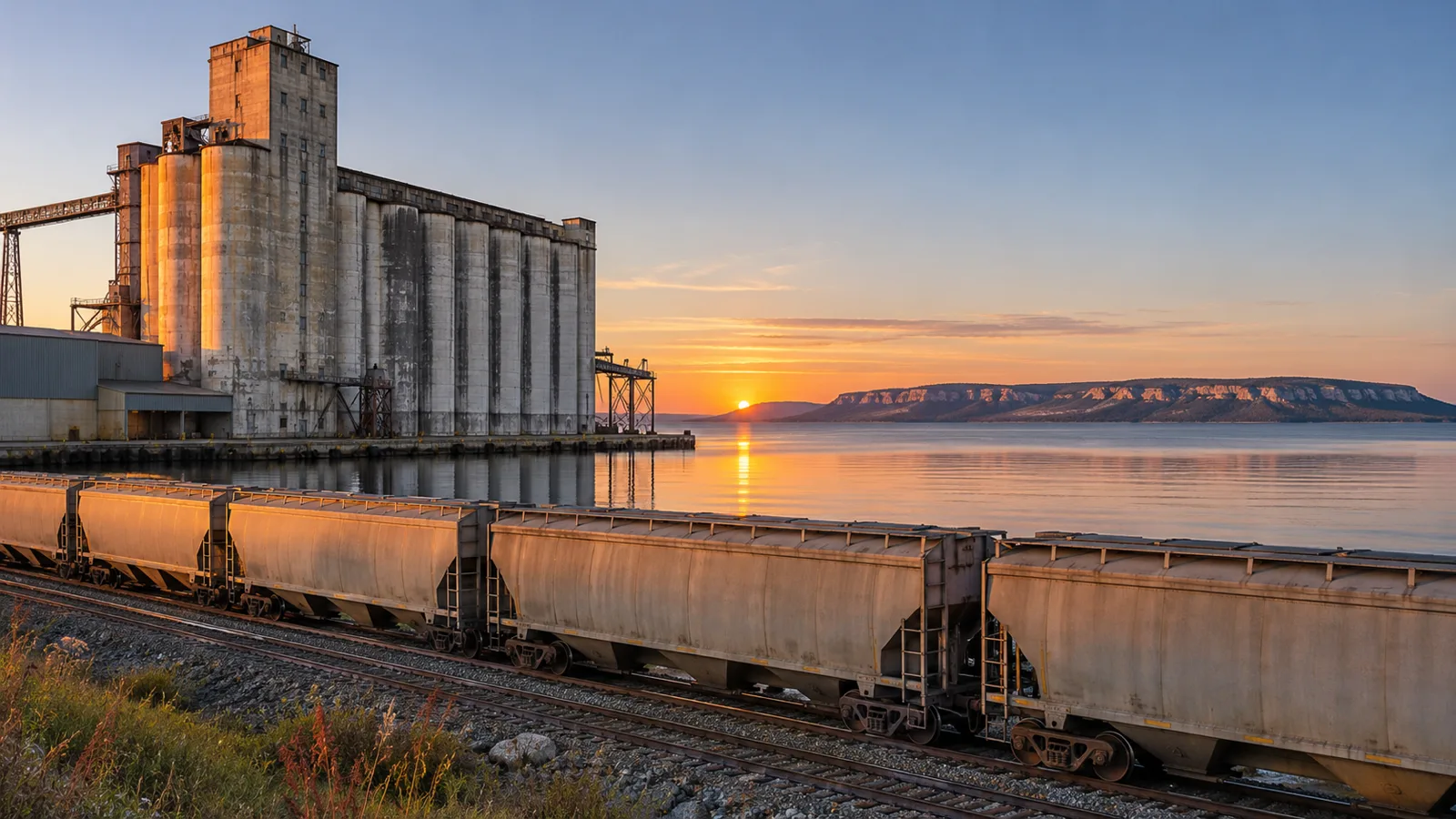
Every truck driving Highway 17 between Ontario and Manitoba passes through Thunder Bay. So does a large share of the grain that leaves the Prairies for eastern and overseas markets, much of the freight supplying communities across Northwestern Ontario, and plenty of the forestry and mining output from the region. Stand on the waterfront on a clear morning and you can see the scope of it: towering grain elevators along the shore of Lake Superior, freight trains rolling in from the west, a laker loading in the harbour, and the long silhouette of the Sleeping Giant across the bay.
For businesses in Southern Ontario, Thunder Bay is easy to think of as just another distant northern city. In logistics terms it is much more than that. It is the westernmost port on the Great Lakes–St. Lawrence Seaway system, the hub for an enormous area of Northwestern Ontario, and the pinch point on the only all-Canadian road route between the eastern half of the country and the West.
This guide looks at Thunder Bay from three angles: shipping into the city and the region it supplies, shipping out of it, and moving freight through it on the way to Western Canada.
Why Thunder Bay Matters
Thunder Bay has a population of a little over 100,000 and serves as the service centre for Northwestern Ontario, a region larger than many countries. Hospitals, schools, retailers, mines, mills and remote First Nations communities from Marathon to Kenora and up to the far north draw supplies through it.
Its geography explains its importance. Lake Superior pushes the road and rail lines from the East into a narrow band along the north shore, and Thunder Bay sits where those routes meet the open country heading towards Manitoba. To the south-west, the Pigeon River crossing connects to Minnesota and Duluth, about 300 kilometres away. Winnipeg is roughly 700 kilometres west, closer than Sudbury.
Shipping Into Thunder Bay From Southern Ontario
Transit times and routes
From the GTA, Thunder Bay is about 1,400 kilometres by road via either Highway 11 through North Bay and Nipigon or Highway 17 through Sudbury, Sault Ste. Marie and Wawa. A solo truck driver working within Canada's hours-of-service limits typically needs two days. Team drivers can cover it in a little over one day. LTL shipments usually take three to five business days, depending on terminal schedules and the final destination.
Many national carriers handle Thunder Bay freight through their own terminal there, then deliver locally or interline to regional carriers for smaller communities. Check whether your carrier runs its own equipment to the final destination, especially for places like Dryden, Fort Frances, Atikokan or Geraldton.
Weather and road closures
Both main highways into Thunder Bay from the east pass through stretches that close in severe winter weather, especially Highway 17 along the Lake Superior shore near Wawa and Marathon. Because there is no alternative road for hundreds of kilometres, a closure can halt traffic until it reopens. The January 2016 failure on the Nipigon River Bridge, which briefly severed the Trans-Canada Highway, showed how fragile this link can be. The new bridge has since been completed, but the lesson stands: add buffer time for winter shipments and avoid promising exact delivery dates during storm season.
Freeze-sensitive goods need heated service for much of the year. Temperatures well below -30°C are not unusual in January and February in Northwestern Ontario, and freight may sit in terminals or trailers overnight. Our article on cold weather freight protection explains the options.
Consolidating to control cost
Rates to Thunder Bay are higher per kilometre than on busy southern lanes, partly because carriers often struggle to find return loads heading east. Shippers can reduce costs by consolidating orders into fewer, larger shipments, shipping on fixed weekly days and using full pallets. Regular shippers to the region often find that a weekly truckload or partial load, split at a Thunder Bay cross-dock, works out cheaper than many separate LTL shipments.
Shipping Out of Thunder Bay
The port
The Port of Thunder Bay is one of the largest outbound ports on the Seaway system. Grain from Western Canada arrives by rail and is loaded onto lake freighters and ocean-going vessels at the terminal elevators along the waterfront. The port also handles potash, coal, forest products and project cargo. Its Keefer Terminal has handled wind turbine components and heavy equipment bound for projects across Western Canada and the US Midwest.
Like every Seaway port, Thunder Bay has a navigation season that usually runs from late March to late December. Shippers using the port for outbound or inbound cargo need to plan around the winter closure.
Forestry, mining and manufacturing
Northwestern Ontario's forestry sector ships pulp, paper and lumber by rail and truck. Gold mines in the region, including those near Red Lake and Hemlo, depend on a steady flow of supplies in and concentrate or doré out. Thunder Bay also has manufacturing, including a long-established rail car and transit vehicle plant. These shippers rely on a mix of rail, truckload and specialised freight.
Sending freight east
Because so much more freight moves into Thunder Bay than out by road, eastbound truckload rates can be attractive. Businesses shipping from Northwestern Ontario to Southern Ontario or Quebec should ask carriers about backhaul pricing, which can be noticeably lower than headhaul rates in the other direction.
Shipping Through Thunder Bay to the West
For freight between Ontario and Manitoba, Saskatchewan or Alberta, carriers choose between two broad routes:
- The all-Canadian route: via Highway 11 or 17 through Northern Ontario and Thunder Bay, then Highway 17 to Kenora and Highway 1 into Manitoba.
- The US route: crossing into Michigan at Sarnia or Sault Ste. Marie and travelling through the US Midwest before re-entering Canada at Emerson, Manitoba or another crossing.
The US route can be faster in winter and may use better highways, but freight moving between two Canadian points through the US must travel in-bond, with US customs procedures, and the driver and equipment must be able to enter the United States. Certain goods, including some restricted products and freight with customs complications, are better kept on the Canadian route. Your carrier will usually decide, but it is worth asking which route your shipment will take and how that affects transit time. Our post on Ontario to Alberta freight covers this choice in more detail.
Rail is the other major option for westbound freight. Intermodal containers move between Toronto and Winnipeg, Calgary, Edmonton and Vancouver on CN and CP, passing through Northwestern Ontario without the driver-hours and weather constraints of trucking. For non-urgent freight moving in large volumes, intermodal is often the most economical choice.
The Pigeon River Crossing to Minnesota
About an hour south-west of Thunder Bay on Highway 61, the Pigeon River crossing links Ontario with Grand Portage, Minnesota, and continues along the Lake Superior shore to Duluth. It is a much quieter border point than the Ambassador Bridge or the Blue Water Bridge, and that has advantages: queues are rarely long, and Northwestern Ontario businesses can reach Duluth, Minneapolis and the Upper Midwest without first driving 1,400 kilometres east.
The same rules apply as at any other crossing. US-bound freight needs an eManifest filed in advance, a customs broker acting for the US importer, a complete commercial invoice and, for qualifying goods, NAFTA origin documentation. Because the crossing is smaller, inspection facilities and broker presence are more limited, so shippers should confirm in advance that their broker can clear freight there and that any partner agency requirements, such as for food or wood products, are handled before the truck arrives. For regular cross-border lanes out of the region, a cross-border shipping partner can keep the paperwork consistent.
Supplying Remote Communities From Thunder Bay
Many fly-in First Nations communities in Northwestern Ontario are supplied through Thunder Bay or Sioux Lookout by air cargo, and by winter roads in the coldest months. If you sell to customers in these communities, plan for:
- Higher costs per kilogram for air cargo, which favours compact, lightweight packaging.
- Limited cargo space on scheduled flights, so freight may wait for capacity.
- Winter road windows, typically from late January into March, for heavy or bulky items such as building materials and furniture.
- Clear coordination with the receiving organisation, since there may not be a delivery service to individual addresses.
For an overview of remote logistics across the country, see our guide to rural and remote delivery in Canada.
Questions Shippers Ask About Thunder Bay
Is it better to supply Northwestern Ontario from Toronto or Winnipeg?
For Kenora, Dryden and Fort Frances, Winnipeg is much closer, and many businesses supply those areas from Manitoba. For Thunder Bay itself and points east to Marathon, the choice depends on where your inventory is. Some companies keep a small stock in Thunder Bay or Winnipeg for the region.
Does parcel service reach Thunder Bay quickly?
Parcels move faster than LTL because of air connections. Overnight and two-day services are available to Thunder Bay from Southern Ontario, though ground parcel service is typically three to five days.
How do I avoid freight damage on such a long haul?
Use sturdy pallets, stretch-wrap and corner boards, avoid overhang, and label freight clearly. Long distances, cold temperatures and multiple handlings at terminals all increase risk, so packaging should be stronger than for a short southern run.
Plan Your Thunder Bay Lanes
Whether you are supplying a customer in Thunder Bay, shipping out of Northwestern Ontario, or moving freight through it to the Prairies, the city deserves its own place in your logistics planning. Realistic transit times, winter contingencies and smart consolidation keep these long lanes reliable and affordable.
ShipCarte arranges LTL freight, truckload and distribution services for businesses across Ontario, including regular lanes to Thunder Bay and the West. Request a quote or schedule a consultation to plan your next shipment.