
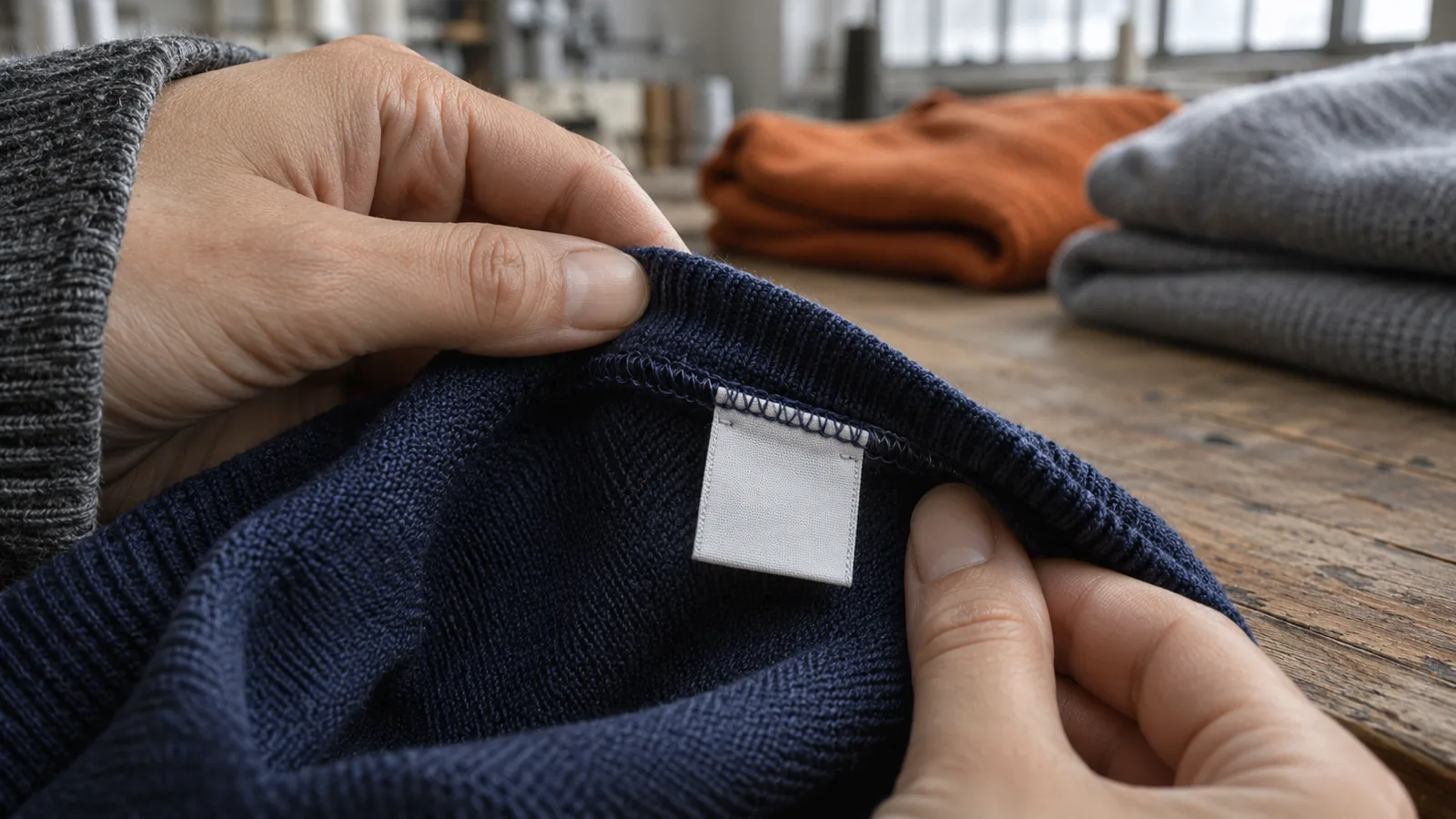
An online apparel brand has its first production run of merino sweaters and cotton-blend joggers sewn overseas. The factory used the labels it prints for American customers: "100% Merino Wool, Made in China," with the brand's US-style registered number on the back. The shipment lands in Vancouver, gets received at the warehouse, and the brand's first wholesale buyer in Quebec sends it back with a note: the labels are not compliant for Canada.
Clothing and other consumer textiles sold in Canada must carry labels that meet the federal Textile Labelling Act and the Textile Labelling and Advertising Regulations. The Competition Bureau enforces these rules, and retailers increasingly check them as part of vendor compliance. The good news is that the requirements are clear and not especially complicated once you understand them. The bad news is that fixing labels after production is expensive, slow and, for sewn-in labels, sometimes impossible.
This guide walks through building a compliant Canadian textile label one element at a time, then covers the related rules apparel sellers often miss.
Which products are covered?
The Textile Labelling Act applies to consumer textile articles, meaning textile fibres, yarns and fabrics, and articles made wholly or partly from them, that are sold to consumers. That includes clothing, outerwear, sleepwear, socks, scarves, hats, bedding, towels, many household textiles and fabric sold by the metre.
Some articles are exempt or have reduced requirements, such as certain made-to-measure garments, some disposable products and articles where the textile is a minor component. Check the regulations if your product is unusual, but assume that anything resembling a garment needs a full label.
Building the label, step by step
Step 1: Identify the fibres by generic name
Fibre content must be shown using generic names, in both English and French. "Cotton / coton," "polyester / polyester," "wool / laine," "spandex / spandex," "nylon / nylon," "viscose / viscose" or "rayon / rayonne," and so on. The regulations list the accepted generic names.
Trademarked fibre names may appear on the label only alongside the generic name, and with equal prominence. A label that says only a brand name for a stretch fibre, without "spandex" or "elastane," does not meet the requirement.
Watch out for marketing-driven names that do not match the generic fibre. Fabric made from bamboo through a chemical process is generally a regenerated cellulose fibre and should be labelled with the appropriate generic name, such as rayon or viscose, not simply "bamboo." The Competition Bureau has taken action on this issue in the past, so it is worth getting right.
Step 2: Show the percentages by mass
Each fibre making up 5% or more of the total fibre mass is listed by percentage, in descending order of predominance. Fibres under 5% can generally be grouped as "other fibres / autres fibres," unless they have a functional purpose that the label chooses to name. The figures must be accurate within the tolerance the regulations allow.
For garments with distinct sections, such as a jacket with a polyester shell and a cotton lining, the fibre content of each section can be shown separately. Trims, small decorations and elastic bands below set thresholds generally do not need to be included in the fibre calculation.
Step 3: Add dealer identity
The label must identify the Canadian dealer responsible for the product, in one of two ways:
- The dealer's full name and postal address, or
- A CA identification number, issued by the Competition Bureau, which links back to the dealer's registered details.
Most brands choose a CA number because it is short and does not change if the company moves. CA numbers are registered to a Canadian business. Foreign brands selling into Canada often show the name and address of their Canadian importer or distributor instead. A US registered identification number does not substitute for Canadian dealer identity.
Step 4: Choose the right label type and placement
Most apparel must carry a permanent label, meaning one that is sewn in, printed directly on the garment or otherwise attached so that it stays legible through the product's normal life. Some articles can use non-permanent labels, such as hang tags or packaging, but clothing generally cannot.
The label needs to be easy for the consumer to find and read. If information is split across a sewn-in label and a hang tag, make sure the required information appears where the regulations say it must.
Step 5: Make it bilingual and legible
All mandatory information must appear in English and French, in letters that are clear and legible. Quebec's language rules also apply to products sold there, which in practice means French information should be at least as prominent as English across packaging and documentation.
A worked example
A compliant sewn-in label for a cotton-blend hoodie might contain:
- "80% cotton / coton"
- "20% polyester / polyester"
- The CA number registered to the Canadian brand
Country of origin ("Made in Portugal / Fabriqué au Portugal"), care symbols and size are commonly on the same label, but they are governed by other rules or are voluntary, as discussed below.
What about care labels?
Care labelling is voluntary in Canada. If you choose to include care instructions, they should be accurate, and many brands use the care symbol system set out in the Canadian standard for care labelling, which aligns with international symbols. Retailers often require care information as part of their vendor standards, so in practice most apparel includes it. Misleading care instructions could still raise concerns under general rules against false or misleading representations.
Country of origin
The Textile Labelling Act does not itself require country of origin on most garments, but country of origin marking may be required for customs purposes on certain imported goods, and retailers usually expect it. If you do state it, it must be truthful. Claims like "Made in Canada" need to meet the Competition Bureau's guidelines for such claims, which generally require that the last substantial transformation happened in Canada and that a high share of costs were incurred here.
Online listings and advertising
Ecommerce brands sometimes focus on the physical label and forget the product page. When an advertisement or listing makes representations about fibre content, the regulations set rules for how that information is presented, and claims must not mislead. Keep your product descriptions consistent with the label: if the garment is 95% cotton and 5% spandex, a listing that says "pure cotton" is a problem.
It is also simply good customer service. Fibre content and care information help shoppers decide, reduce sizing and fit surprises and cut down on returns.
Stuffed articles: a provincial wrinkle
If your products include stuffing, such as puffer jackets, quilted vests, pillows or plush toys, some provinces have their own requirements for stuffed articles. Quebec and Manitoba have long had registration and labelling rules for upholstered and stuffed articles, while Ontario ended its program at the start of 2019. If you sell padded products nationally, confirm the current requirements in each province before you print labels.
How compliance shows up in logistics
Labelling feels like a design and legal issue, but it lands in the warehouse more often than people expect.
- Receiving checks. A warehouse can spot-check new styles on arrival for bilingual fibre content and dealer identity before stock is put away and sold.
- Relabelling projects. Where hang tags or packaging need correction, a warehouse can apply compliant tags as a value-added service. Sewn-in label fixes are much harder and should be avoided by getting artwork right before production.
- Retail compliance. Department stores and chains may refuse or charge back non-compliant goods. Our retail fulfillment team ships to vendor guide requirements.
- Imports. Non-compliant textiles can face problems at the border or after entry. Including label checks in your supplier quality process prevents holds.
Clear identifiers help too. Assigning each style, colour and size its own SKU and barcode, as explained in our article on SKUs and UPC numbers, makes it easier to isolate a style if a label problem is found.
Working with overseas factories
Most label problems start with a factory doing exactly what it was told, for a different market. The simplest fix is to send each supplier a Canadian label specification as part of every purchase order: the exact bilingual text, the CA number or dealer address, the label type and where it should be sewn. Ask for a photo of the finished label on a pre-production sample, and check fibre percentages against the fabric mill's test reports rather than the factory's estimate. When one style is sold in both Canada and the United States, a single combined label that meets both countries' rules is usually cheaper than running two label versions.
A pre-production label checklist
- Generic fibre names in English and French
- Percentages by mass, largest first, with fibres under 5% handled correctly
- Trademarked fibre names paired with generic names
- Canadian dealer name and address, or a CA number
- Permanent label for garments
- Clear, legible text in both languages
- Optional care symbols accurate and consistent with the fabric
- Country of origin truthful if shown
- Provincial stuffed-article requirements checked where relevant
- Online product descriptions matching the label
From compliant labels to happy customers
Getting textile labels right is the foundation for selling apparel in Canada without nasty surprises. Once your products are ready, the next challenge is operations: sizes, returns and seasonal peaks, which we cover in our guide to apparel ecommerce logistics in Canada. ShipCarte supports clothing brands with ecommerce fulfillment, receiving checks and retail-ready shipping across the country. Request a quote to get started.