
The founder of a small home fragrance brand in Port Credit has a recurring problem. Customers love the candles, and many of them write to say how much they appreciate the brand's environmental values. They also write, less happily, when they open a box full of plastic air pillows. So the founder switches to paper fill. Within a month, breakage reports climb, refunds follow, and replacement candles are shipped in yet more packaging. The greener choice ended up creating more waste than the one it replaced.
That story captures the central tension of sustainable packaging. Customers, retailers and regulators increasingly expect businesses to reduce plastic and packaging waste. But packaging exists to protect products, and a damaged product that has to be shipped twice is worse for the environment than one that arrived safely the first time. The goal is not just greener materials. It is packaging that protects well while using less, using better materials, or both.
This guide walks through the practical options available to brands shipping from Mississauga, how to test them, and how to avoid the common mistakes that turn a sustainability project into a damage problem.
Start With Less, Not Just Different
Before changing materials, look at quantity. The most sustainable packaging is often the packaging you do not use. Many shipments contain far more material than they need because the box is too large and the empty space is filled with dunnage. Right-sizing tackles that at the source.
Right-size your boxes
Reviewing your order profile and introducing a few more box sizes that match your products more closely can reduce void fill, corrugated usage and dimensional weight charges all at once. Cartonization software can recommend the smallest suitable box for each order automatically, so packers are not guessing.
Consider mailers for non-fragile items
Apparel, soft goods and many accessories do not need a box at all. Paper mailers or padded paper envelopes can replace both the box and the void fill, often with a lower shipping weight.
Ship in the product's own packaging when possible
Some products, such as sturdy retail-boxed electronics or small appliances, can travel in their own packaging with a shipping label applied directly, sometimes called ships-in-own-container. This eliminates an outer box entirely, though it may reveal the contents and is not suitable for every product.
A Practical Guide to Greener Materials
Once you have reduced what you use, look at what it is made of. Here is how the common options compare for ecommerce shipping.
Corrugated cardboard
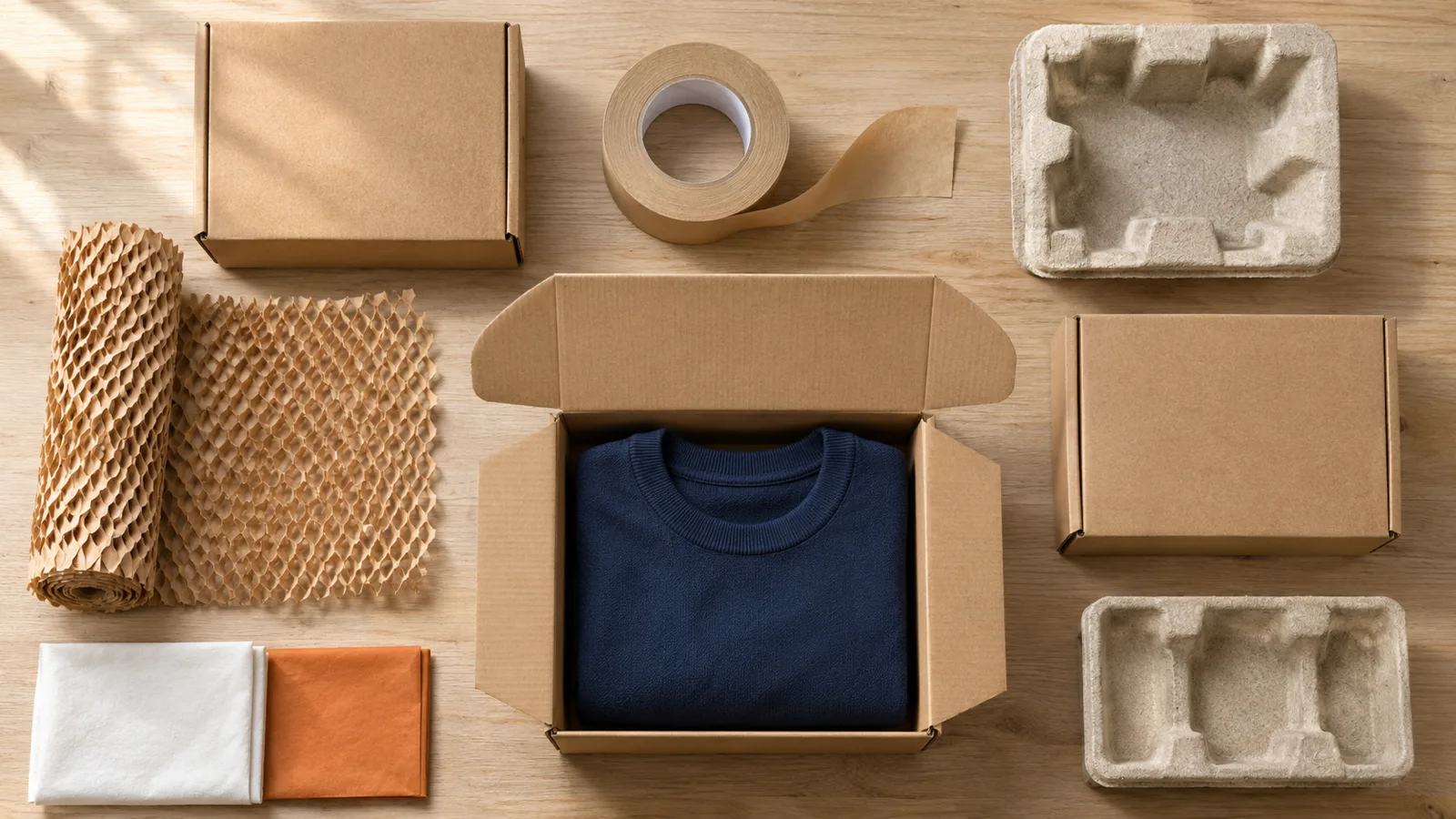
Corrugated boxes are widely recycled in Canada, including through residential blue box programs in Ontario. Boxes with recycled content are widely available. Look for the right strength for your product; a box that is too weak causes damage, while one that is too heavy wastes material.
Paper void fill
Crumpled kraft paper and paper-based fill are curbside recyclable in most programs. They work well for light to moderately fragile goods but need to be used in sufficient quantity and packed tightly to prevent movement. Paper settles in transit more than air pillows do, which is often the cause of breakage when brands switch.
Honeycomb paper wrap
Expanded honeycomb paper creates a cushioned, interlocking structure around items and is a popular replacement for bubble wrap. It works well for wrapping glass, ceramics and bottles, though it may not match bubble wrap's protection for very heavy fragile items.
Moulded pulp
Moulded fibre inserts, similar to egg carton material, can be shaped to hold specific products. They are excellent for repeat items like bottles, jars and electronics, and are generally recyclable or compostable depending on the formulation. Custom moulds involve setup costs, so they make most sense for high-volume SKUs.
Paper tape
Water-activated or self-adhesive paper tape avoids plastic tape and allows the whole box to be recycled without removal. Water-activated tape also tends to create a strong seal on corrugated boxes.
Compostable mailers
Compostable poly mailers are sold as an alternative to plastic, but they come with caveats. Many require industrial composting facilities, which are not available to every household, and they may not be accepted in curbside programs. Check local acceptance before making environmental claims about them.
Recycled-content plastics
In some cases, plastic is still the best protective option, especially for moisture protection or very heavy items. Using recycled-content plastic and reducing the amount used can be a reasonable middle ground.
Testing Before You Switch
The founder in our opening story did not do anything wrong by choosing paper. The mistake was switching everything at once without testing. A simple testing approach prevents that:
- Pick your most fragile and most common SKUs as test cases.
- Pack samples with the new materials using the same instructions packers would follow.
- Run basic drop and vibration tests, such as dropping packages from a set height onto corners, edges and faces. Formal test standards exist, but even informal testing reveals weaknesses.
- Ship test parcels to real addresses, including longer routes to Western Canada or the US, and inspect them on arrival.
- Roll out gradually, monitoring damage claims and customer feedback before switching all SKUs.
Our guide on packing fragile items properly covers techniques that apply regardless of materials.
Ontario's Producer Responsibility Rules
Ontario has been moving its blue box program to a producer responsibility model, where businesses that supply packaging to consumers in the province bear responsibility for the costs of collecting and recycling it. Depending on your size and situation, you may have reporting or other obligations related to the packaging you ship to Ontario households. The rules have thresholds and specific definitions, so check with the provincial regulator or a compliance adviser about whether and how they apply to your business.
Beyond compliance, this shift means packaging choices increasingly carry a direct cost. Using less material, and materials that are easier to recycle, can have financial as well as environmental benefits.
Making Honest Environmental Claims
Customers are rightly sceptical of vague green marketing. If you talk about your packaging, be specific and accurate. "Our boxes are made with recycled content and are curbside recyclable in most Ontario municipalities" is more credible than "eco-friendly packaging." Federal competition law in Canada addresses misleading environmental claims, so make sure you can substantiate anything you say, and avoid suggesting materials are compostable or recyclable everywhere if that is not the case.
Clear disposal instructions on or inside the package also help. Customers often want to do the right thing but are unsure which bin a material belongs in.
Sustainability Beyond the Box
Packaging is the most visible part of a shipment's environmental impact, but not the only part. Several logistics choices also matter:
- Consolidating shipments so customers receive one parcel instead of several.
- Choosing ground over air where delivery timelines allow.
- Locating inventory closer to customers to shorten delivery distances. Mississauga's central location in the GTA puts a large share of Ontario's population within a short ground transit.
- Reducing returns through better product information and sizing guidance, since every return is another trip.
- Reusing inbound packaging such as clean cartons and void fill from supplier shipments where suitable.
Balancing Brand Experience and Sustainability
Unboxing matters to many ecommerce brands, and sustainable packaging does not have to look plain. Printed kraft boxes, paper tissue, recycled-paper inserts and soy- or water-based inks can create a premium feel. What tends to work less well is layering many components, such as a box inside a box with tissue, stickers, ribbons and cards, which increases material without improving protection. Our article on package insert ideas offers ways to make an impression with fewer materials.
Measuring Whether It Is Working
Sustainability efforts are easier to maintain when you can show results. A few simple metrics help Mississauga brands track progress without a complex reporting system:
- Packaging weight per order. Weigh a sample of packed orders before and after changes, subtracting product weight.
- Share of orders shipped in plastic-free packaging. Useful if reducing plastic is your main goal.
- Damage rate by packaging type. Claims and customer reports of breakage, tracked by SKU and packaging configuration, show whether protection has slipped.
- Average box volume. A falling number usually means less void fill and lower dimensional weight charges.
- Supply cost per order. Greener materials sometimes cost more per unit, but right-sizing can offset that.
Reviewing these figures quarterly makes it easier to spot problems early and to report honestly to customers and retail partners who ask about your packaging practices.
Seasonal Considerations in Southern Ontario
Paper-based materials react to moisture more than plastics do. In humid summer months, corrugated boxes can lose some compression strength, and in winter, parcels can sit on wet porches or in damp trucks. Store packaging materials in a dry area, choose box grades with enough margin for the weight inside, and consider a moisture barrier for products that are sensitive to humidity. For candles, chocolates and cosmetics, summer heat may also call for insulated or expedited shipping, which is a separate decision from material choice.
How a 3PL Can Help
For many brands, the hardest part of sustainable packaging is consistency. It is easy to design a better box; it is harder to make sure every packer uses it correctly on every order. A fulfillment partner can standardize packing instructions, source materials in volume, apply cartonization logic and track damage rates by packaging type.
ShipCarte's ecommerce fulfillment and pick and pack services can incorporate your preferred packaging, including custom and recyclable materials, into a documented process. Brands in health and wellness and other categories with fragile glass products often find this especially helpful.
Ship Greener Without Breaking Things
If you want to reduce packaging waste without increasing damage, ShipCarte can review your current packaging, suggest practical alternatives and help you test them in real shipments. Schedule a consultation to get started.