
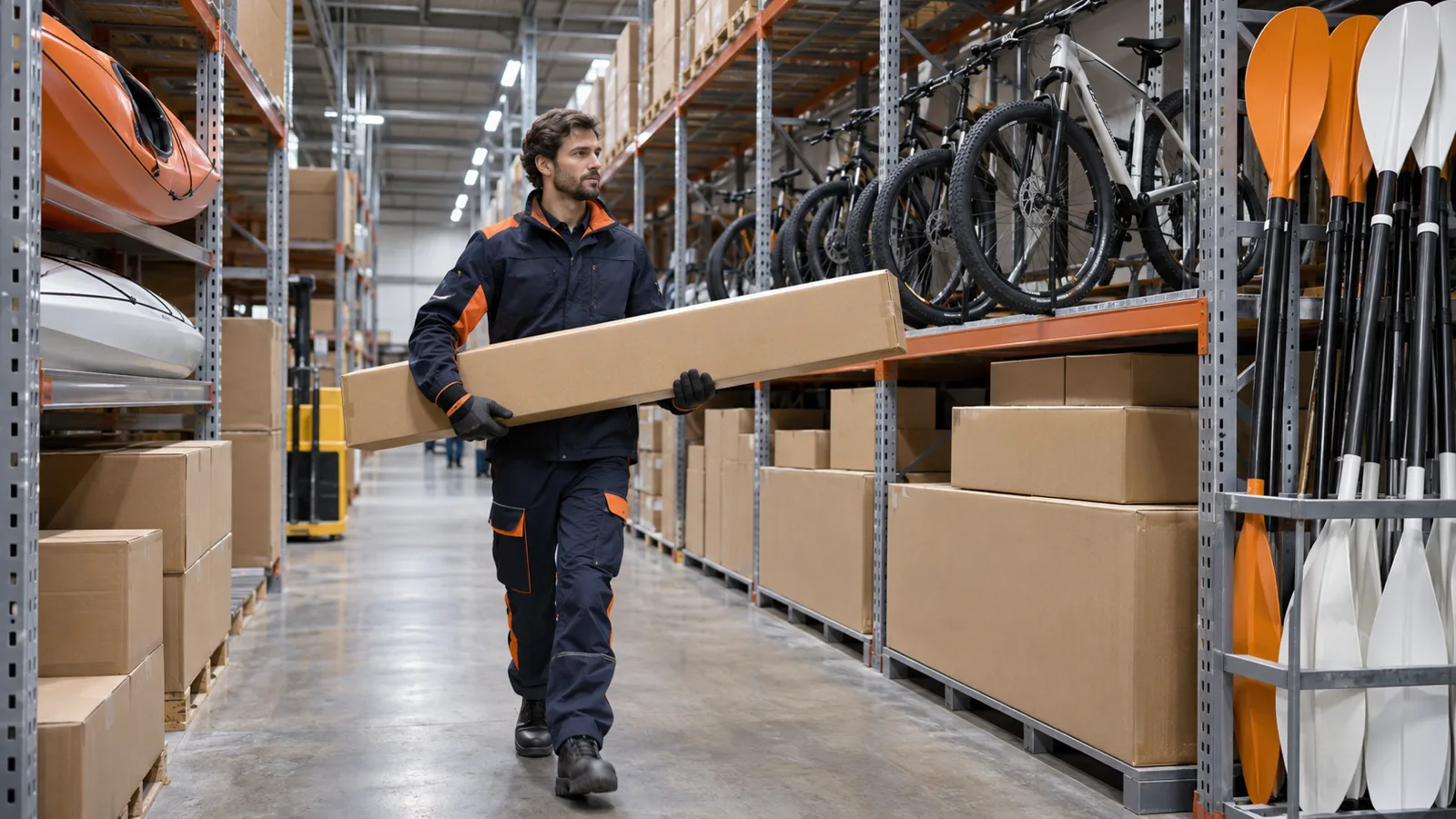
Every August, an online hockey equipment retailer based near Churchill Meadows starts to feel the pressure. Minor hockey registration is wrapping up, parents are buying skates and sticks, and orders climb week after week until early October. Then come the holidays, with goalie pads and sticks as gifts. By spring, the same warehouse is quiet, and racks full of composite sticks sit waiting for next season. Meanwhile, a paddle sports brand across town has the exact opposite curve, with almost nothing in January and a wave of kayak paddles and PFDs in May.
Sporting goods are one of the trickiest categories in e-commerce fulfillment. Products are long, bulky, heavy or awkwardly shaped. Demand rises and falls with the seasons, the school calendar and even the weather forecast. And customers buying gear for a game this weekend do not want to hear that their order is delayed. For brands operating in Mississauga and across the GTA, getting fulfillment right means solving for shape, size and timing at the same time.
This article breaks down the specific challenges and the practical solutions, season by season and product by product.
The Shape Problem
Parcel carriers build their networks around boxes that fit on conveyors. Anything long, heavy or irregular costs more to ship and is more likely to be damaged. Sporting goods hit almost every one of these triggers.
Long items
Hockey sticks, fishing rods, skis, ski poles, paddles, lacrosse sticks and golf club sets often exceed the length thresholds where carriers apply additional handling or oversize charges. A single hockey stick in a long, narrow box can cost far more to ship than its weight suggests. Our guide to types of shipping surcharges explains how these fees are triggered.
Bulky, light items
Helmets, hockey bags, inflatable paddleboards, soccer balls and goalie pads take up space without weighing much. That makes them expensive under dimensional weight pricing, where carriers charge based on box size rather than actual weight.
Heavy items
Dumbbells, kettlebells, weight plates, benches and treadmills are dense and heavy. Above certain weights, parcel shipping becomes impractical or very expensive, and LTL freight with liftgate or residential delivery is often the better choice.
Fragile or high-value items
Carbon fibre bikes and frames, composite sticks, graphite rods and smart fitness devices can be damaged by poor packing. Damage claims on these items are costly, both in refunds and in customer goodwill.
Packaging Solutions That Cut Costs
The packaging decision often matters more than the carrier rate. A few approaches that work well for sporting goods:
- Right-size the box. Every extra centimetre on a long box adds to dimensional weight. Stock several box lengths for sticks and paddles rather than one universal size.
- Use smart cartonization. A cartonization tool picks the best box for each order based on product dimensions, which is especially valuable when customers combine a stick, tape and a puck bag in one order.
- Protect the vulnerable points. Blade tips, shaft ends, derailleurs and bike handlebars need targeted protection rather than a box full of loose fill.
- Ship in the manufacturer's carton when it works. Bikes and fitness equipment often come in sturdy shipping cartons. Shipping in original packaging (sometimes with an overbox) saves material and labour.
- Consider partial assembly. Bikes shipped mostly assembled in a bike box reduce the customer's work but increase box size. Test which approach gives the best mix of cost and customer satisfaction.
Parcel or Freight? Drawing the Line
Many sporting goods catalogues straddle the boundary between parcel and freight. A single adjustable dumbbell set might ship economically as a parcel, while a power rack, rowing machine or table tennis table almost certainly will not. The mistake many growing brands make is letting the checkout decide by default, so a 70 kg item gets quoted at a parcel rate and the real cost only shows up on the carrier invoice weeks later.
A better approach is to tag each SKU by shipping profile in your product data:
- Standard parcel: fits normal size and weight limits, such as balls, apparel, gloves and accessories.
- Oversize parcel: ships by courier but triggers additional handling or large package surcharges, such as sticks, paddles and boxed bikes.
- Freight: too heavy or bulky for parcel networks, such as home gym equipment and large outdoor items, shipped by LTL with liftgate and residential delivery.
With those profiles in place, your checkout can show accurate shipping prices, your warehouse knows which orders need a pallet and freight booking, and customer service can set realistic delivery expectations. For residential freight deliveries in Mississauga neighbourhoods with narrow driveways or townhouse complexes, it also helps to confirm access details with the customer before booking, so the carrier sends the right truck.
Inventory Accuracy in a Size-Heavy Catalogue
Sporting goods catalogues explode into variants. One skate model might come in a dozen sizes and several widths; one stick model comes in multiple flexes, curves and handedness. That means many SKUs with small quantities each, and lots of opportunities for a picker to grab a left-handed stick instead of a right-handed one.
Barcode scanning at every pick, clear bin labelling and a real-time inventory system are essential. Cycle counting high-velocity variants during peak season catches errors before they turn into oversells. It is far cheaper to count a bay of goalie gloves than to apologize to a parent whose child's first game is on Saturday.
The Seasonal Calendar
Sporting goods demand follows the Canadian calendar closely. A typical year for a multi-sport retailer in Ontario looks something like this:
January to March
Winter sports continue, with skis, snowshoes and hockey replacements, plus New Year fitness spikes for home gym equipment. Spring sports pre-orders begin. This is a good time to clear winter stock and receive spring inventory.
April to June
Baseball, soccer, cycling, golf and paddle sports take off. Bikes are a major category, and demand can swing sharply based on weather. A warm April weekend can trigger a rush; a cold, wet May can stall sales.
July and August
Summer activities hold steady, while hockey and fall sports begin their back-to-school build. Inbound shipments for hockey season should be received and put away by mid-summer.
September to December
Hockey, skating and skiing peak, followed by the holiday gift season with Black Friday and Cyber Monday. This is when fulfillment capacity is tested hardest.
Planning around this calendar is half the battle. For broader advice, see the role of a 3PL in seasonal inventory management.
Matching Space to Seasons
One of the biggest cost traps for sporting goods brands is paying for peak-sized warehouse space all year. If you lease your own building in Mississauga sized for October, you will be paying for empty racks in March.
A 3PL model helps here because storage scales with inventory. You pay for more pallet positions when goalie pads and skates fill the shelves, and fewer when they are gone. Some practical ways to make that work:
- Share a 12-month inventory forecast with your fulfillment partner so space and staffing can be planned.
- Stage pre-season inbound shipments rather than receiving everything at once.
- Store slow off-season stock in denser, higher locations, and move fast sellers to accessible pick faces as the season shifts.
- Plan off-season liquidation of discontinued models before new season stock arrives. Our post on liquidating e-commerce inventory outlines the options.
Shipping Within Canada and Into the US
Mississauga's position on Highways 401, 403 and 410 gives sporting goods brands quick ground access to much of Ontario and Quebec, which together make up a large share of Canada's population. For western provinces, transit times stretch, so some brands use a second inventory location or accept longer delivery windows for oversize items.
For US customers, sticks and paddles can be shipped cross-border by parcel, but oversize surcharges and customs clearance add cost. High-volume sellers sometimes send bulk inventory across the Niagara or Windsor crossings to a US-side location instead. Our cross-border shipping team can help compare approaches.
Kits, Bundles and Team Orders
Sporting goods lend themselves to bundles: a youth hockey starter kit, a beginner paddle package, a home gym set. Bundles can raise order value, but they complicate packing because the components have very different shapes. A starter kit with a stick, helmet and gloves may ship best as two boxes rather than one oversized carton.
Team and club orders are another opportunity. A minor soccer club in Erin Mills might order 200 jerseys and 200 pairs of socks, sorted by team and size. That is a B2B shipment with sorting requirements, not a pile of individual parcels. A partner with kitting and assembly and retail fulfillment capabilities can handle team orders alongside regular e-commerce.
Returns: Sizing, Fit and Feel
Sporting goods returns are common for sizing-sensitive items like skates, helmets, cleats and apparel. Customers often order two sizes and return one. To keep returns from eroding margin:
- Publish detailed sizing guides and fit notes on product pages.
- Inspect returns carefully. Skates that were sharpened or used on ice, or helmets with signs of impact, may not be resellable.
- Restock quickly during peak season so returned sizes are available for the next customer.
- Track return reasons by SKU to catch sizing or quality problems early.
A structured returns management process gets resellable items back on the shelf while the season is still on.
A Quick Checklist for Sporting Goods Sellers
- Know the oversize thresholds for each carrier you use and measure products accurately.
- Stock box sizes that match your longest and bulkiest products.
- Use LTL or freight for heavy fitness equipment above parcel limits.
- Forecast demand by season and share it with your fulfillment partner.
- Plan inbound receiving before each sports season starts.
- Price shipping on oversize items accurately so it does not eat your margin.
- Set clear return policies for used and fitted equipment.
Fulfillment Built for Odd Shapes
Sporting goods brands in Mississauga need a fulfillment partner who can handle a hockey stick and a set of dumbbells in the same afternoon and scale up for the October rush. ShipCarte offers e-commerce fulfillment, freight options for bulky goods and flexible storage that follows your season. Request a quote or book a consultation to plan your next season.