
A housewares distributor in Meadowvale lands a new account with a chain of stores in Alberta and British Columbia. The buyer wants weekly replenishment, the first order is twelve pallets, and the purchasing contract has a delivery window that leaves little room for error. The question that lands on the operations manager's desk is deceptively simple: what is the best way to get product from Mississauga to Calgary and Vancouver?
The honest answer is that it depends. Western Canada is a long way from the Greater Toronto Area. Vancouver is more than 4,000 kilometres away by road, and the route crosses the Canadian Shield, the Prairies and the Rockies, each with its own weather and terrain challenges. The three main options, rail intermodal, trucking and small-parcel networks, each make sense in different situations, and many businesses end up using all three.
This article compares those options side by side, explains what drives cost and transit time on each, and offers a practical way to decide which mode to use for which shipment.
The Geography You Are Working With
Freight leaving Mississauga for the West generally heads north and west out of the GTA. Trucks have two main choices. One is the Trans-Canada route through Northern Ontario, via Sudbury or North Bay and on toward Thunder Bay and Kenora, before reaching Winnipeg. The other is to cross into the United States, often through the Ambassador Bridge at Windsor or the Blue Water Bridge at Sarnia, and run through the Midwest before re-entering Canada. The US route can be faster in some conditions, but it adds customs requirements for goods in transit and is not appropriate for every shipment.
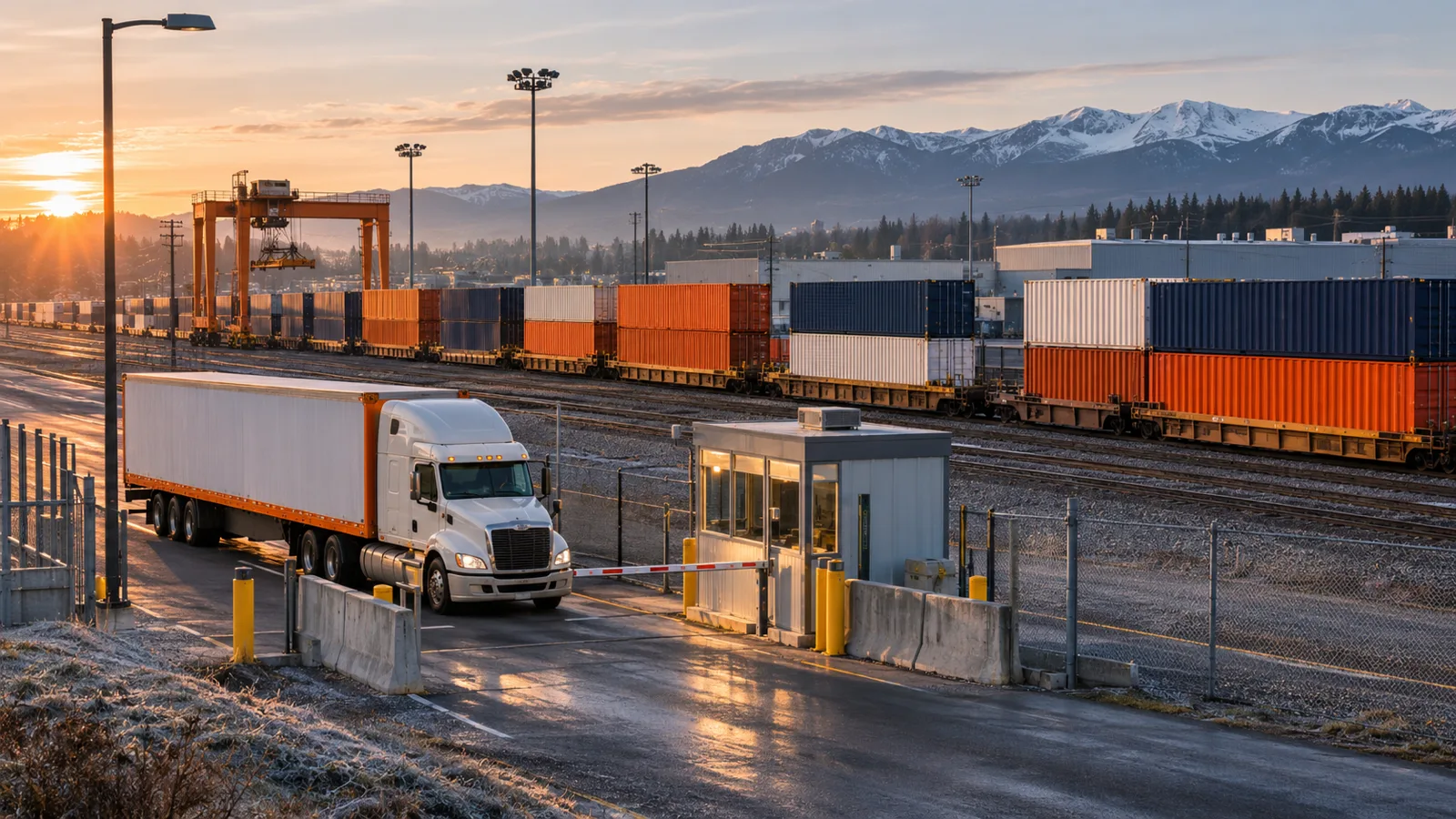
Rail freight leaves from intermodal terminals in the GTA, with Canada's two major railways operating facilities in the region, including terminals in Brampton and Vaughan. Containers and trailers are trucked to the rail terminal, loaded onto trains, moved west and then trucked from the destination terminal to the consignee.
Parcel networks move through carrier hubs in and around Mississauga and the airport lands, then use a combination of linehaul trucking and, for faster services, air freight via Toronto Pearson.
Option 1: Rail Intermodal
How it works
Your goods are loaded into a domestic container or trailer, either at your facility or at a warehouse, then drayed to a rail terminal. The railway carries the box west, and another truck delivers it from the destination terminal. A logistics provider or intermodal marketing company usually arranges the full door-to-door move. Our explainer on drayage covers the short truck moves at each end.
Where it shines
- Full loads of non-urgent freight. When you can fill a container and the delivery window is flexible, rail is often the most economical way to move goods across the country.
- Heavy, dense products. Rail handles weight efficiently, which suits building materials, packaged foods, beverages and similar goods.
- Regular replenishment. If you ship to the same western warehouse every week, rail can become a reliable conveyor belt once the schedule is set.
- Lower emissions per tonne. Rail is generally more fuel-efficient than trucking for long distances, which matters to businesses tracking their carbon footprint.
Where it struggles
- Transit time. Rail is usually slower than a team truck, and the total door-to-door time includes terminal handling at both ends.
- Variability. Weather in the mountains, network congestion and terminal backlogs can stretch transit time, sometimes significantly.
- Extra handling. Containers are lifted and moved, so freight must be loaded and braced well to avoid shifting.
- Small volumes. A few pallets do not justify a whole container unless they are consolidated with other freight.
Option 2: Truck (Full Truckload and LTL)
Full truckload
A full truckload shipment dedicates a trailer to your freight from origin to destination. There is no intermediate handling, which reduces the chance of damage, and transit time is more predictable than rail. Solo drivers are limited by hours-of-service rules, so a Mississauga-to-Vancouver run takes several days. Team drivers, who alternate driving and resting, can move freight considerably faster at a higher cost.
Full truckload makes sense for time-sensitive full loads, high-value goods that should not be transferred, and freight that needs special equipment such as a temperature-controlled reefer trailer or a flatbed.
Less-than-truckload
When you have between one and several pallets, LTL freight lets you share trailer space with other shippers. Freight is picked up, consolidated at a terminal, moved west on linehaul trailers and delivered from a destination terminal. LTL is usually the default for small B2B orders going to Winnipeg, Regina, Saskatoon, Edmonton, Calgary or Vancouver.
The trade-offs are more handling, because freight moves through terminals, and more variables in pricing. Freight class or density, accessorial services such as liftgate or residential delivery, appointment requirements and fuel surcharges all affect the final invoice. Our guide on how freight differs from small-package shipping is a useful primer.
Seasonal realities
Winter is the biggest wild card on western lanes. Highway closures in Northern Ontario and the mountain passes of British Columbia can hold up trucks for hours or days. Build buffer time into delivery commitments from roughly November to March, and communicate with customers early when weather is forecast.
Option 3: Small-Parcel Networks
For individual cartons, especially direct-to-consumer orders, parcel carriers are the obvious choice. Ground parcel services move across the country on scheduled linehaul trucks and typically reach western provinces in about a week, though this varies by carrier and destination. Expedited services use air for part of the journey and arrive faster at a higher price.
Parcel works best for:
- Ecommerce orders to consumers in Western Canada.
- Small B2B replenishment of a few cartons.
- Samples, spare parts and urgent single items.
Parcel becomes expensive when cartons are large or heavy, because dimensional weight pricing and oversize surcharges kick in. At some point, often when a single shipment reaches several cartons going to one business address, consolidating them on a pallet and moving it via LTL is cheaper. ShipCarte's small parcel shipping service can help compare those break points.
Side-by-Side Comparison
Here is a qualitative comparison to help frame decisions. Actual transit times and rates depend on carrier, season, origin and destination details, and the specifics of your freight.
- Cost per unit for large volumes: Rail is usually lowest, full truckload next, and LTL and parcel highest per kilogram.
- Speed: Team full truckload and expedited parcel are fastest; solo truckload and standard parcel are moderate; rail and LTL tend to be slower and more variable.
- Handling and damage risk: Full truckload has the least handling; rail and LTL involve more transfers; parcel involves many automated sort points.
- Minimum practical shipment: Parcel starts at a single carton; LTL at one pallet; truckload and rail work best with full or near-full loads.
- Predictability in winter: All modes are affected; rail and truck routes through the mountains are both exposed to weather.
A Practical Decision Framework
When a shipment to Western Canada lands on your desk, run through these questions in order:
- How much is going? Single cartons point to parcel. A few pallets point to LTL. A full trailer opens up truckload and rail.
- When does it need to arrive? If the date is fixed and tight, eliminate the slowest options first.
- What is it worth, and how fragile is it? High-value or fragile goods favour fewer transfers.
- Does it need temperature control? Food, beverages, pharmaceuticals and some chemicals may need heated or refrigerated equipment, especially in winter when freezing is a real risk on the Prairies.
- Is the delivery address a business with a dock? Residential addresses, construction sites and locations without docks add accessorial charges for LTL and truckload.
- Is this a one-off or a recurring flow? Recurring volume justifies setting up a rail program or a dedicated carrier relationship.
When Forward Stocking in the West Makes Sense
If your western customer base grows large enough, it may be more efficient to stop shipping each order across the country and instead move inventory in bulk to a warehouse in the West, then fulfil orders locally from there. Bulk replenishment can travel by rail or truckload at lower cost per unit, while customers in Calgary or Vancouver receive their orders faster.
The trade-off is more inventory in the system and the need to manage stock across two locations. A good inventory management platform that shows stock by location makes that much easier. ShipCarte's distribution services can help design a network that matches your order profile.
Preparing Freight for a Cross-Country Trip
Long-haul freight takes a beating. A few habits protect your goods regardless of mode:
- Use sound pallets and stack cartons squarely, without overhang.
- Stretch-wrap pallets tightly and use corner boards for heavier loads.
- Label every carton and every pallet with consignee details and handling instructions.
- Provide accurate weights and dimensions to avoid reclassification charges.
- Protect freeze-sensitive products with heated service in winter.
- Keep a copy of the bill of lading and photos of the loaded freight. Our article on the bill of lading explains why that document matters.
Back to the Meadowvale Distributor
For the housewares distributor in our opening example, a sensible starting plan might look like this: send the initial twelve-pallet order by full truckload to make the first delivery date with minimal handling, then shift ongoing weekly replenishment to LTL or a scheduled rail program once order patterns are clear. Urgent top-ups for individual stores could go by parcel. As the account grows, they could review whether forward stocking in Alberta makes sense.
The point is not that one mode wins. It is that each shipment should travel on the mode that fits its size, urgency and value.
Let ShipCarte Map Your Western Lanes
ShipCarte helps Mississauga shippers move parcels, LTL and truckload freight to customers across Western Canada, and can help you weigh the options shipment by shipment. Request a quote for your next western shipment, or schedule a consultation to plan a longer-term program.