
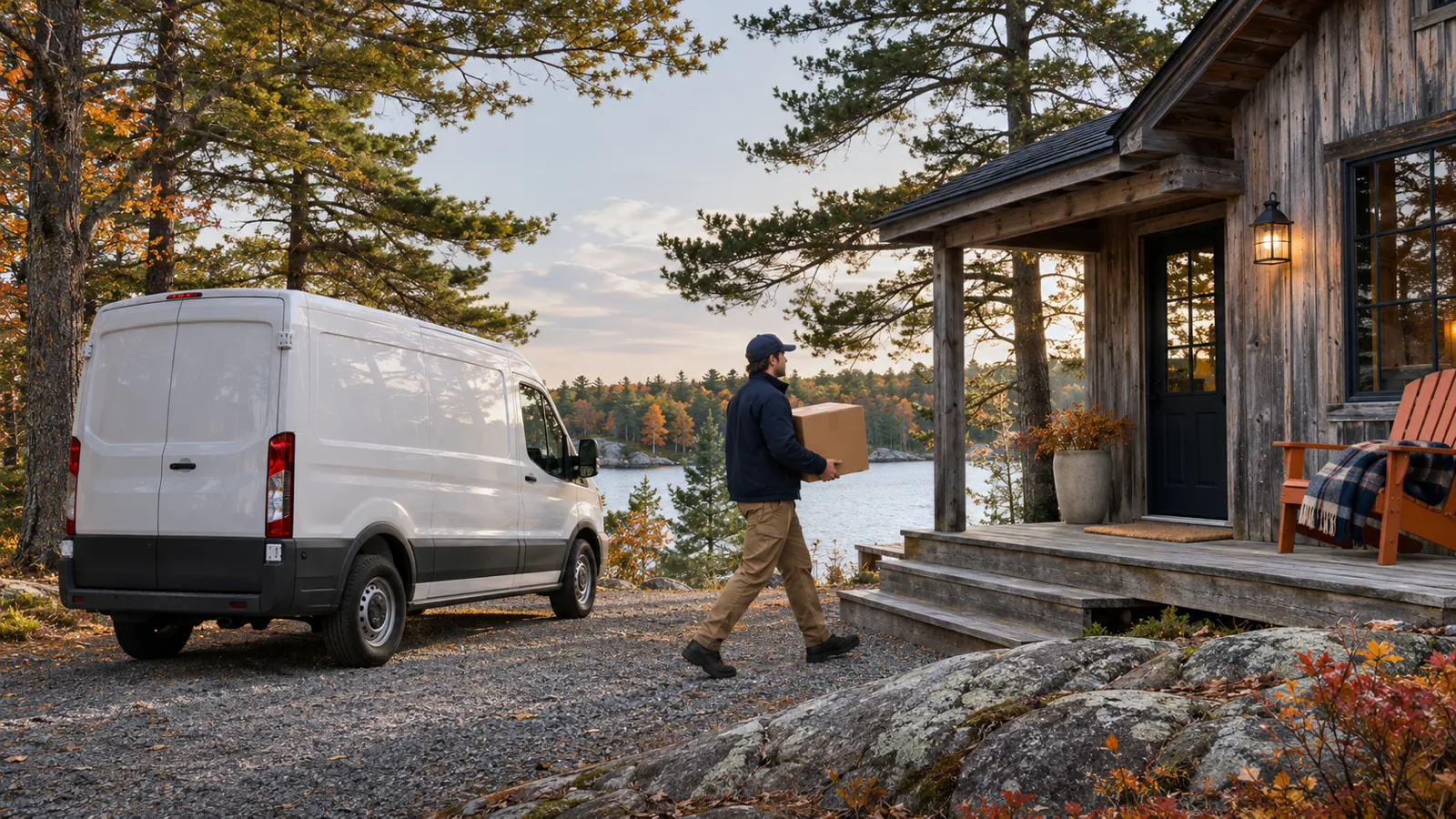
Every spring, a Mississauga company that sells outdoor furniture and dock accessories sees the same pattern in its order book. As soon as the snow melts, customers start ordering Muskoka chairs, kayak racks and solar lights for their cottages. The orders look like any others at checkout, but delivering them is a different story. Addresses read "Lot 12, Concession 4" or simply list a road name with no number. Some properties sit at the end of a long, unmaintained lane. A few are accessible only by boat.
Cottage country, which for most people in the Greater Toronto Area means Muskoka, Haliburton, the Kawarthas, Parry Sound and the Georgian Bay shoreline, is only a few hours' drive north of Mississauga. For many shippers, it might as well be another world. Carriers that deliver effortlessly to Erin Mills or Streetsville can struggle with rural addresses, seasonal access and long distances between stops.
This article answers the questions Mississauga businesses ask most often about shipping to cottage country and rural Ontario, whether you are an ecommerce brand selling seasonal goods, a contractor sending materials to a renovation site, or a supplier serving resorts and marinas.
Why is shipping to cottage country harder than shipping to the city?
Several factors combine to make rural and cottage deliveries more complex.
- Distance and density: a driver in Mississauga might make many stops in a single neighbourhood. In cottage country, stops can be many kilometres apart, so each delivery takes more time and fuel.
- Addressing: rural properties may use civic numbers that do not appear in every carrier's database, older lot-and-concession descriptions, or rural route designations. Mapping software does not always place them accurately.
- Access: private roads, steep driveways, gates and seasonal lanes can make it difficult for a truck, especially a large one, to reach the door.
- Seasonality: many cottages are occupied only in summer. Deliveries made when nobody is there may be left unattended for weeks, or returned.
- Carrier coverage: some carriers hand off rural deliveries to partner carriers or local agents, adding time and an extra point of handling.
For a broader look at the differences between the first and final legs of a delivery, see our explainer on first-mile and last-mile delivery.
What routes do shipments from Mississauga usually take?
Most freight heading north from Mississauga uses Highway 410 or 427 to reach Highway 401 or 407, then Highway 400 north toward Barrie. From there, Highway 11 continues toward Gravenhurst, Bracebridge and Huntsville, while Highway 400 continues toward Parry Sound. Shipments to the Kawarthas and Haliburton often head east and north via Highway 35 or other routes. Summer weekend traffic on Highway 400 is notoriously heavy, which affects both carriers and anyone driving goods up themselves.
Parcel carriers generally move freight from GTA terminals to regional facilities overnight, then out for delivery the following day or later depending on the destination. Remote properties may take longer than published transit times suggest.
Will I pay more to ship to rural addresses?
Often, yes. Many carriers apply remote or extended area surcharges to rural postal codes, and these can apply to parts of cottage country. The surcharge varies by carrier and by postal code. Freight shipments may also carry accessorial charges for residential delivery, limited access, liftgate service or extra time on site.
The best way to understand your actual costs is to rate real cottage-country postal codes across several carriers before setting your shipping prices. Our article on shipping costs for Mississauga ecommerce breaks down how these charges stack up on an invoice. A multi-carrier shipping platform lets you compare rates for the same postal code side by side, since the cheapest carrier to a downtown address may not be the cheapest to a rural one.
How do I reduce failed deliveries?
Collect better address information
Ask customers for a civic (911) address where one exists, and add an optional field for delivery instructions such as "blue gate, second driveway past the marina." These instructions should flow through to the carrier label or delivery notes.
Confirm a phone number
Rural drivers frequently call ahead when an address is unclear. A valid phone number can be the difference between a delivery and a return.
Ask about occupancy
For seasonal goods, a simple checkout question such as "Will someone be at the property to receive this?" helps avoid packages sitting on a porch for weeks. Some customers will choose to ship to their city address or a local pickup point instead.
Offer pickup options
Many towns in cottage country have carrier pickup points or post offices. For customers on island properties or with difficult access, shipping to a pickup location in Bracebridge, Huntsville or Minden can be more reliable than attempting door delivery.
What about large or heavy items?
Furniture, boat accessories, building materials and appliances travel as freight rather than parcels. This introduces more considerations.
- Truck size: a full-size tractor-trailer may not be able to navigate narrow cottage roads. Smaller straight trucks with liftgates are common for final delivery.
- Curbside versus inside delivery: standard freight delivery is usually to the curb or end of the driveway. Getting goods down to a waterfront cottage or onto a deck may require additional service or the customer's help.
- Spring road restrictions: many rural Ontario municipalities impose reduced load limits on certain roads during the spring thaw to prevent damage. Heavy deliveries may need to wait or use smaller vehicles during that period. Check with the municipality if timing matters.
- Appointments: freight carriers usually call to schedule rural deliveries, which helps ensure someone is there to receive and inspect the shipment.
For loads of several pallets, LTL freight is usually the most economical option, with final-mile delivery arranged through a carrier that serves the region regularly.
Can I ship perishables to the cottage?
Perishable goods, such as specialty foods, meal kits or beverages, are possible but require more care. Transit times to rural areas can be longer, and summer heat in the region can be intense. Insulated packaging, ice packs or dry ice and conservative transit-time estimates are essential. Dry ice is regulated as a dangerous good in certain transport modes, so packaging and labelling must follow the rules. ShipCarte's cold chain fulfillment service covers how temperature-sensitive orders are typically packed and routed. Avoid shipping perishables late in the week, when a delay could leave a package sitting over the weekend.
How should seasonal businesses plan inventory?
Demand for cottage-related products spikes sharply in late spring and early summer, then drops through fall. Businesses selling into this market should plan stock levels around that curve, with inventory in place before the May long weekend, when many cottagers open their properties. Holding inventory in a Mississauga warehouse is practical, because the city's highway access means goods can head north quickly once orders come in. Seasonal overflow storage and flexible ecommerce fulfillment can absorb the peak without committing to year-round space.
What about businesses in cottage country receiving supplies?
Resorts, marinas, restaurants and contractors in Muskoka and similar regions often source supplies from the GTA. For these businesses, consolidating orders into fewer, larger shipments is usually more efficient than receiving many small parcels. A Mississauga distributor that builds a weekly consolidated pallet for a regional customer can offer more predictable delivery and lower cost per unit than shipping individual cartons as orders come in.
Do water-access properties need a different plan?
Yes. Island cottages and properties reachable only by boat cannot receive door delivery from a standard carrier. The usual approach is to ship to the marina the owner uses, to a pickup point in the nearest town, or to a mainland address such as a neighbour's or a storage facility, and have the owner ferry goods across. Some marinas accept deliveries on behalf of their customers, but policies vary, so the customer should confirm before ordering. For heavy items such as dock hardware or building materials, a barge service may be needed for the final leg, which the customer typically arranges locally.
If your business sells products commonly bought for water-access properties, it is worth adding a note at checkout explaining these options. Clear expectations up front prevent the frustration of a failed delivery and a return trip to Mississauga.
What changes in fall and winter?
After Thanksgiving, many cottages close for the season. Deliveries to closed properties risk sitting outside through freezing weather, or being returned as undeliverable. Year-round residents and winterized cottages still receive shipments, but snow, ice and unplowed private lanes can make access difficult. Carriers may leave freight at the end of an unplowed driveway or reschedule until access improves. Liquids and other freeze-sensitive goods need extra protection, and transit times can stretch when storms close stretches of Highway 400 or Highway 11. Building a little extra time into winter delivery promises keeps customers on side.
A Quick Checklist for Cottage Country Shipments
- Capture a civic address, delivery instructions and phone number at checkout.
- Rate rural postal codes across multiple carriers before setting shipping prices.
- Warn customers that transit times to remote areas may be longer.
- Offer local pickup points as an alternative for hard-to-reach properties.
- Book freight deliveries with appointments and confirm truck access.
- Watch for spring load restrictions on heavy shipments.
- Pack perishables for longer transit and ship early in the week.
Ship North With Confidence
Cottage country is close enough to Mississauga to feel like a local delivery, but rural addressing, seasonal access and longer distances make it a different kind of shipment. With good address data, the right carrier for each postal code and realistic expectations, deliveries can be reliable. If you ship seasonal goods or freight to Muskoka and rural Ontario and want help comparing carriers or planning peak-season inventory, request a quote from ShipCarte.