
A small-batch hot sauce maker in Streetsville gets an email from a customer in Calgary: the parcel arrived soaked, the label was smeared, and two of the three bottles were cracked. A week later a different customer receives a perfectly intact order. Same product, same box, same carrier. The difference was luck, and luck is not a shipping strategy.
Liquids are among the trickiest items to ship by parcel. They are heavy for their size, they slosh, glass breaks, plastic caps loosen with changes in air pressure, and a single leak can ruin every other parcel sharing that cage or conveyor. Some liquids are also regulated as dangerous goods, which changes how they can move at all. And in Mississauga, there is a seasonal twist: from roughly December to March, water-based products can freeze in an unheated trailer.
This guide covers how to pack liquids so they arrive intact, how to tell whether your product is restricted, and what Mississauga shippers should think about when choosing carriers and services.
First Question: Is Your Liquid a Dangerous Good?
Before thinking about bubble wrap, figure out what you are shipping. In Canada, the Transportation of Dangerous Goods (TDG) Regulations govern the movement of hazardous materials by road, rail, and ship, and international air shipments follow the IATA Dangerous Goods Regulations. Many everyday consumer liquids fall into regulated classes without their sellers realizing it.
Common examples that are often regulated or restricted include:
- Perfumes, colognes and essential-oil blends with an alcohol base, which are typically classed as flammable liquids.
- Alcohol-based hand sanitizers and cleaning products.
- Nail polish, nail polish remover and some cosmetics.
- Aerosol cans such as dry shampoo, sprays and spray paint.
- Lithium battery-powered devices containing liquids, such as some vape products, which raise both battery and liquid issues.
- Corrosive cleaners and some pool or automotive chemicals.
Products that are usually not dangerous goods include water-based beverages without alcohol, most sauces and syrups, many lotions and shampoos, and liquid supplements. The product's Safety Data Sheet (SDS), especially Section 14 on transport information, is the most reliable place to check. If it lists a UN number and a hazard class, treat it as a dangerous good and plan accordingly.
Many consumer-size products can ship under reduced requirements such as "limited quantity" provisions, but those still come with packaging, marking and documentation rules, and some carriers or services do not accept them at all, particularly for air. Shippers who handle dangerous goods generally need staff trained under TDG, and for air, under IATA rules. If you are not sure, ask before you ship. For a specific example, our article on how to ship perfume safely walks through one of the most common cases.
Alcohol Is Its Own Category
Wine, beer, spirits and cider raise a separate issue beyond transport safety: provincial liquor laws. Shipping alcohol directly to consumers in Canada is controlled province by province, and many carriers either do not accept alcohol for consumer delivery or only do so for licensed shippers under specific agreements. If you are an Ontario producer or retailer, check your licensing obligations and your carrier's alcohol policy before planning any direct-to-consumer program. Do not assume that because a parcel was accepted once, it is permitted.
How to Pack Liquids So They Do Not Leak
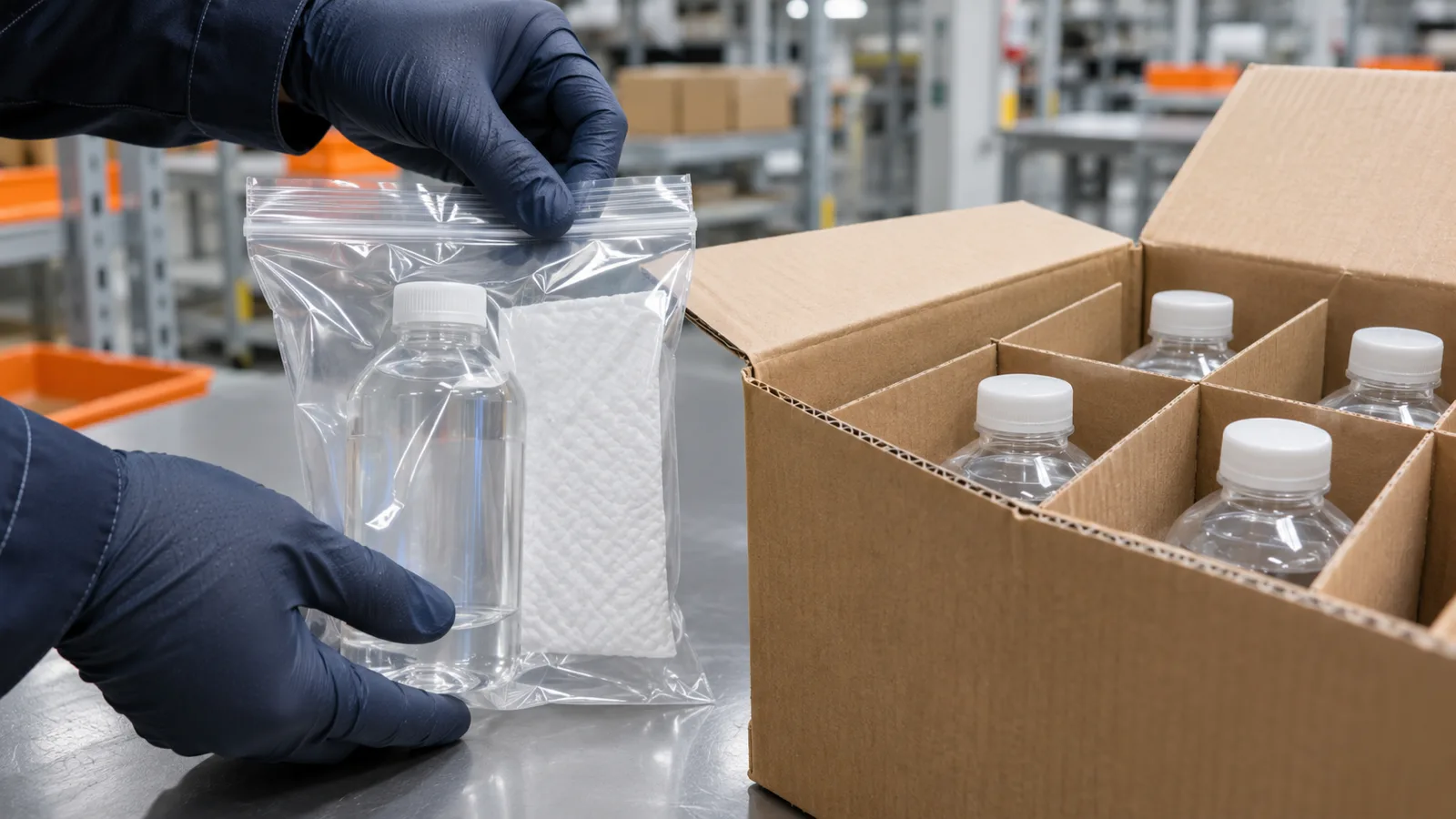
For non-hazardous liquids, good packaging comes down to a principle sometimes called "triple packaging": a sealed primary container, a leak-resistant secondary layer with absorbent material, and a sturdy outer box. Here is how that looks in practice.
1. Secure the Primary Container
Start with the bottle, jar or pouch itself. Tighten caps fully. For screw caps, add an induction seal, a shrink band, or wrap the cap and neck with tape to stop it backing off from vibration. Pump dispensers and flip-top lids should be locked or replaced with travel caps where possible. Leave a little headspace in containers you fill yourself, because liquids expand with temperature changes.
2. Bag It
Place each primary container in a sealed plastic bag. Zip-top bags work for small products; heat-sealed poly bags are better at volume. If something leaks, the bag contains it, protecting the other items in the order and the carrier's equipment.
3. Add Absorbent Material
Put an absorbent pad or material inside the bag or around it, enough to soak up the contents if the container fails. This is standard practice for regulated liquids and a smart habit for everything else.
4. Separate and Cushion
Glass bottles should never touch each other. Use cardboard dividers, molded pulp inserts or foam cut-outs. For single items, wrap with bubble wrap and centre the bottle in the box with at least a few centimetres of cushioning on every side. The goal is for the container not to move when you shake the closed box.
5. Use a Strong Outer Box
Liquids are dense, so a box that holds a jacket comfortably may collapse under a case of bottles. Choose corrugated boxes rated for the weight you are shipping, and use double-wall cartons for heavier multi-bottle orders. Tape all seams with the H-method.
6. Orient and Mark
Pack bottles upright. Orientation arrows ("this way up") help, though parcels are handled by conveyors and sorters, so the packaging must protect the product in any position. Do not rely on markings alone.
If you sell food-grade liquids, see our guide on food and beverage fulfillment for additional considerations around shelf life and lot tracking.
The Mississauga Winter Problem
Parcel networks do not always keep product warm. Trailers, sortation facilities and delivery vans can sit well below freezing during a southern Ontario cold snap, and a parcel heading north or west across the Prairies can spend much longer in the cold. When water-based products freeze, they expand, which can crack glass, split plastic and push off caps. Some products, such as emulsions, also separate or lose quality when frozen and thawed.
Practical steps for winter shipping from Mississauga include:
- Shipping early in the week so parcels do not sit in a depot over a weekend.
- Choosing faster services for freeze-sensitive goods during the coldest months.
- Adding insulated liners or thermal bubble mailers for short-transit orders.
- Avoiding shipments to remote destinations during extreme cold warnings, or holding them for a few days.
- Telling customers on your product page if you pause liquid shipping in very cold weather.
For products that need active temperature protection all year, such as some pharmaceuticals or fresh beverages, look at dedicated cold chain fulfillment rather than trying to manage it with standard parcels.
Carrier Restrictions: What to Check
Every carrier publishes its own rules for liquids and prohibited items, and those rules change. Rather than memorizing them, build a habit of checking a few points for each carrier you use:
- Is the liquid accepted at all? Check prohibited and restricted item lists.
- Are there quantity limits? Some services cap the volume per container or per package.
- Ground versus air. Many restricted liquids can move by ground within Canada but not by air. That matters for expedited services, which may route parcels by air without you choosing it explicitly.
- Cross-border rules. US-bound liquids may face additional restrictions from both carriers and US agencies. Food and cosmetic products, for example, may need to meet US FDA requirements.
- Packaging specifications. Some carriers specify absorbent material, sealed inner bags or minimum box strength.
- Claims eligibility. Find out whether damage to liquids is covered if packaging rules were not followed. Often it is not.
Using a multi-carrier shipping platform makes it easier to route liquid orders to the carrier and service level that actually accepts them, rather than sending everything through one default service and hoping.
Frequently Asked Questions
Can I ship glass bottles by courier?
Yes, glass is generally accepted as long as it is packed to withstand normal handling. Separating each bottle, using inserts or dividers, and choosing a box with proper crush strength are what make the difference. Expect that claims for broken glass may be refused if packaging was inadequate.
Do I need special labels for liquids?
Non-hazardous liquids usually do not need special hazard markings, though orientation arrows are good practice. Dangerous goods, including limited-quantity shipments, require specific marks and documentation set by TDG and, for air, IATA rules.
Why do pouches and plastic bottles still leak?
Changes in pressure and temperature during transit can push liquid past caps that seemed tight, and repeated vibration can loosen threads. Shrink bands, induction seals or taped caps, plus a sealed bag around each item, solve most of these issues.
Is dimensional weight a concern for liquids?
Liquids are usually heavy relative to their size, so actual weight often drives the price rather than dimensional weight. However, oversized boxes with lots of cushioning can tip the balance. Our article on how package dimensions affect shipping costs explains the calculation.
Can a 3PL handle liquids for me?
Many can, and it is often worth it once your volumes grow. A fulfillment partner with established packing standards, the right materials on hand and carrier accounts that accept your product removes much of the trial and error. Ask any prospective partner specifically about leak packaging, winter shipping practices and whether they handle dangerous goods.
A Quick Pre-Shipment Checklist
- SDS checked; product confirmed as non-hazardous or properly classified.
- Caps tightened and sealed with tape, shrink band or induction seal.
- Each container bagged with absorbent material.
- Bottles separated by dividers or inserts; no contact between glass.
- Box rated for the total weight; seams taped.
- Shake test passed with no movement inside.
- Carrier and service confirmed to accept the product, including air routing.
- Weather and transit time considered for freeze risk.
Ship Liquids With Confidence
Leaks and breakage are avoidable with the right packing method, accurate product classification and a carrier choice that fits the product. ShipCarte helps brands in Mississauga and across Canada handle e-commerce fulfillment for products that need a little more care. If liquids are part of your catalogue, request a quote and tell us about your products, packaging and shipping destinations.