
An industrial supply company near Tomken Road ships most of its orders as parcels: gloves, fittings, small tools. Then a customer in Sudbury orders a bench grinder, a parts washer and four cases of degreaser. The warehouse team tapes everything into a few heavy boxes, prints courier labels and sends them off. The invoice that arrives a week later is full of surcharges for weight and handling, one box arrives with a cracked housing, and the customer asks why it came in four separate deliveries over three days.
Nothing about that order was unusual. It simply crossed an invisible line where parcel shipping stops being the cheapest, safest option and freight starts to make more sense. Many Mississauga businesses cross that line every week without noticing, because the default in the shipping software is always "parcel."
This article explains where the line usually falls, how parcel and less-than-truckload (LTL) freight compare for heavy goods, and how to make the call order by order.
How parcel networks treat heavy packages
Parcel networks are built for speed and volume. Packages move on conveyors and through automated sorters, handled individually many times between pickup and delivery. They work brilliantly for boxes a person can lift comfortably. They struggle as packages get heavier, larger or more awkward.
- Weight limits: each carrier sets a maximum weight per package, and those limits vary by carrier and service. National postal services generally have lower limits than the major courier networks. Above the limit, a package simply cannot travel as a parcel.
- Size limits: there are also maximums on length and on combined length and girth. Long items like flooring, pipe or furniture components can hit these before they hit weight limits.
- Surcharges: well before the hard limits, carriers typically add charges for packages that are heavy, large, irregularly shaped or not fully enclosed in corrugated cardboard. These can significantly increase the cost of a single box.
- Dimensional weight: parcel pricing uses the greater of actual weight and dimensional weight, so a bulky but light item may cost as much as a heavy one.
- Damage risk: heavy boxes on conveyors are more likely to crush other parcels and to be dropped or damaged themselves.
How LTL freight works differently
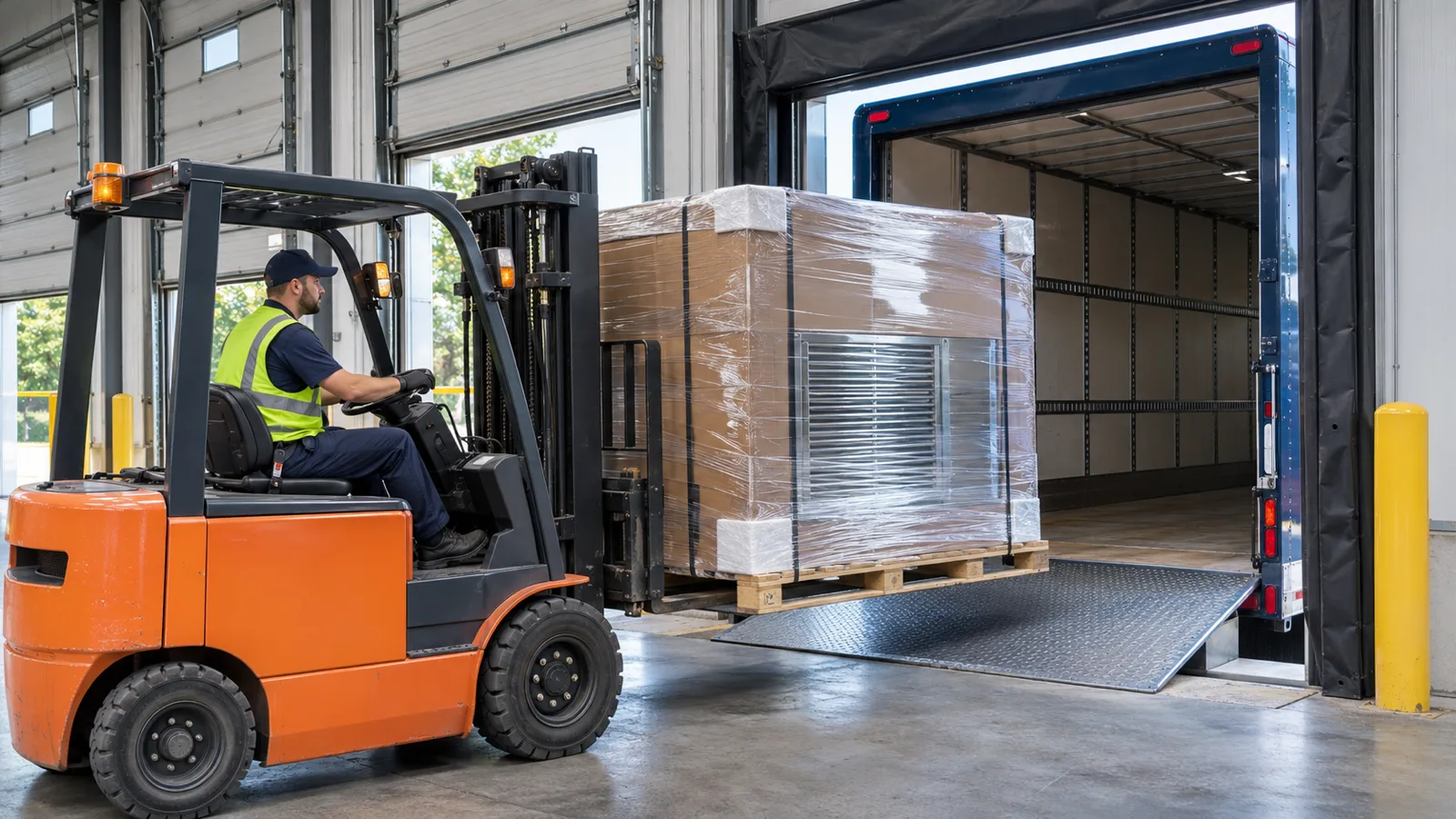
LTL freight moves goods on pallets or skids, loaded onto trailers with other shippers' freight, typically by forklift rather than by hand. Shipments pass through terminals where they are cross-docked onto line-haul trailers and then to local delivery trucks. Pricing usually considers weight, dimensions or density, distance, the nature of the goods and any accessorial services such as liftgate delivery or residential delivery.
Because the pallet is handled as a single unit by equipment designed for it, heavy and awkward items are often safer as freight than as a stack of separate parcels. Multiple boxes going to the same address arrive together. And for consolidated heavy shipments, the cost per kilogram is often lower.
The trade-offs are that LTL can be slower than express parcel services, delivery appointments are often needed, and residential or limited-access deliveries carry extra charges. Our explainer on delivery appointments in freight covers what to expect.
Parcel vs. LTL at a glance
Parcel tends to win when
- Each box can be lifted comfortably by one person and stays well under carrier weight limits.
- The shipment is one or two boxes.
- The destination is a residence and speed matters.
- The product is robust and well packed in standard cartons.
LTL tends to win when
- Individual items are heavy or bulky enough to trigger parcel surcharges.
- Several boxes are going to the same address and can be palletised.
- The destination is a business with a loading dock or forklift.
- The item is fragile, awkward or unboxed, such as machinery, stone or large equipment.
- The shipment's total weight would make multi-parcel pricing expensive.
Three Mississauga scenarios
The fitness equipment retailer
A retailer in Heartland Town Centre's commercial area sells home gym equipment online. Dumbbells and resistance bands ship easily as parcels. Squat racks and treadmills, boxed at well over parcel-friendly weights, do not. The smart approach is to split the catalogue: light accessories through parcel, heavy equipment through LTL with residential delivery and, where customers pay for it, inside delivery. Pricing at checkout should reflect the different costs so margins are not wiped out on heavy orders.
The B2B parts distributor
A distributor in the Airport Corporate Centre area ships replacement parts to garages and plants across Ontario. Orders vary from a single gasket to dozens of cartons. A simple rule in its shipping system, such as "if the order exceeds a set total weight or carton count, rate it as LTL as well as parcel and choose the cheaper," catches the orders that cross the line. The heavy ones go out on a pallet, arrive together and avoid surcharges.
The furniture start-up
A furniture brand stores flat-packed tables in a Mississauga warehouse. Each table is shipped in two long boxes that exceed parcel length limits. Here freight is the only option, and the real question is which service level to offer: curbside, threshold or room-of-choice delivery. Our article on white-glove delivery in Mississauga explores those options.
How to make the call order by order
- Record accurate weights and dimensions for every product and packaging combination. Bad data causes bad mode decisions.
- Set thresholds in your shipping platform, such as per-box weight, total order weight or number of cartons, that trigger an LTL rate check.
- Compare landed cost, not just base rate. Include surcharges for parcel and accessorials for freight, such as liftgate, residential, inside delivery and appointments.
- Consider damage risk and customer experience, not just price. A cheaper parcel shipment that arrives broken is not cheaper.
- Review monthly. Look at orders shipped as parcel that incurred heavy surcharges, and at freight shipments that could have gone parcel. Adjust thresholds accordingly.
Packing heavy goods for freight
Moving to freight does not remove the need for careful packing. Good practice for heavy items includes:
- Use a sound pallet sized to the load, with no overhang. Overhanging cartons get crushed.
- Stack the heaviest items at the bottom and keep the centre of gravity low.
- Strap or band heavy items to the pallet, then stretch-wrap the whole load tightly, including around the pallet itself.
- Use corner boards and top sheets to spread the load and protect edges.
- Crate items that are fragile or cannot be safely boxed.
- Label clearly on at least two sides, and mark "do not stack" where needed, understanding that markings help but do not guarantee handling.
- Describe the goods accurately on the bill of lading. Incorrect descriptions or weights often lead to reweigh and reclassification charges.
Accessorial charges that catch heavy shippers out
Freight quotes often look attractive until the accessorials are added. These are charges for services beyond standard dock-to-dock movement, and heavy-item shippers meet them constantly. Knowing them in advance helps you quote customers accurately and avoid billing disputes.
- Liftgate service: needed when the pickup or delivery location has no loading dock or forklift. Common for small businesses, retail storefronts and homes.
- Residential delivery: applies when freight goes to a home, which takes longer and needs smaller equipment.
- Limited access locations: schools, construction sites, farms, storage facilities and some mixed-use buildings can attract extra charges.
- Inside delivery: moving the freight beyond the door or loading area.
- Appointment or notification: calling ahead or booking a delivery time.
- Redelivery and storage: if nobody is available to receive, the carrier may charge for a second attempt or for holding the freight at the terminal.
- Reweigh and reclassification: if the carrier finds the shipment heavier, larger or different from what was declared, the bill is adjusted.
The fix is mostly about information. Ask the receiver up front whether they have a dock, a forklift or any access restrictions, and include the right accessorials when you book. That small step prevents most surprise invoices.
What heavy items mean for your checkout
If you sell heavy products online, the parcel-versus-freight decision also shapes what customers see at checkout. Flat-rate shipping that works for light products can lose money on a heavy order, while real-time freight rates can confuse shoppers. Many retailers handle this by setting product-level shipping rules: standard rates for parcel-friendly items, a fixed freight charge or "freight delivery" tier for heavy items, and clear messaging about delivery appointments and liftgate service. Being upfront prevents the abandoned carts and angry calls that come when a customer expects a courier at the door and gets a call from a freight terminal instead.
Insurance and liability
Carrier liability for freight is usually limited and may be far less than the value of high-value equipment. Check the carrier's standard liability and consider additional cargo insurance for valuable shipments. Document condition with photos before pickup. Our post on freight insurance explains the options.
Why Mississauga is a good base for freight
Mississauga sits among some of the busiest freight corridors in Canada. Many LTL carriers have terminals in Mississauga, Brampton and the surrounding area, and the 401, 403, 407, 410 and 427 connect quickly to routes across Ontario, to Quebec and to the US border crossings. For shippers, that means plenty of carrier choice and frequent pickups, which helps keep transit times and costs competitive.
Let us help you draw the line
ShipCarte helps businesses ship the right way for every order. Our small parcel shipping and LTL freight services sit side by side, and our shipping platform makes it easy to compare modes. For larger volumes, full truckload is available too. If heavy orders are eating your margins, request a quote and we will look at your lanes and order profile with you.