
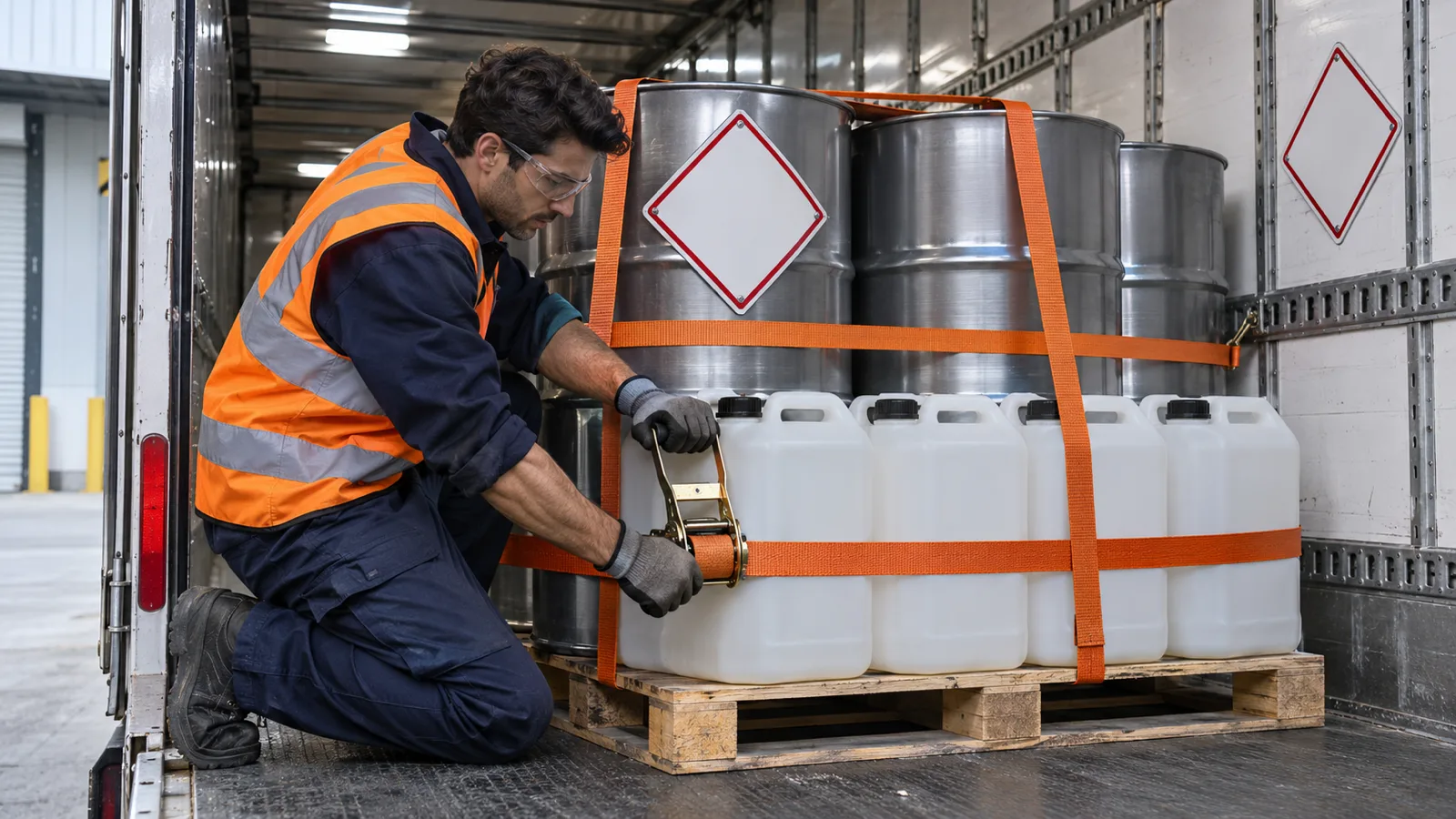
Plenty of Mississauga businesses ship dangerous goods without thinking of themselves as hazmat shippers. A cleaning products distributor near Dixie Road sends pallets of disinfectant and degreaser. An e-commerce brand in Erin Mills sells perfume, nail polish and aerosol dry shampoo. An industrial supplier in Gateway ships paints, adhesives and compressed gas cylinders. A tech reseller ships laptops and power banks every day. Every one of them is offering dangerous goods for transport, and every one of them has legal obligations under Canada's Transportation of Dangerous Goods (TDG) rules.
Mississauga knows better than most cities why those rules matter. The 1979 train derailment here, involving tank cars of chlorine and other chemicals, led to one of the largest peacetime evacuations in North American history and helped shape how Canada regulates dangerous goods in transport. Today, the TDG Act and Regulations, administered by Transport Canada, set out what shippers, carriers and receivers must do.
This article is a practical overview, organized around the questions every shipper has to answer before a dangerous good leaves the dock. It's not a substitute for TDG training or the regulations themselves, but it will help you understand where your responsibilities lie.
Question 1: Is My Product a Dangerous Good?
Classification is the shipper's responsibility, and everything else depends on it. The TDG Regulations divide dangerous goods into nine classes:
- Explosives (including some fireworks and ammunition).
- Gases (aerosols, compressed and liquefied gases, such as propane or CO2 cylinders).
- Flammable liquids (many solvents, paints, perfumes, alcohol-based sanitizers).
- Flammable solids and substances liable to spontaneous combustion.
- Oxidizing substances and organic peroxides (some pool chemicals, hair bleach developers).
- Toxic and infectious substances (certain pesticides, diagnostic specimens).
- Radioactive materials.
- Corrosives (many acids, alkaline cleaners, wet batteries).
- Miscellaneous products, substances or organisms (including lithium batteries and some environmentally hazardous substances).
Start with the product's Safety Data Sheet. Section 14, "Transport Information," usually lists the UN number, shipping name, class and packing group. If that section is blank or says "not regulated," confirm it rather than assuming, especially for consumer products whose formulas have changed. If you're the manufacturer or importer, classification may require a qualified person's review.
Question 2: Who in My Company Needs TDG Training?
Anyone who handles, offers for transport or transports dangerous goods must be adequately trained and hold a training certificate, or work under the direct supervision of someone who is. That typically includes the people who classify products, prepare shipping documents, pack and label shipments, and load trucks.
Key points about training:
- The employer issues the training certificate once the employer is satisfied the employee is adequately trained for their specific duties.
- Certificates for road transport have a set expiry and must be renewed through retraining.
- Training for air or marine transport follows different requirements; air shipments follow the ICAO Technical Instructions and, in practice, the IATA Dangerous Goods Regulations.
- Employees must be able to show their certificate to an inspector on request.
For warehouses that pack and ship on your behalf, confirm that the staff handling your products are trained for the classes involved.
Question 3: Does My Shipment Qualify for an Exemption?
Many everyday shipments don't need the full set of TDG requirements because they qualify for exemptions. The most commonly used include:
- Limited quantities. Dangerous goods packed in small inner containers, within limits set by the regulations for each product, can ship with reduced requirements. Packages carry the limited quantity mark instead of full class labels, and in many cases a shipping document isn't required for road transport.
- Excepted quantities. Very small amounts of certain goods, packed to specific standards, with an excepted quantities mark.
- Special provisions. Specific products have their own exemptions or conditions, such as certain lithium batteries contained in equipment.
- The 500 kg gross mass exemption. Under specific conditions, shipments of certain dangerous goods with a total gross mass of 500 kg or less can be transported with reduced requirements on road vehicles. It does not apply to every class or product.
Exemptions come with conditions, and getting them wrong means the shipment is fully regulated and non-compliant. Read the exact wording that applies to your product.
Question 4: How Must It Be Packed?
Dangerous goods must be packed in a "means of containment" that meets the applicable safety standard. For many products, that means UN-specification packaging, tested and marked to show it's approved for the class and packing group. Limited and excepted quantity shipments have their own packaging requirements.
Good packing practice includes:
- Using packaging rated for the product's packing group and physical state.
- Closing inner containers as specified, with secondary closures or absorbent material where required.
- Orienting liquids upright and marking packages with orientation arrows where required.
- Never mixing incompatible goods, such as oxidizers and flammable liquids, in the same package.
- Following the packaging manufacturer's closure instructions exactly.
Question 5: What Labels, Marks and Placards Are Required?
TDG uses "dangerous goods safety marks" to communicate hazards. They include:
- Labels on packages showing the primary class and any subsidiary class.
- The UN number and shipping name on packages, where required.
- Placards on the outside of trucks and containers when quantities or specific classes require them. As a general rule, placards are needed when a vehicle carries more than 500 kg of dangerous goods, but some goods require placards in any quantity, and exceptions apply.
- Special marks, such as the limited quantity mark, the marine pollutant mark or the lithium battery mark.
Labels must be durable, visible and placed according to the regulations. Old or conflicting labels from previous use must be removed or covered when boxes are reused.
Question 6: What Goes on the Shipping Document?
Unless an exemption applies, a TDG shipping document must accompany the shipment. It typically includes:
- The shipper's name and address.
- The date the document was prepared.
- For each dangerous good, the UN number, shipping name, primary class, subsidiary class if any, and packing group, in the prescribed order.
- The quantity and number of packages.
- A 24-hour emergency telephone number of someone able to provide technical information about the goods.
- An Emergency Response Assistance Plan (ERAP) reference number and activation telephone number, if an ERAP is required for the goods and quantity.
- A shipper's certification statement, where required.
The shipping document can be part of the bill of lading, but the dangerous goods information must be clearly identified. The driver must keep it within reach while driving.
Question 7: Will My Carrier Accept It?
Compliance with TDG doesn't guarantee a carrier will take your shipment. Carriers set their own acceptance policies:
- Parcel carriers usually require a dangerous goods contract or account setup before accepting fully regulated shipments, and some don't accept certain classes at all.
- Air services, including shipments routed through Toronto Pearson, follow stricter air rules. Many products allowed by ground are forbidden or restricted by air.
- LTL carriers may restrict certain classes or require advance notice so they can segregate freight at terminals.
- Some bridges and tunnels restrict dangerous goods. Cross-border shipments to the US must also meet US hazardous materials regulations, which are closely aligned with TDG but not identical.
Talk to your carrier management partner before your first shipment, not on the day it's ready.
Common Mistakes We See
- Assuming consumer products like perfume, nail polish, hand sanitizer or aerosols are not regulated. Our guide on shipping perfume safely covers one common example.
- Shipping lithium batteries or battery-powered devices without the correct marks and documentation.
- Using a limited quantity exemption for inner containers that exceed the limit.
- Missing or outdated 24-hour emergency numbers on shipping documents.
- Untrained warehouse staff packing dangerous goods.
- Reusing boxes with old hazard labels still visible.
A Worked Example: Hand Sanitizer by LTL
Consider a Mississauga distributor shipping eight pallets of alcohol-based hand sanitizer to a customer in Kingston. Here's how the questions above play out.
The Safety Data Sheet identifies the product as a flammable liquid, Class 3, with a UN number, shipping name and packing group listed in section 14. The sanitizer is packed in one-litre bottles, twelve to a case, which may fall within the limited quantity limits for that product. If it does, each case carries the limited quantity mark rather than Class 3 labels, and the reduced requirements apply. If the bottles were larger, such as four-litre refill jugs, the limited quantity exemption might not apply, and the shipment would need full labelling, a shipping document and, at eight pallets, placards on the trailer.
The staff who built and wrapped the pallets and prepared the bill of lading need valid TDG training certificates. The LTL carrier needs to know in advance, because dangerous goods must be segregated from incompatible freight at its cross-dock. And if the same product were heading to a customer in Buffalo, US hazardous materials rules would apply to the US leg as well.
Small details, like the size of the bottle, change the whole compliance picture. That's why classification and exemption checks should happen when the product is set up, not when the truck arrives.
Storing Dangerous Goods in a Warehouse
TDG covers transport, but storage is also regulated through fire codes, municipal requirements and occupational health and safety rules, including WHMIS for workplace hazard communication. Warehouses storing flammable liquids, aerosols or oxidizers often have limits on quantities and specific requirements for segregation and fire protection. If you're placing dangerous goods with a 3PL, ask which classes they can store, in what quantities, and how they're segregated.
Ship Dangerous Goods With Confidence
TDG compliance isn't complicated once the foundations are in place: classify correctly, train your people, use exemptions carefully, pack and mark to standard, document properly, and confirm carrier acceptance in advance. For Mississauga businesses shipping across Ontario, Canada or into the US, that groundwork keeps shipments legal and keeps people safe.
If you need help shipping regulated products by small parcel or LTL freight, schedule a consultation with ShipCarte to talk through your products and lanes.