
An online furniture brand working out of a unit near Dixie Road had a simple product line: solid wood side tables, a couple of bookcases and an upholstered accent chair. Their first few hundred orders went out by parcel courier because it was easy. Then the damage reports started. Corners crushed, legs snapped, a chair arriving with a tear in the fabric. Each one meant a refund, a replacement and a customer who probably would not order again.
Furniture is one of the hardest product categories to ship well. Items are big, heavy, awkwardly shaped and often fragile at the joints. Customers expect them delivered to a home, sometimes up stairs and into a specific room. The economics are tight too: the shipping cost on a large item can rival the product margin if you choose the wrong method.
For sellers based in Mississauga, the good news is that the region has a deep pool of freight carriers, home delivery specialists and warehousing options. The challenge is matching each product to the right one. Here is a practical look at the choices.
Know What You Are Actually Shipping
Before comparing carriers, sort your catalogue into a few groups. Shipping decisions depend far more on these characteristics than on the product name.
- Flat-pack and boxed items that ship in one or two cartons under typical courier size and weight limits.
- Oversized boxed items that exceed parcel limits or trigger heavy surcharges.
- Fully assembled pieces such as upholstered sofas, dining tables or cabinets that cannot be boxed easily.
- High-value or fragile pieces including glass tops, marble, mirrors and antiques.
- Multi-piece sets such as bedroom suites or sectionals that must arrive together.
Record accurate weights and dimensions for every carton. Carriers bill on the greater of actual and dimensional weight, and furniture is often light for its size. Our guide on how package dimensions affect shipping prices explains why a few centimetres can move the price meaningfully.
Option 1: Small Parcel Couriers
Parcel carriers are fast, widely available and easy to integrate with an online store. For flat-pack furniture that fits within their size and weight rules, they can be the most convenient choice, with tracking and doorstep delivery included.
The downsides appear as items get bigger. Large packages often attract additional handling, oversize or large package surcharges. Parcel networks are built around conveyors and sorting machines, so cartons get dropped, stacked and pushed. Packaging has to be robust enough to survive that environment. Small parcel shipping works best for furniture that is genuinely boxed for it.
Option 2: LTL Freight
Less-than-truckload freight moves palletized shipments that share trailer space with other shippers' goods. For larger furniture, it is often more economical and gentler than parcel, because items stay on a pallet and are moved by forklift rather than conveyor.
Residential delivery is where LTL gets more complicated. Most homes have no loading dock, so you will usually need a liftgate truck, a residential delivery fee and possibly a delivery appointment. Standard LTL delivery generally means curbside or to the garage, not into the home. Our post on delivery appointments in freight explains how scheduling works. For business-to-business furniture, such as office fit-outs in the Airport Corporate Centre or hotel projects in City Centre, LTL freight to a commercial dock is often the cleanest option.
Option 3: White Glove and Threshold Home Delivery
For upholstered and fully assembled furniture, many customers expect more than curbside delivery. Home delivery specialists offer levels of service such as:
- Threshold: item brought to the front door or just inside.
- Room of choice: carried to a specific room.
- White glove: room of choice plus unpacking, debris removal and sometimes light assembly.
These services cost more but can sharply reduce damage, failed deliveries and support tickets. Two-person crews are typically used for heavy pieces. In the GTA, condo deliveries add their own layer: booked elevator times, loading bay reservations and building rules about delivery hours. Capture those details at checkout so the carrier has what it needs.
Option 4: Full Truckload and Pool Distribution
If you are moving large volumes to retailers or into regional warehouses, a full truckload from Mississauga can carry a whole store order or a container's worth of stock in one move. A related approach, sometimes called pool distribution, sends a full truck to a regional hub where orders are split and delivered locally. It can reduce handling on long-distance home deliveries to markets such as Ottawa, Montreal or Western Canada.
Comparing the Options at a Glance
There is no single best method. A rough way to decide:
- Boxed, durable, within parcel limits: parcel courier.
- Heavy or bulky but robust, going to businesses: LTL to dock.
- Heavy going to homes, customer comfortable with curbside: LTL with liftgate and appointment.
- Assembled, upholstered or premium: threshold or white glove home delivery.
- Large volumes to one destination: full truckload.
Many furniture sellers end up using two or three of these, with rules in their order management system that choose the method by SKU and destination postal code.
Packaging Furniture to Survive the Trip
Most damage traces back to packaging that was designed for the showroom rather than the delivery network. A few principles go a long way:
- Protect corners and edges. Use corner protectors and edge boards; these are where impacts land first.
- Remove or secure legs. Detachable legs should be packed separately inside the carton. Fixed legs need blocking.
- Immobilize moving parts. Drawers and doors should be taped or strapped shut, and hardware bagged and attached securely.
- Use double-wall cartons for heavy pieces and foam or molded pulp inserts to suspend the item away from the walls.
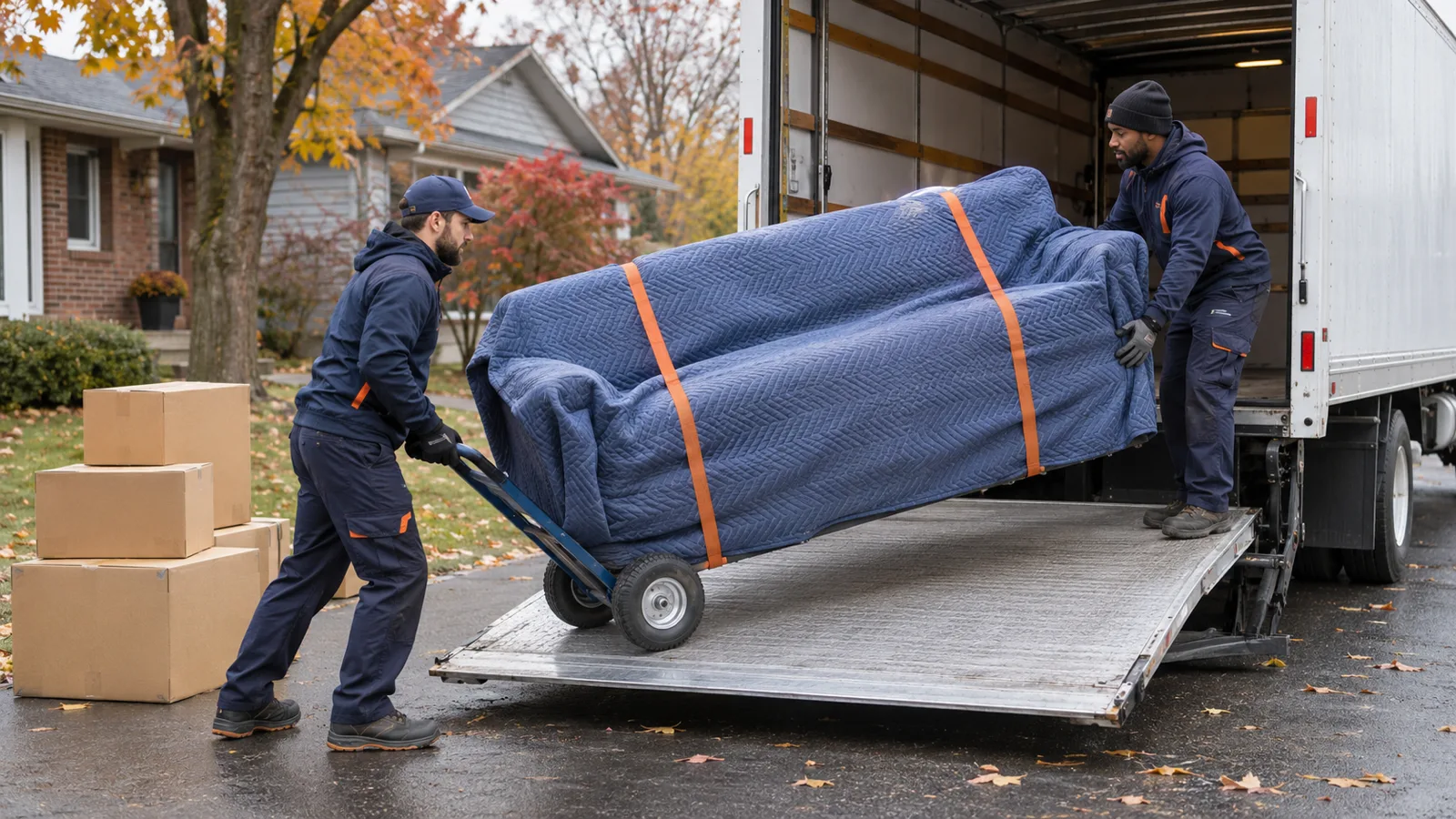
- Shrink-wrap and blanket-wrap upholstered items to protect fabric from dirt and moisture.
- Palletize properly for freight, with the item strapped to the pallet and nothing overhanging the edges.
- Test it. Drop and vibration testing, even informally, reveals weak points before customers find them.
If damage is persistent on a particular SKU, consider repackaging it in your warehouse as a value-added service rather than relying on the factory pack.
Seasonal and Weather Factors
Ontario winters affect furniture delivery more than most products. Snow and ice make carrying heavy items to a front door slower and riskier, and solid wood can react to swings between a cold truck and a warm home. Moisture is a concern during spring thaw and summer humidity, so wrapping that keeps water out of upholstery and particleboard is worth the cost. Plan for longer delivery windows during storms and around the holidays.
Insurance, Liability and Claims
Carrier liability is often limited, and the default coverage may be much less than the value of a quality piece of furniture. Check each carrier's liability terms and consider additional coverage for higher-value items. Our post on freight insurance explains the options.
For claims, evidence is everything. Photograph items before packing and after loading. Ask customers and delivery crews to note visible damage on the delivery receipt rather than signing it clean. File claims promptly, within the carrier's stated window, with photos, invoices and proof of value.
Shipping Furniture Across the Border
Mississauga's access to the Peace Bridge, Lewiston-Queenston and the Ambassador Bridge makes the US market reachable, but furniture brings particular paperwork. Wood products may face questions about materials and treatment, upholstered goods may have labelling requirements in some states, and duties depend on classification and origin. Furniture that qualifies as originating under CUSMA may benefit from preferential treatment, but only with proper documentation. A customs broker and a cross-border shipping partner can help you set this up correctly from the start.
Returns: The Expensive Afterthought
Furniture returns are costly. Shipping a sofa back costs as much as shipping it out, and the item may not be resellable as new. Reduce returns with accurate dimensions on product pages, clear photos of colour and texture, and fabric swatches for upholstered items. When returns happen, decide in advance which items are worth bringing back, which can be resold as open-box locally, and which are better handled through a partial refund. A defined returns management process keeps those decisions consistent.
Frequently Asked Questions
Can I offer free shipping on furniture?
Many retailers do, but they build the cost into the product price. Calculate the real delivery cost by zone, including surcharges, before committing.
How long does furniture freight take within the GTA?
Local deliveries from Mississauga to Oakville, Brampton, Toronto or Vaughan can often be completed within a few business days, depending on the service and appointment availability. Long-distance moves take longer, and white glove services typically schedule deliveries by region.
Should I store furniture in a 3PL warehouse?
If you are growing, it often makes sense. Bulky items take a lot of space, and a warehouse with racking for large items, dock access and carrier relationships can lower your shipping and handling costs compared with running out of a small unit.
Ship Big Items Without the Big Headaches
Furniture rewards careful planning: accurate dimensions, the right carrier for each product, packaging built for real-world handling and clear customer communication. ShipCarte helps home goods brands in Mississauga store bulky inventory, book parcel and freight shipments and manage delivery across Canada and into the US.
Tell us about your catalogue and your delivery expectations, and request a quote for a shipping setup that fits how your furniture is built and where it needs to go.