
An office supplies distributor in Churchill Meadows promised a school board a delivery by Thursday. On Wednesday afternoon, the tracking page still shows the shipment sitting at a terminal. A phone call reveals that the pallet was flagged for a missing appointment, which the consignee required but nobody had booked. The truck will try again on Friday. The school board is not impressed, and the distributor's sales rep spends the afternoon apologising for a problem that started with a single missing note on a bill of lading.
Shipping delays rarely have one dramatic cause. More often, they come from small gaps: a data entry error, a missed cut-off, an unprepared receiver, a customs form with a vague description, or a winter storm that no one planned for. In a busy logistics hub like Mississauga, where thousands of trucks move through the 401, 403, 410 and 427 corridors each day, small problems compound quickly.
This article breaks down the most common reasons shipments get delayed, grouped by where they start, and gives practical ways to prevent each one.
Delays That Start Inside Your Business
It is tempting to blame carriers, but many delays begin before a package ever leaves the building.
Missed carrier cut-offs
Every carrier has a pickup time, and every warehouse has an internal cut-off for orders to be picked and packed in time to meet it. When orders are released late, when packing runs behind, or when a driver arrives before shipments are ready, freight waits until the next day.
Prevention: Set clear internal cut-offs, communicate them to sales and customer service teams, and track how often orders miss them. If a particular order type always runs late, find out why.
Inaccurate addresses
Wrong postal codes, missing unit numbers and misspelled street names are among the most common causes of delayed parcels. Mississauga's many condo towers and townhouse complexes make unit numbers especially important.
Prevention: Use address validation in your checkout and order entry systems, and require unit or suite fields where relevant.
Incomplete shipment information
For freight, the bill of lading needs to accurately describe the shipment, including weight, dimensions, freight class where relevant, and special requirements such as liftgate, appointment or residential delivery. Missing details can lead to the carrier refusing to deliver until they are sorted out. Our article on delivery appointments in freight covers one of the most common oversights.
Prevention: Build a standard checklist for creating bills of lading and store consignee requirements in your customer records.
Stockouts discovered at picking
If the system says an item is available but it is not on the shelf, the order stalls. That delay never shows up on a carrier's tracking page, but the customer experiences it just the same.
Prevention: Accurate, real-time inventory management, including regular cycle counts, keeps available stock in sync with what is physically there.
Poor packaging
Damaged or poorly sealed packages can be pulled aside at carrier sort facilities for repackaging, which adds days.
Prevention: Use appropriate box strength, secure tape and enough cushioning. Our guide on packing fragile items has practical tips.
Delays in the Carrier Network
Volume surges
Carrier networks are built for typical volumes. During peak periods, especially the run-up to the holidays, sort facilities and delivery routes can be overwhelmed. Packages may wait a day or more for capacity.
Prevention: Plan for peak season early, set realistic delivery expectations with customers, and consider spreading volume across more than one carrier. Our article on preparing for peak season goes into more detail.
Missorts and misroutes
Automated sortation is very good, but labels that are smudged, wrinkled or placed on a seam can be misread, sending a parcel to the wrong facility.
Prevention: Use thermal labels printed at the right resolution, place them on a flat top surface, and remove old labels when reusing boxes.
Terminal transfers in LTL
Less-than-truckload freight moves through terminals where it is unloaded, sorted and reloaded. Each transfer adds time and the chance of a pallet being left behind.
Prevention: For time-critical freight, ask about direct or guaranteed services, or consider a full truckload if volume justifies it.
Delays on Mississauga's Roads
Mississauga sits at the centre of one of North America's busiest highway networks, which is excellent for reach but challenging for timing.
- Highway 401 through Mississauga and toward Toronto is notoriously congested at rush hour, and collisions can bring traffic to a crawl.
- Highway 410 and Highway 427 link the airport area and Brampton with the 401 and QEW, and often back up at interchanges.
- The QEW and Highway 403 carry traffic toward Hamilton and the Niagara crossings.
- Highway 407 is a tolled alternative that can save time, though at an added cost.
- Construction on major roads and arterials such as Hurontario Street can change travel times for months.
Prevention: Schedule pickups and deliveries outside peak hours where possible, build realistic local transit times into promises, and work with carriers and drivers who know the area.
Weather
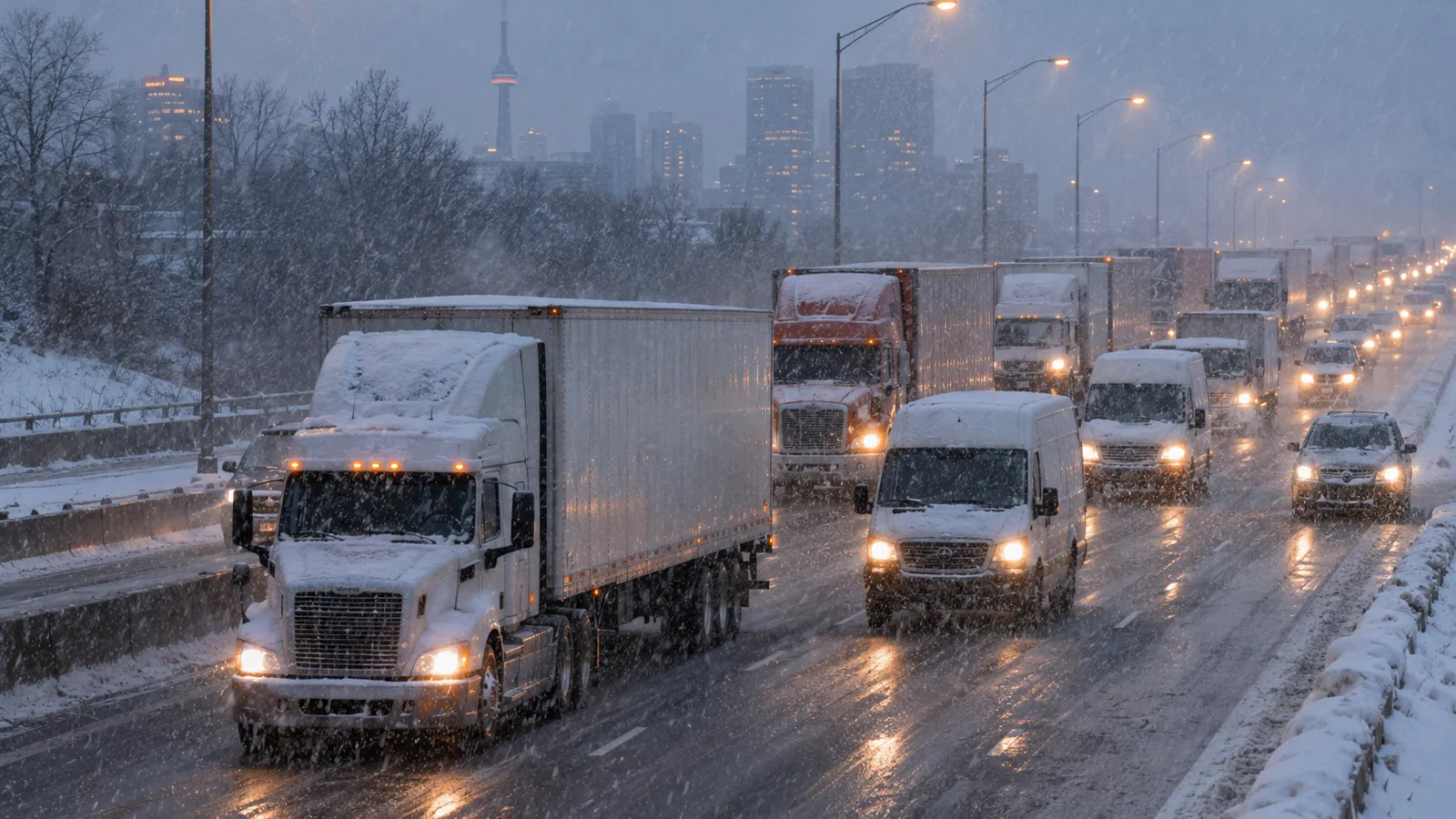
Southern Ontario winters bring snow, freezing rain and the occasional whiteout. Even moderate storms slow traffic and can close highways. Freight heading north or west faces even more weather risk through Northern Ontario. Summer storms can also disrupt flights at Pearson, affecting air cargo and express parcels.
Prevention: Monitor forecasts, communicate proactively with customers when weather threatens, and protect freeze-sensitive goods with heated service during cold months.
Delays at the Receiving End
Closed or busy receivers
Businesses with limited receiving hours, docks that are fully booked, or staff who are unavailable can turn away deliveries. Large retailers and distribution centres often require appointments and enforce them strictly.
Residential delivery issues
Nobody home, a locked lobby, or a parcel room that is full can lead to failed delivery attempts.
Prevention: Capture receiving hours and appointment requirements for business customers, and offer residential customers delivery notifications and pickup point alternatives.
Cross-Border Delays
Shipments between Mississauga and the United States must clear customs, and documentation problems are a common cause of holds. Vague product descriptions, missing values, incorrect tariff classifications and missing permits for regulated goods can all lead to a shipment waiting at the border or a customs facility. Border crossings themselves, including the Ambassador Bridge, Peace Bridge, Lewiston-Queenston and Blue Water Bridge, can experience long commercial wait times.
Prevention: Prepare complete commercial invoices, work with an experienced customs broker, and send documentation before the shipment reaches the border. ShipCarte's cross-border shipping service helps coordinate these steps.
Delays in Air and Express Shipments
Being close to Toronto Pearson gives Mississauga businesses access to fast air and express services, but those services have their own failure points. Flights can be cancelled or delayed by weather or operational issues, cargo can be offloaded when an aircraft is full or weight-restricted, and shipments containing undeclared dangerous goods such as lithium batteries or aerosols can be rejected at acceptance. Express parcels also depend on tight sort windows: a pickup that reaches the hub late may miss the night's linehaul.
Prevention: Screen products for dangerous goods before booking, tender air cargo well before the cut-off, and for critical shipments, ask about options on more than one flight or carrier.
Build a Simple Delay Log
The fastest way to reduce delays is to understand which ones you actually have. Many businesses rely on memory and anecdotes, which tend to overweight the most recent or most painful incident. A simple log, kept in a shared spreadsheet or your shipping software, changes that. For every late shipment, record:
- The order or shipment number, carrier and service.
- The promised and actual delivery dates.
- The cause, using a short list of categories such as internal cut-off, address, documentation, carrier network, weather, receiver or customs.
- Whether the cause was preventable and what would have prevented it.
After a month or two, patterns appear. You might find that most delays come from a single carrier on a particular lane, from one customer's receiving dock, or from orders entered after a certain time of day. Each of those has a different fix, and the log tells you which to tackle first. Our list of logistics KPIs includes on-time delivery and related measures worth tracking alongside it.
Quick Answers to Common Delay Questions
How long should I wait before contacting the carrier?
If tracking has not updated for a day or two on a domestic ground parcel, or a freight shipment has missed its estimated delivery date, contact the carrier. Earlier contact is wise for time-sensitive shipments.
What does "exception" mean in tracking?
An exception is any event that interrupts normal transit, such as an incorrect address, damage, weather, or a delivery attempt that failed. The detail behind the exception tells you what action, if any, is needed.
Can I get a refund for a late delivery?
Some carriers offer service guarantees on certain services, but these are often suspended during peak periods or for weather. Check the terms of the service you used.
Visibility Is Half the Battle
Not every delay can be prevented. What turns a delay into a customer service problem is surprise. When customers and staff can see exactly where a shipment is and why it has stopped, they can adjust plans. ShipCarte's tracking tools and shipping platform centralize tracking across carriers, making exceptions easier to spot early.
Keep Your Shipments Moving
If delays are costing you customers or eating into your team's time, ShipCarte can help identify where they start and how to prevent them. Schedule a consultation to review your shipping process, or request a quote for your next shipment out of Mississauga.