
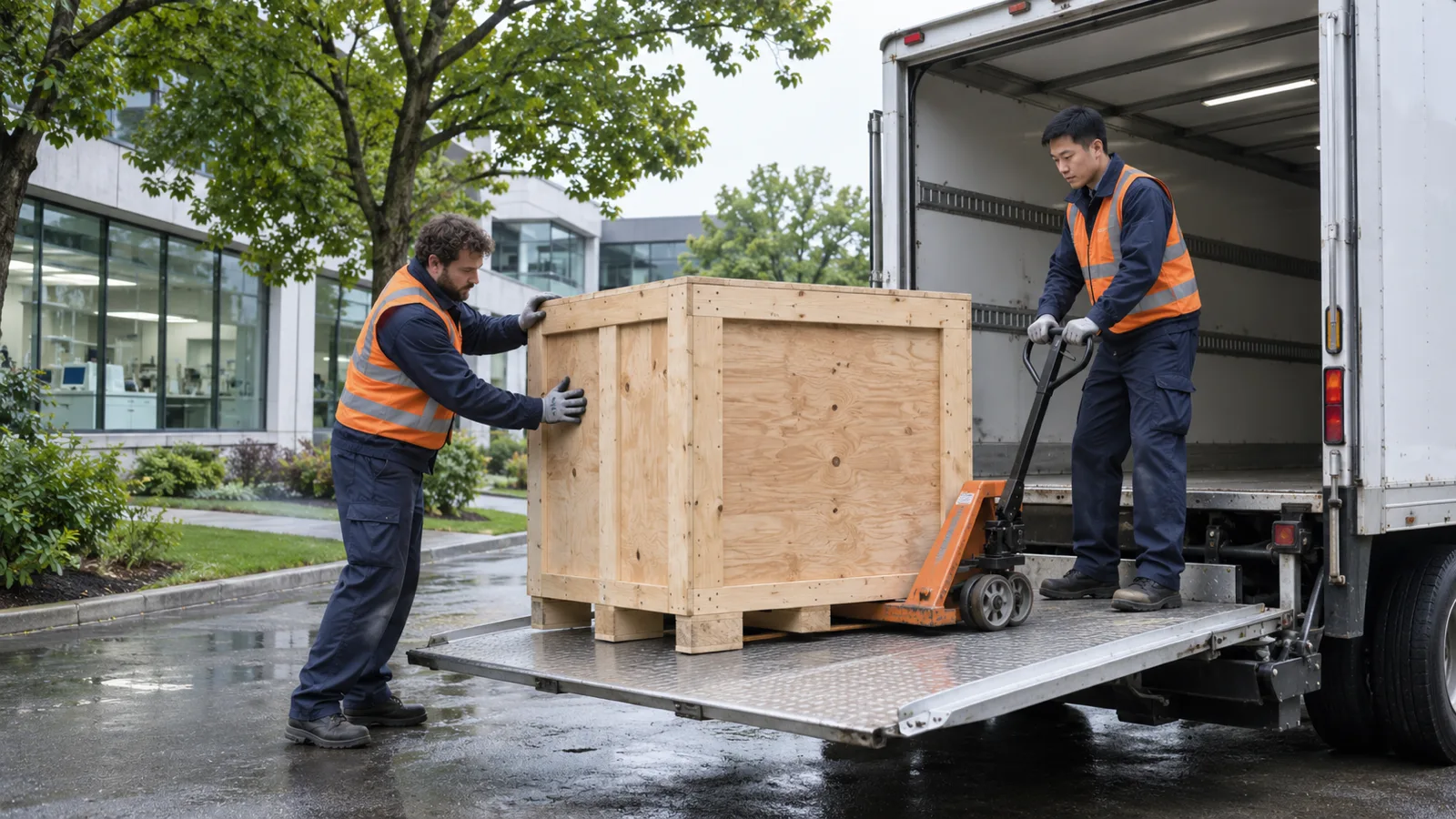
An engineering team in Sheridan Park has spent eight months building a prototype sensor rig. It weighs about 300 kilograms, contains calibrated optics and needs to be at a partner's test facility in Michigan in ten days. The lab manager knows exactly how the rig works. What she does not know is whether it can travel on a standard pallet, whether it needs an export permit, who handles customs at the Ambassador Bridge or how to make sure the receiving dock at the other end has a liftgate.
Research and technology companies ship a very different mix of goods from a typical retailer. One week it is a few vials of samples on dry ice; the next it is a delicate instrument worth more than the truck carrying it, a batch of prototype boards for a customer demonstration or a pallet of consumables for a pilot project. Volumes are irregular, stakes are high and the people organising shipments are usually scientists and engineers who have better things to do than learn freight terminology.
Sheridan Park, the research and business park in the west end of Mississauga near the QEW and Erin Mills Parkway, has been home to research-focused organisations for decades. This guide is written for the operations, lab and facilities teams in and around the park, and for similar firms across Mississauga, who need a practical framework for moving high-value, sensitive and sometimes regulated items.
The Location Advantage
Sheridan Park's position is a genuine logistics asset. The QEW runs along its southern edge, connecting west to Hamilton and the Niagara crossings into New York State, and east toward downtown Toronto. Highway 403 and Highway 407 are a short drive north, giving quick access to Highway 401 and the Windsor corridor that leads to the Ambassador Bridge and Detroit. Toronto Pearson International Airport is reachable in roughly half an hour outside rush hour, which matters for urgent air shipments and international samples.
That proximity only helps if the logistics behind it are well organised. A courier that misses the airline cut-off at Pearson, or a truck that arrives at the Peace Bridge without proper paperwork, wipes out the time advantage of being close.
Shipment Type 1: Laboratory Instruments and Capital Equipment
Analytical instruments, test rigs, microscopes and server hardware share some characteristics: high value, sensitivity to shock and vibration, awkward dimensions and often a need for careful positioning on arrival.
Preparing the equipment
- Follow the manufacturer's transport instructions, including locking moving parts, removing or securing optics and draining fluids where required.
- Photograph the equipment and record serial numbers before packing.
- Back up data and remove sensitive information from embedded computers if the equipment is leaving your control.
- Check whether lithium batteries are installed, as they bring dangerous goods requirements.
Crating and protection
For many instruments, a custom wooden crate with foam or shock-absorbing mounts is the safest option. Shock and tilt indicators on the outside of the crate show whether it was dropped or tipped in transit, which supports any later claim and encourages careful handling. Crates going across the border or overseas generally need heat-treated wood marked to the ISPM 15 standard.
Choosing the transport
Standard LTL networks involve forklift handling and cross-docking, which may be acceptable for robustly crated equipment but risky for delicate instruments. Options include dedicated or exclusive-use trucks, air-ride trailers that reduce vibration, and white-glove services that handle inside delivery and placement. Confirm whether the pickup and delivery sites have loading docks, or whether a liftgate truck is needed. Many research buildings were designed with limited dock space.
Shipment Type 2: Samples and Biological Materials
Research firms frequently send samples to partner labs, contract research organisations or testing facilities. Depending on what they are, samples may be regulated as dangerous goods. Biological substances that may contain pathogens, for instance, are commonly shipped under UN3373 as Category B biological substances, which requires specific triple packaging and markings. Samples preserved in dry ice add another dangerous goods classification and require labelling with the quantity of dry ice.
Key points for sample shipments include:
- Classify the material correctly before booking. If you are unsure, your biosafety officer or a dangerous goods specialist should make the call.
- Make sure the person preparing the package holds appropriate dangerous goods training for the mode of transport. Ground shipments in Canada fall under Transportation of Dangerous Goods regulations, and air shipments follow IATA rules.
- Book with a carrier and service that accepts the material, since not every courier service accepts every class of dangerous goods.
- Plan transit times around coolant life. Dry ice sublimates and gel packs warm up, so avoid shipping late in the week when a delay could strand the package over a weekend.
- Coordinate with the receiver so someone is ready to accept and store the samples on arrival.
For temperature-sensitive materials, ShipCarte's temperature-sensitive products team can help with packaging and monitoring. Our guide on shipping temperature-sensitive products also covers packaging choices.
Shipment Type 3: Prototypes and Confidential Hardware
Prototypes create a different kind of risk. The biggest concern is often confidentiality rather than damage. Unreleased products can reveal a company's roadmap, and partners may be bound by non-disclosure agreements that extend to how goods are handled.
Practical measures include plain outer packaging with no product names, tamper-evident seals, limiting who at the logistics provider can see shipment descriptions, and choosing services that minimise handling stops. Chain-of-custody records, showing who had the shipment and when, can satisfy both your security team and your customer's.
Customs paperwork must still describe goods accurately, so confidentiality cannot extend to hiding what is in the box from border authorities. Work with your customs broker to write descriptions that are accurate and sufficient for classification without disclosing more than necessary.
Shipment Type 4: Cross-Border Moves for Testing, Demos and Trade Shows
Research equipment often crosses the border temporarily, for a conference in Chicago, a field trial in Ohio or a calibration visit to a manufacturer in the United States. Temporary exports and re-imports can usually be handled without paying full duties each way, but they need the right documentation. Options may include ATA Carnets for professional equipment and trade show goods, or temporary import provisions on the US side. Your broker can advise on which fits.
Some technology and research goods are also subject to export controls. Canada's Export Control List covers certain dual-use items, encryption technologies, advanced electronics and materials, and some exports need a permit under the Export and Import Permits Act. If your equipment or technical data might fall into a controlled category, check before you ship rather than after the truck is booked. ShipCarte's cross-border shipping service coordinates paperwork with brokers on both sides of the border.
Inbound Logistics: Receiving Into a Research Facility
Research sites often struggle more with inbound freight than outbound. Shipments arrive at reception desks, sit in hallways or end up in the wrong building on a multi-tenant campus. A few simple improvements help:
- Publish a single receiving address and delivery instructions, including building number and dock location, for suppliers to use on every order.
- Require suppliers to include a purchase order and requester name on the label.
- Set aside a secure receiving area with temperature control for sensitive deliveries.
- Use a receiving log, even a simple digital one, to record what arrived, its condition and who collected it.
For firms with more consumables than their buildings can hold, off-site storage near the park can free valuable lab space. Consumables, packaging and spare parts can be held in a warehouse and delivered as needed, which is the idea behind inventory management services for growing technology companies.
Because Sheridan Park sits close to many industrial warehouses in western Mississauga, off-site stock can often be delivered the same day it is requested, so labs do not have to trade convenience for space.
Insurance and Valuation
Carrier liability is usually limited and may be calculated by weight, which leaves a large gap for a light but expensive instrument. Declared value options and separate cargo insurance can close that gap. Read the terms carefully, as some policies exclude calibration loss or require specific packaging. Our article on freight insurance explains the main options.
Building a Simple Internal Process
Research organisations often have no shipping department, just whoever happens to be available. A short internal procedure makes a large difference:
- A request form capturing what is being shipped, dimensions, weight, value, destination, deadline and any hazards.
- A named person who reviews requests for dangerous goods, export control and insurance needs.
- Approved carriers and logistics partners for each shipment type.
- Standard packaging supplies and crate suppliers on file.
- A shared record of shipments and tracking numbers for follow-up and audit.
Consolidating shipping through one logistics partner that understands freight, parcel and cross-border moves simplifies this further. A single shipping platform can provide quotes, labels and tracking for every mode in one place, which suits teams that ship irregularly.
Supporting Mississauga's Research Community
Firms in Sheridan Park and elsewhere in Mississauga have a location that puts major highways, Pearson and three key border crossings within easy reach. The challenge is matching that geography with logistics processes that respect the value, sensitivity and regulatory status of what they ship.
If your lab or engineering team needs help moving instruments, samples or prototypes, ShipCarte can plan the shipment from crating to delivery. Schedule a consultation to talk through an upcoming move, or request a quote for a specific shipment.