
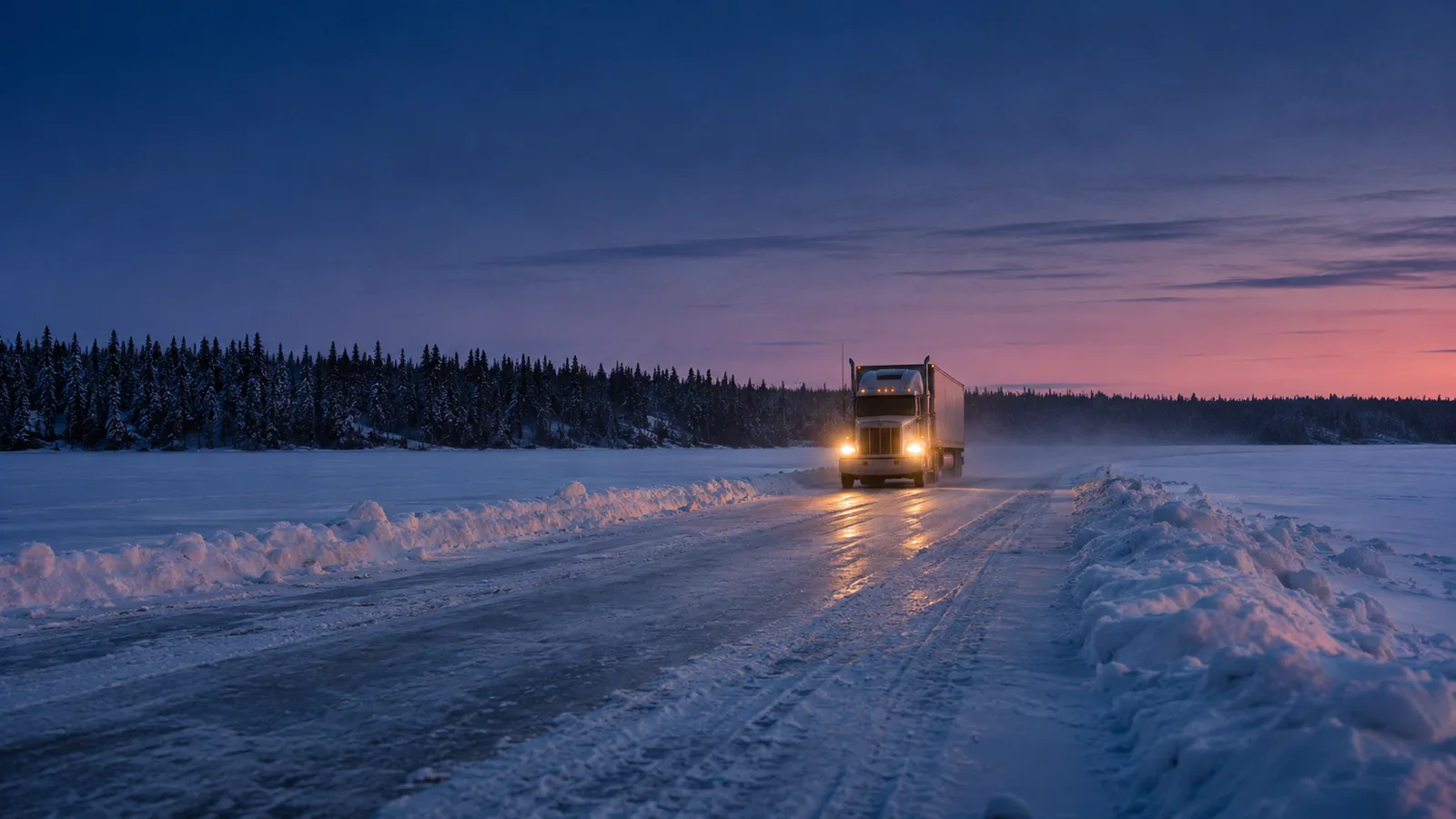
For most of the year, a First Nation community in the far north of Manitoba or Ontario can only be reached by air. Every litre of fuel, every bag of cement and every pallet of groceries arrives on a small plane, at a cost that makes even ordinary goods expensive. Then, for a few weeks in the depths of winter, the lakes and muskeg freeze hard enough to drive on. Trucks roll in loaded with a year's worth of heavy supplies, and the community restocks while the window lasts.
Winter roads and ice roads are one of the most remarkable parts of Canada's freight network, and one of the most misunderstood. They are not permanent highways. They are built fresh every season, depend entirely on the weather, and can open late or close early with little warning. For suppliers, contractors and organisations that serve northern communities and remote work sites, planning around this short season is essential.
With fall well under way and winter approaching, crews in several provinces and territories will soon be getting ready to build this season's routes, which makes now the time to plan. Here is what shippers need to know to get freight on those trucks.
Winter roads versus ice roads
The terms are often used interchangeably, but there is a difference:
- Ice roads are routes built on the frozen surface of lakes and rivers. Crews clear snow so the cold can penetrate and thicken the ice, and they sometimes flood the surface to build it up faster.
- Winter roads include ice road sections but also overland portages through forest and muskeg that are only passable when the ground is frozen.
Most of the long northern routes are a mix of both. Some cover hundreds of kilometres, crossing dozens of frozen lakes connected by short land portages.
Where they operate
Seasonal roads are used across a broad band of northern Canada:
- Northern Ontario and northern Manitoba: networks of winter roads connect many remote First Nations communities to the all-season highway system for a few weeks each year.
- Northwest Territories: winter roads link several communities along the Mackenzie Valley, and a long winter road serves diamond mines north of Yellowknife, with much of its length on frozen lakes.
- Northern Saskatchewan, Alberta and Quebec: seasonal roads support communities, forestry and resource projects.
- Yukon and other regions: seasonal access routes support mining exploration and remote sites.
The network changes over time. For example, the ice road that once connected Inuvik to Tuktoyaktuk was replaced by an all-season highway that opened in 2017. Other communities continue to rely on seasonal access.
How the season works
Construction
Once the ice is thick enough to support light equipment, crews begin clearing and flooding. As the ice thickens, heavier equipment can work on it. Construction can start in December in colder years and later in milder ones.
Opening and weight limits
Roads typically open in stages. Early in the season, only lighter vehicles may be allowed. As the ice gets thicker, the permitted gross weight increases until fully loaded trucks can travel. The exact limits are set by the authority that operates the road, based on regular ice thickness measurements.
Operating rules
Ice roads have their own rules. Speed limits are low, partly because a moving truck creates a wave under the ice that can damage it if the truck travels too fast. Trucks must keep their distance from each other, and some routes have checkpoints, dispatch systems or convoy requirements. Drivers who work these routes are specially experienced.
Closing
As temperatures rise in late winter, the roads close, often in March or early April depending on the route and the year. A warm spell can shorten the season dramatically, and in recent years some routes have had shorter or interrupted seasons. Anything that misses the window may have to wait for the next winter or travel by air at a much higher cost.
What travels on winter roads
Because the season is short and air freight is expensive, winter roads carry the heaviest and bulkiest goods a community or site needs for the year:
- Fuel for heating, generators and vehicles
- Building materials for housing, schools and infrastructure
- Vehicles, heavy equipment and machinery
- Non-perishable groceries and household goods in bulk
- Mining supplies, explosives and equipment for resource sites
- Furniture, appliances and other large items
Perishable groceries and urgent items generally continue to travel by air year-round. Our article on air cargo to remote communities covers that side of northern logistics.
A planning timeline for winter road freight
Late summer and fall: plan the order
Work with your customer in the community or at the site to determine what is needed for the year. Order early so suppliers have time to produce and ship to a staging point.
Early winter: stage the freight
Goods are typically gathered at a southern staging point on the all-season road network, such as a town at the start of the winter road. This lets trucks load and go as soon as the road opens. Staging freight early is the single best way to make sure it reaches its destination in a short season.
Winter: book carriers and monitor openings
Book carriers experienced with winter road operations well in advance. Demand is concentrated into a few weeks, so capacity is tight. Monitor road status updates closely, as opening dates and weight limits change with conditions.
Late winter: prioritise
If the season looks short, decide which items are most critical and ship them first. Have a backup plan for anything that might not make it.
Packaging and cargo considerations
Freight on winter roads faces extreme cold, rough surfaces and long trips. Prepare it accordingly:
- Protect from freezing: liquids, paints, adhesives, beverages, some foods and many chemicals can be ruined by freezing. Use heated trailers or insulated packaging when needed, and tell the carrier.
- Secure loads well: portages and uneven ice can be bumpy. Use strong pallets, robust wrapping and solid securement.
- Consider weight distribution: since weight limits on ice depend on gross vehicle weight, carriers may need to balance loads carefully. Provide accurate weights.
- Dangerous goods: fuel and many industrial supplies are regulated under the Transportation of Dangerous Goods Regulations. Ensure classification, packaging and documentation are correct before goods reach the staging point.
- Label clearly: freight may be consolidated with other shippers' goods. Clear labels with the consignee and community name reduce misdirected deliveries.
Common mistakes southern suppliers make
Suppliers based in the Greater Toronto Area, Montreal or Winnipeg who sell into northern communities only occasionally tend to make the same handful of mistakes. Each one can cost a shipment its place on the winter road.
- Treating the order like a normal delivery. A standard "ships in five to seven business days" promise means nothing if the staging point needs goods before a specific date. Confirm the deadline in writing with the buyer.
- Shipping to the community address. Freight sent directly to the final community by a southern carrier may simply be returned or held because the carrier does not serve it. Goods usually need to be addressed to the staging point or the winter road carrier, with the final consignee noted.
- Ignoring the freeze risk. An order of liquid products shipped in an unheated trailer in January may freeze long before it reaches the ice. Ask for protective service when shipping temperature-sensitive goods anywhere in Canada during winter.
- Sending incomplete orders. Partial shipments that leave the rest of the order to follow later can miss the window. Where possible, consolidate the order and ship it complete.
- Missing documentation for dangerous goods. Fuel, propane, batteries and many chemicals need proper TDG paperwork. A winter road carrier will refuse freight that arrives without it, and there may be no time to fix it.
Working with community buyers
Many winter road shipments are ordered by First Nations band offices, community stores, housing authorities, schools and contractors. These buyers often know the local road better than anyone in the south. Ask them about the staging location they use, the carriers they trust, the typical opening dates in recent years and the best contact for receiving freight. Building that relationship helps you plan, and it shows respect for the people who rely on the road every year.
Costs and how they compare
Winter road freight is generally far cheaper per kilogram than air freight for heavy goods, which is why communities rely on it so heavily. However, it is still more expensive than ordinary highway trucking because of the slow speeds, specialised drivers, short season, empty return trips and risk. Costs vary by route and year, and they can rise when demand is high or the season is short. Ask carriers how they price and what happens if the road closes while freight is in transit.
Alternatives when the window closes
Winter roads are one of several modes that northern logistics depends on:
- Air freight runs year-round but at much higher cost.
- Sealift supplies Arctic coastal communities by ship during the summer open-water season. See our guide to sealift shipping in Canada.
- River barges serve some communities along major northern rivers in summer.
- All-season roads reach some communities, especially in the Yukon and parts of the Northwest Territories.
Many organisations use a combination, moving heavy, non-urgent goods by winter road or sealift and time-sensitive items by air.
How a logistics partner helps
Shipping to the North involves many moving parts: sourcing products from suppliers across southern Canada, consolidating them, getting them to a staging point on time, and coordinating with northern carriers. A logistics partner can manage the southern end of that chain. ShipCarte can receive goods from multiple suppliers, consolidate and palletise them through our distribution warehousing, and move them north via full truckload or LTL freight to the staging location you specify. Our distribution services can help coordinate deliveries for organisations supplying several communities at once. For general guidance on freight versus parcel options, read our article on how freight differs from small package shipping.
Start planning for this winter's window
The winter road season is short and unforgiving, and the businesses and organisations that succeed are the ones that plan months ahead. If you need to get supplies to a staging point for northern communities or remote sites this season, request a quote from ShipCarte and we will help you consolidate and move your freight in time for the roads to open.