
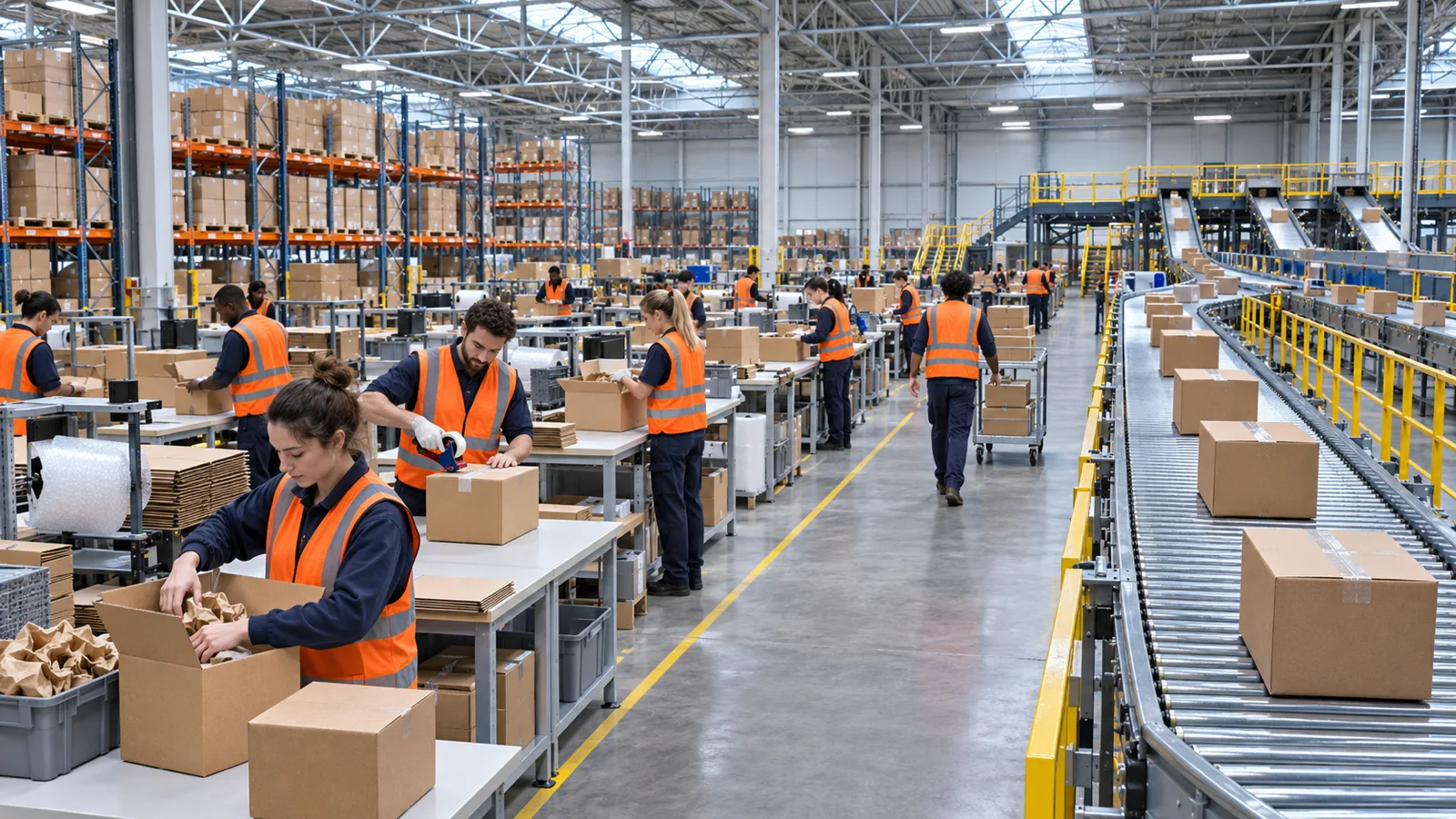
At 100 orders a day, a Mississauga apparel brand can still feel personal. The founder knows the best-selling SKUs by heart, the team of four packs at two long tables in a unit near Highway 10, and the courier driver knows everyone by name. Then a creator video takes off, a wholesale account opens up, and within a year the brand is regularly hitting several hundred orders a day, with 1,000-order days during sales. The tables, the spreadsheets and the courier routine that worked so well start failing, one after another.
Growth is the goal, but logistics rarely scales in a straight line. Processes that work at one volume break at the next. The brands that grow smoothly are the ones that see each breaking point coming and invest just ahead of it, rather than scrambling after customers start complaining.
This article maps out the milestones between 100 and 1,000 orders a day: what typically breaks at each stage, what to change, and the questions to ask yourself before moving to the next. The order counts are approximate. Your own thresholds depend on units per order, product size and how many SKUs you carry.
Milestone 1: Around 100 orders a day — the end of improvisation
What breaks
- Inventory is tracked in a spreadsheet or only in the ecommerce platform, and counts drift.
- Pickers rely on memory to find items, and new staff are slow.
- Labels are printed one at a time from the carrier's website.
- Stockouts happen without warning.
What to change
- Give every SKU a home. Label shelves and bins with location codes, and record each SKU's location in your system.
- Barcode everything. If products do not have UPCs, create internal SKU barcodes. Our post on SKUs versus UPCs explains the difference.
- Batch label printing through a multi-carrier shipping tool rather than one-by-one entry.
- Set reorder points for your top sellers, based on lead time and average daily sales.
At this stage, many brands also start comparing the cost of self-fulfillment with a 3PL. It is a good moment to do the maths, even if you decide to keep things in-house for now.
Milestone 2: Around 250 orders a day — systems over spreadsheets
What breaks
- Orders from multiple channels (website, marketplace, wholesale) are managed in different places.
- Mis-picks increase as the team grows and turns over.
- "Where is my order?" emails take up a growing share of customer service time.
- Packaging choices are inconsistent, inflating shipping costs.
What to change
- Centralize orders in one order management system so every channel flows into a single queue. See how ShipCarte handles this with its order management tools.
- Scan to verify at packing. Scanning each item against the order before sealing the box is one of the most effective ways to reduce errors.
- Standardize box sizes and match each SKU or order profile to a box. Cartonization logic can automate this and reduce dimensional weight charges.
- Send proactive tracking notifications so customers do not need to ask.
Milestone 3: Around 400 orders a day — the space and labour wall
What breaks
- The building is full. Inbound shipments clog the floor, and staging areas disappear.
- Hiring and training enough people for peaks becomes a constant struggle.
- One courier pickup a day is not enough, and the dock or door becomes a bottleneck.
- Carrier rates negotiated at lower volume no longer reflect your size.
What to change
- Decide on your operating model. This is often the point where a brand either commits to a larger warehouse with its own management team, or moves to a 3PL. Both are valid; the decision depends on whether you want logistics to be a core competency. Our article on why brands switch to fulfillment centres lays out the trade-offs.
- Slot for velocity. Move fast-moving SKUs closest to the pack stations and keep slower SKUs further back or in reserve.
- Use more than one carrier, choosing per order based on cost and delivery speed. A multi-carrier shipping platform makes this automatic.
- Renegotiate rates or access better rates through a partner with aggregated volume.
Milestone 4: Around 600 orders a day — process design matters
What breaks
- Picking one order at a time wastes too much walking.
- Daily cut-off times slip because the team cannot finish before the last carrier pickup.
- Returns pile up unprocessed, tying up saleable stock.
- Peak days overwhelm everything.
What to change
- Batch and wave picking. Group orders by SKU, zone or carrier so pickers collect multiple orders per trip.
- Separate single-unit orders into their own fast lane. Orders with one item can often be picked in bulk and packed rapidly.
- Set realistic cut-offs and communicate them clearly on your website. Same-day shipping for orders placed by early afternoon is a common promise, but only make it if you can keep it.
- Treat returns as a process, with daily targets for inspection and restocking. ShipCarte's returns management is built for this.
- Plan peak capacity months ahead, including temporary staff, extra carrier pickups and overflow storage.
Milestone 5: Around 1,000 orders a day — data-driven operations
What breaks
- Small inefficiencies multiply into large costs. A few extra seconds per order adds up to many labour hours each week.
- Customers across Canada expect fast delivery, and shipping everything from one point starts to show its limits for distant regions.
- Inventory accuracy problems cause oversells and cancellations at scale.
- Finance wants cost-per-order numbers that operations cannot easily produce.
What to change
- Measure everything that matters: orders per labour hour, order accuracy, dock-to-stock time, on-time ship rate, cost per order and shipping cost per order. Our list of logistics KPIs is a good starting point, and reporting and analytics tools make them visible daily.
- Cycle count continuously instead of relying on an annual stock take.
- Evaluate network design. Some brands at this level add a second fulfillment point, often in western Canada or the US, to reduce transit times and costs for distant customers.
- Invest in automation where the data supports it, such as conveyors, print-and-apply labelling or put walls, rather than buying equipment on instinct.
The thread running through every milestone
Looking across all five stages, three investments keep paying off:
- Accurate inventory data, because every downstream decision depends on it.
- Integrated systems, so orders, inventory and shipping talk to each other without manual re-entry. Platform integrations remove a lot of hidden labour.
- Documented processes, so new staff can be productive quickly and quality does not depend on one person.
Why Mississauga is a strong base for scaling
A fulfillment operation in Mississauga can reach the large population of the Greater Toronto and Hamilton Area quickly by ground, with many carriers offering next-day service across much of southern Ontario and Quebec. Highways 401, 403, 407, 410 and 427 give carriers fast access in every direction, Toronto Pearson is close by for air shipments, and the US border crossings at Niagara and Windsor are within a few hours for cross-border orders. The area's deep labour pool and dense carrier network make it easier to add capacity as you grow than in many other regions of Canada.
There is a practical side too. If your team is based in Mississauga, keeping fulfillment local means you can visit the warehouse, review new packaging in person, drop off samples or influencer kits on short notice, and sit down with your logistics partner before a big launch. As volume grows, that proximity makes it easier to stay close to the operation without having to run it yourself.
Signs you are scaling well
How do you know whether your logistics are keeping pace with growth? Watch for these signals:
- Cost per order holds steady or falls as volume rises.
- Order accuracy stays high even as new staff join.
- You can absorb a sale or a viral moment without delaying regular orders.
- Customer service tickets about shipping grow more slowly than order volume.
- You can answer "how much inventory do we have, and where?" instantly.
If any of these are moving the wrong way, it is a sign that you have hit a milestone without changing the process behind it.
Common traps on the way up
A few mistakes show up again and again in fast-growing brands:
- Waiting for a crisis. Changing systems in the middle of peak season is far harder than doing it in a quiet spring month.
- Adding people instead of fixing process. Doubling headcount to double volume works for a while, then cost per order climbs and quality drops.
- Buying technology before defining the workflow. Software amplifies a good process; it does not create one.
- Letting SKU count grow unchecked. Every new size, colour and bundle adds storage locations, pick complexity and forecasting work.
- Ignoring inbound. Supplier shipments that arrive without labels, packing lists or advance notice slow receiving and delay stock getting to the shelf.
Grow without the growing pains
Scaling from 100 to 1,000 orders a day is an achievement for any Mississauga brand, and the logistics behind it should feel like support rather than a ceiling. ShipCarte's ecommerce fulfillment is designed to flex with brands as they move through these milestones, with warehouse, systems and carrier access in place before you need them. To map out your next stage of growth, schedule a consultation with our team.