
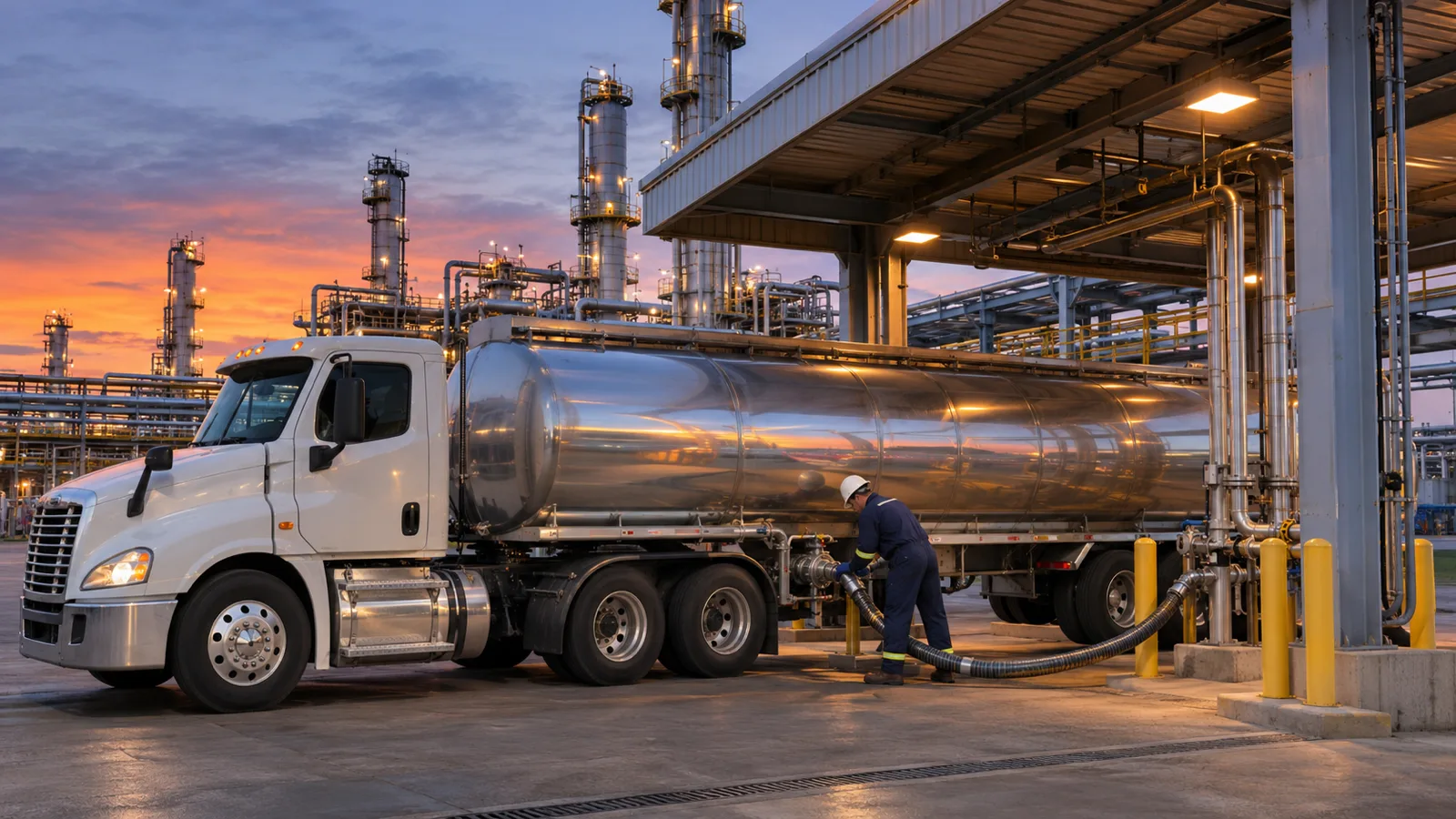
It is the third week of a planned maintenance turnaround at a refinery along the St. Clair River. Several thousand contract workers are on site, cranes are working around the clock, and the turnaround schedule is measured in hours. A shipment of replacement gaskets and valve internals, ordered from a supplier near Hamilton, was due at 6:00 a.m. At 9:00 a.m. it is still sitting at a carrier terminal in London because the driver assigned to the Sarnia run did not have the site's safety orientation. Nobody on the supplier's side knew it was required.
That kind of delay is expensive anywhere, but in Sarnia it can hold up an entire unit's restart. Sarnia-Lambton is home to one of the densest concentrations of refineries and chemical plants in Canada, often called Chemical Valley, along with a growing bio-industrial sector, a busy port and the Blue Water Bridge, one of the most important commercial crossings between Ontario and Michigan. The freight moving in and out ranges from tank truckloads of regulated chemicals to pallets of maintenance parts and oversized fabricated equipment.
This guide explains how logistics works in and around Sarnia, what makes it different from general freight, and how suppliers and shippers across Ontario can serve the area reliably.
The transportation network around Sarnia
Few places in Ontario are served by so many modes at once:
- Road. Highway 402 connects Sarnia to London and Highway 401, putting the GTA about three hours away and Windsor roughly an hour and a half south via Highway 40 and the 401. The Blue Water Bridge carries Highway 402 across the St. Clair River to Port Huron and Interstates 94 and 69.
- Rail. CN's main line from Toronto to Chicago passes through Sarnia and crosses under the river through the St. Clair Tunnel, which handles double-stack and large rail cars. Many chemical plants have their own rail spurs.
- Marine. The Port of Sarnia and private docks along the river handle bulk liquids, grain, salt and project cargo, linked to the rest of the Great Lakes and, via the St. Lawrence Seaway, to the Atlantic.
- Pipeline. Crude oil, natural gas liquids and products move by pipeline into and out of the area, which is part of why the industry clustered here in the first place.
For most suppliers outside the plants, the road network is what matters day to day. The other modes shape the rhythm of the area, though, because rail, marine and pipeline deliveries determine when plants need trucks and when they do not.
Dangerous goods: the starting point for Sarnia freight
A large share of the freight moving in and out of Sarnia is regulated under the federal Transportation of Dangerous Goods Regulations. Shippers have specific responsibilities, and carriers will refuse loads that do not meet them. The core obligations are:
- Classification. The consignor must classify each product correctly using its UN number, shipping name, class and packing group. The safety data sheet is the place to start.
- Means of containment. Packaging, from small containers to tank trucks and rail cars, must meet the applicable standards and be in good condition.
- Safety marks. Labels on packages and placards on vehicles must be displayed as required.
- Shipping document. A TDG shipping document must travel with the load, with the required information and a 24-hour emergency telephone number.
- Training. Anyone who handles, offers for transport or transports dangerous goods must be trained and hold a valid training certificate from their employer.
- Emergency Response Assistance Plan. Certain higher-risk products above specified quantities require an approved ERAP, and its reference number must appear on the shipping document.
On the provincial side, trucks operating in Ontario need a valid CVOR certificate from the Ministry of Transportation, and tank trucks carrying dangerous goods face additional inspection requirements. Choosing carriers that specialise in regulated freight, rather than general LTL carriers that accept the occasional placarded load, is usually safer and faster.
Cross-border freight through the Blue Water Bridge
The Blue Water Bridge is one of the busiest commercial crossings between Canada and the United States and handles a large share of Ontario's chemical and plastics trade with Michigan and the Midwest. It is especially important for dangerous goods, because the Ambassador Bridge and the Detroit-Windsor Tunnel restrict many hazardous materials. Much of that traffic goes through Sarnia-Port Huron instead.
Moving freight across the bridge means meeting both countries' requirements:
- Into the U.S.: advance electronic manifests to U.S. Customs and Border Protection, hazardous materials documentation under U.S. rules, and drivers with appropriate credentials. Carriers in trusted trader programs such as FAST generally move through faster.
- Into Canada: advance commercial information through the CBSA's ACI eManifest, a customs broker to handle release and accounting, and TDG-compliant documentation for regulated products.
- Trade agreement: NAFTA remains in force, so qualifying goods continue to move duty-free with proper certification. The new CUSMA agreement was signed last year but is still awaiting ratification, so watch for changes to rules of origin once it takes effect.
For more on cross-border logistics, our cross-border shipping service page and our article on freight between Ontario and Detroit describe the process step by step.
Turnarounds: the peak season nobody advertises
Refineries and chemical plants periodically shut down units for inspection, cleaning and repair. These turnarounds can last weeks and involve thousands of contractors. For logistics providers and suppliers, they create intense, short-term demand:
- Large volumes of maintenance materials, valves, gaskets, piping, scaffolding and safety equipment arrive in a narrow window.
- Heavy and oversize equipment such as heat exchangers, columns and reactor internals may need permitted loads and specialised trailers.
- Expedited deliveries become routine as crews find unexpected damage.
- Laydown yards and temporary warehouses fill with staged materials.
Spring and fall are traditional turnaround seasons, partly to avoid winter weather and summer demand peaks. Suppliers that plan ahead with their customers, stage material nearby and line up carriers early perform best. Those who wait for the purchase order often find every flatbed and hot-shot truck in Southwestern Ontario already booked.
Site access and receiving rules
As in the opening example, many plants require carriers and drivers to meet site-specific rules before they reach the gate. Expect some combination of:
- Completed site safety orientation, sometimes with an annual refresher.
- Flame-resistant clothing, hard hat, safety glasses, steel-toe boots and sometimes a personal gas monitor.
- Pre-booked delivery appointments, purchase order numbers on the paperwork and a named site contact.
- Vehicle inspections at the gate and restrictions on idling or parking within certain areas.
A supplier who ships to several plants should keep a profile for each site and share it with every carrier handling the work. Carrier management that includes these profiles prevents the failed deliveries that cost so much during turnarounds.
Packaging and handling for industrial freight
Even non-regulated freight to Sarnia's plants tends to be heavy, valuable and awkward. Good practice includes:
- Crating machined parts and protecting flange faces and threads from impact and moisture.
- Using skids rated for the weight and blocking parts so they cannot shift.
- Marking lifting points and centre of gravity on large items.
- Including packing lists and material certificates inside and outside the package, since plants often require them for quality control.
- Labelling every piece with the PO number and tag number used by the site.
Some suppliers use a 3PL to kit and stage turnaround materials by work package before delivery. That kind of value-added service saves time for crews on site, who can pick up a complete kit for a job rather than searching a laydown yard.
Plastics, bio-industrial and outbound freight
Sarnia is also a shipping point. Plastic resins, synthetic rubber, specialty chemicals and increasingly bio-based products leave the area by rail hopper, tank car, bulk truck and packaged freight. Packaged resins and chemicals often move as full truckload to converters across Ontario and the U.S. Midwest, while smaller orders go LTL. Shippers here benefit from the backhaul market: trucks that brought supplies into Sarnia need loads going out, which can help rates on some lanes.
When rail and truck work together
Not every Sarnia customer has its own rail siding, and not every supplier can fill a rail car. Transloading bridges that gap. Bulk liquids, dry bulk and packaged products can arrive by rail at a transload facility in the area and move the last few kilometres by truck, or the reverse for outbound product. This combination is often cheaper than trucking the whole way for long-haul moves from Western Canada or the U.S. Gulf Coast, and it reduces the number of trucks on the road. The trade-off is time: rail transit is slower and less predictable than a dedicated truck, so it suits steady, planned volumes rather than urgent turnaround needs. Shippers who mix the two modes, with rail for base volume and truck for top-ups, tend to get the best of both.
A supplier checklist for Sarnia
- Confirm whether your product is regulated under TDG, and if so, check that your team's training certificates are current.
- Choose carriers with dangerous goods experience and an up-to-date CVOR record.
- Build site profiles for each plant you serve, including orientation and PPE requirements.
- Ask customers about turnaround schedules months ahead and plan staging and transport.
- For cross-border shipments, confirm customs broker, eManifest and NAFTA documentation before the truck leaves.
- Keep material certificates and packing lists with every shipment.
For more on industrial supply chains, see ShipCarte's manufacturing industry page or our guide to freight insurance, which is worth reviewing for high-value equipment.
Work with ShipCarte on Sarnia-Lambton freight
Sarnia rewards suppliers and shippers who respect its rules and plan around its rhythms. ShipCarte helps businesses across Ontario book qualified carriers, manage cross-border paperwork through the Blue Water Bridge and stage materials for turnarounds. Request a quote for your next shipment, or schedule a consultation to plan your industrial lanes.