
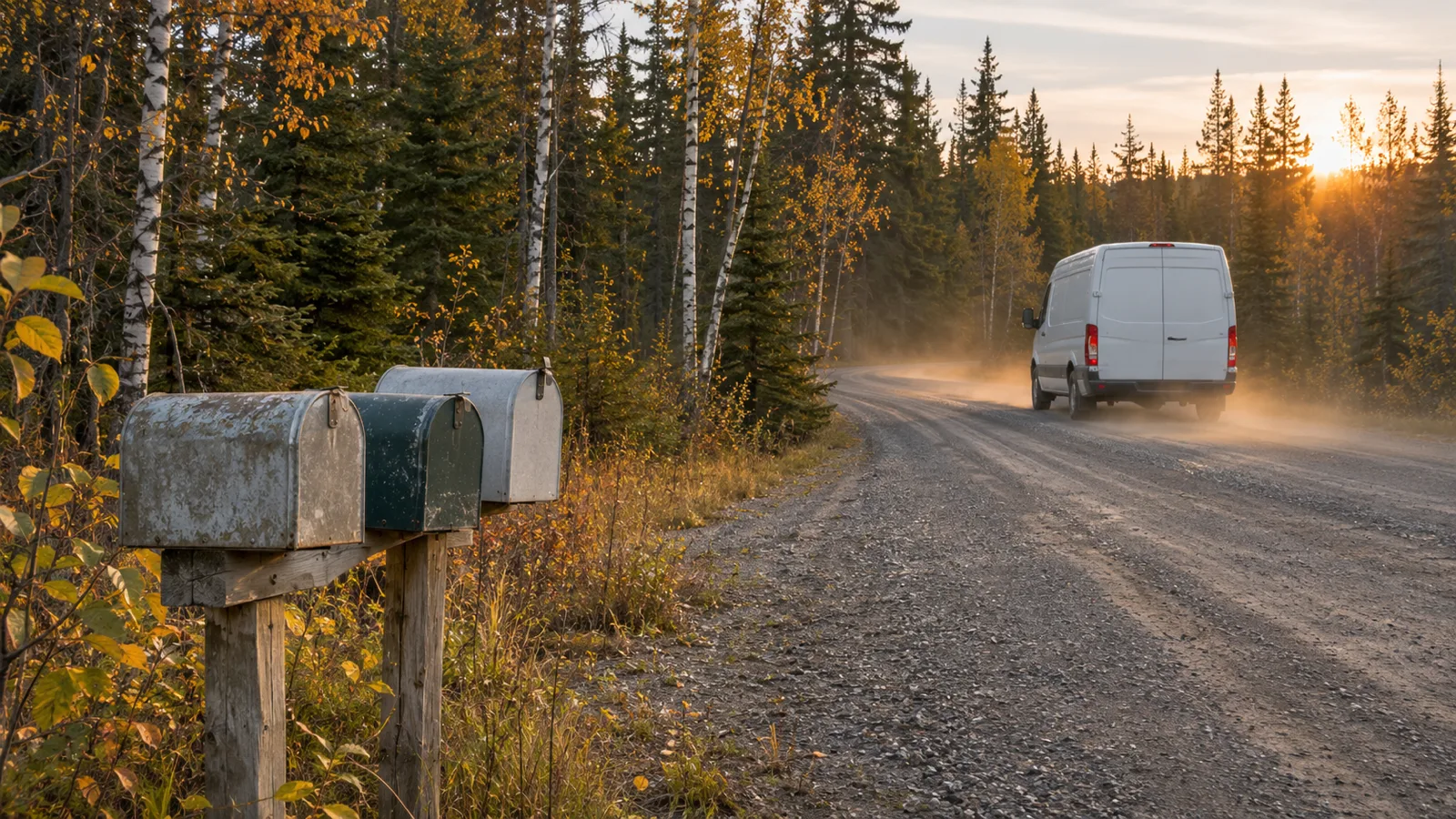
An order comes in from a customer whose address reads like a set of directions: a rural route number, a lot and concession, and a postal code whose second character is a zero. Another arrives from a community in northern Manitoba that has no year-round road. A third is headed to a cottage on an island in Georgian Bay. Your checkout quoted the same flat shipping rate for all three as it did for a customer in downtown Ottawa.
For Canadian ecommerce brands, rural and remote customers are not an edge case. A meaningful share of Canadians live outside major cities, and many of them shop online precisely because local stores are far away. They are often loyal customers once they find a seller who gets their orders to them reliably. But delivering past the end of the pavement costs more, takes longer and fails in different ways than urban delivery.
This guide walks through the main types of hard-to-reach destinations in Canada, what actually happens to a parcel on its way there, and the practical settings and habits that help you deliver without losing money or customer goodwill.
How to Spot a Rural Address
The quickest clue is the postal code. In Canada, the first three characters form the forward sortation area, and when the second character is a zero (for example K0A or T0L), that area is served as rural. This is a useful flag for your shipping rules, though not a perfect one: some rural-coded areas sit close to cities, and some urban codes include outlying addresses.
Other signs include rural route (RR) or general delivery addresses, site and compartment numbers, lot and concession descriptions, and addresses that point to a post office box rather than a street. Each of these affects which carriers can deliver and how.
Scenario 1: The Rural Route Customer
A customer lives on a farm an hour outside Saskatoon, or in a small village in New Brunswick's interior. There is a road, but the nearest courier depot may be a long drive away.
What happens: national couriers often serve these areas through their own longer routes or through local partners, and they typically apply an extended area or rural surcharge. Delivery may take a day or two longer than to the nearest city. Canada Post serves these addresses directly, sometimes to a roadside mailbox or community mailbox, and often to the local post office for larger parcels.
What helps:
- Use rate shopping by postal code so rural orders go to the carrier with the best rate and coverage, rather than defaulting to your city courier.
- Set delivery estimates at checkout that reflect rural transit times, instead of promising the same speed as urban orders.
- Make sure the address fields at checkout can capture rural route, site and compartment details without truncating them.
Scenario 2: The PO Box Only Customer
Many small communities across Canada have no home delivery at all. Residents receive mail and parcels at the post office. A customer in a small town in rural Alberta or on Cape Breton Island may give you only a PO box address.
What happens: private couriers generally cannot deliver to a PO box. A parcel sent by courier to a PO box address may be returned, held at a depot, or delayed while the carrier tries to find a civic address. Canada Post can deliver to PO boxes, and larger items are usually held for pickup at the counter with a notice card left in the box.
What helps: detect PO box addresses at checkout and either route them automatically to Canada Post or ask the customer for a civic address as well. This single rule can prevent a surprising number of failed deliveries.
Scenario 3: Island and Ferry-Dependent Communities
Vancouver Island, the Gulf Islands, Haida Gwaii, Newfoundland, Prince Edward Island, the Magdalen Islands and countless smaller islands all depend on ferries, bridges or air to receive freight. Prince Edward Island has the Confederation Bridge, but many other communities rely on scheduled ferry service.
What happens: parcels move on ferry schedules, which can be disrupted by weather, especially on Atlantic routes in winter. Some carriers apply surcharges for island destinations or route them through partners. Large or heavy items may need freight service rather than parcel service.
What helps: build a little extra time into delivery promises for island destinations, and keep an eye on weather disruptions during winter months so customer service can set expectations proactively.
Scenario 4: Fly-In Northern Communities
Many communities in Nunavut, the Northwest Territories, northern Quebec, northern Ontario, northern Manitoba and parts of other provinces have no year-round road access. Some are reachable by winter road for part of the year, and many depend on summer sealift for bulky goods, with air cargo carrying everything else.
What happens: parcels travel by road or air to a northern gateway, such as Winnipeg, Thompson, Yellowknife, Iqaluit, Montreal or Ottawa depending on the region, and then by air on regional carriers. Canada Post serves many of these communities, often more broadly than private couriers. Transit can be considerably longer, and weather can ground flights for days.
Products that count as dangerous goods are a particular problem. Items like lithium batteries shipped on their own, aerosols, flammable liquids and some cleaning products face strict rules for air transport, and in some cases cannot travel by air at all under the regulations that apply. For a community that is reachable only by air for most of the year, that can mean the item cannot be shipped by standard parcel service.
What helps:
- Identify which of your products are restricted for air transport and either exclude them for fly-in postal codes or explain the limitation clearly.
- Pack for a longer, rougher journey with more handling and possible temperature swings.
- Avoid shipping perishable items to fly-in communities unless you have a cold chain plan that accounts for delays. Retailers serving these communities with perishable food may want to look at how the federal Nutrition North Canada program works, as it is designed around eligible retailers and suppliers.
- Communicate honestly about delivery time. Northern customers generally understand that orders take longer, but they value accurate estimates.
Scenario 5: Seasonal and Cottage Addresses
Summer cottage country in Muskoka, the Laurentians, the Kawarthas, the Okanagan and many other regions brings a seasonal wave of orders to addresses that may not be well mapped, may be reachable only by water, or may be unoccupied when the parcel arrives.
What helps: encourage customers to use a delivery note field, offer pickup at a nearby post office or carrier location, and avoid signature-required services unless the customer confirms they will be there.
Understanding the Cost Side
Rural and remote delivery costs more for real reasons: longer routes with fewer stops, partner handoffs, air legs and ferry crossings. Carriers recover this through extended area, remote area or beyond-point surcharges, which vary by carrier and by postal code. Our overview of common shipping surcharges explains how these work.
You have a few ways to handle the extra cost:
- Absorb it as part of your free or flat-rate shipping, if your margins and order values allow.
- Use zone-based rates that charge rural and remote customers a bit more, based on postal code ranges.
- Set a higher free-shipping threshold for remote areas, so larger orders cover the cost.
- Show live carrier rates at checkout for remote postal codes so customers can choose between speed and price.
Whatever you choose, be transparent. Customers outside cities are used to paying a bit more for delivery. They are much less forgiving when a shipping charge appears unexpectedly or a "free two-day shipping" promise turns into two weeks.
Packaging for the Long Way Round
A parcel to a remote community may be handled many more times than one going across town, sometimes in open-air conditions or in freezing temperatures. Use sturdier boxes, more cushioning and moisture protection for items that cannot get wet. Our guide to packing fragile items is a good reference. In winter, products that can freeze, such as liquids and some cosmetics, need extra thought for any address with a long transit time.
Handling Failed and Returned Deliveries
Even with good rules, some rural and remote deliveries will fail: an incomplete address, a customer who never collects a parcel from the post office, a courier that cannot find a property. Decide in advance how long you will wait before reshipping, who pays for a second attempt, and whether you will offer a refund or store credit when a parcel comes back. Return transit from a remote community can take as long as the outbound trip, so track these cases separately rather than letting them sit in a general returns queue.
Your Rural Delivery Checklist
- Flag rural postal codes and PO box addresses automatically
- Route PO boxes to a carrier that can deliver them
- Show realistic delivery estimates by region
- Decide how you will recover or absorb remote surcharges
- Know which products cannot travel by air
- Upgrade packaging for long, multi-handoff journeys
- Give customer service a clear script for remote delivery questions
Reaching Every Customer in Canada
ShipCarte helps Canadian sellers reach customers wherever they live. Our shipping platform compares carriers by postal code so rural and remote orders go with the carrier that can actually deliver them, and our small parcel shipping service brings together national couriers and postal options. If you prefer to outsource the whole operation, our Shopify fulfillment and wider fulfillment services apply carrier rules automatically to every order, and customers can follow their parcel through our tracking page. For a closer look at how individual carriers compare, see our guide to national parcel carriers in Canada.
Have a lot of customers outside the big cities? Schedule a consultation and we will help you build a delivery plan that works for them.