
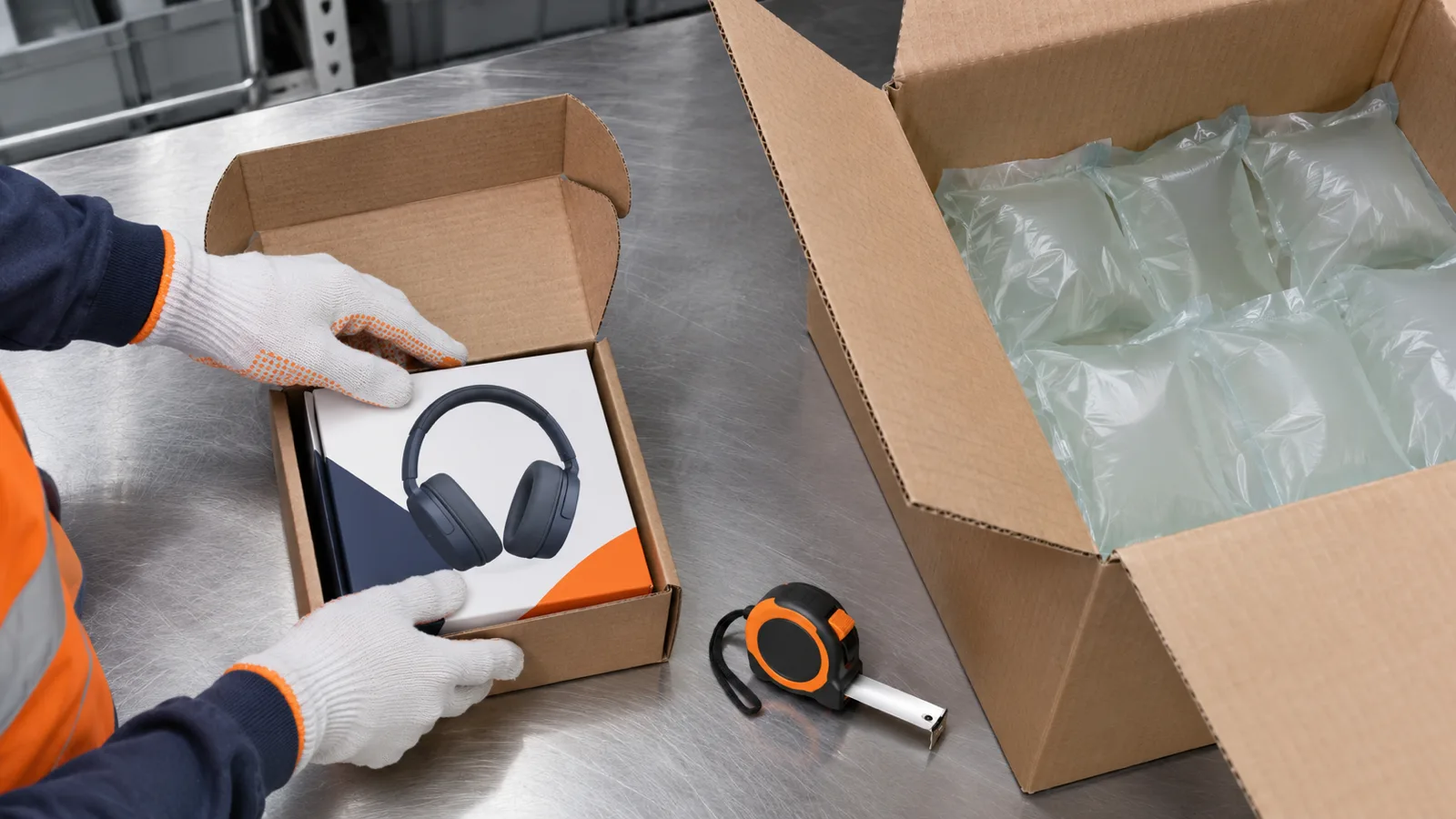
Picture a small online retailer in Winnipeg selling candles and home fragrance. Business has been brisk since spring, but when the owner sits down with the monthly carrier invoices, the numbers do not add up. A 600-gram candle should cost very little to ship, yet some parcels are being billed as if they weighed three or four kilograms. The difference is not a billing error. It is dimensional weight, and it is triggered by the boxes sitting on the packing table.
Dimensional weight, often shortened to DIM weight or called volumetric weight, is one of the least understood costs in Canadian ecommerce shipping. Parcel carriers charge for the space a package takes up in their trucks, planes and sortation systems, not just how heavy it is. If your boxes are larger than they need to be, you pay to ship air, and across a few thousand orders that air becomes a real line item.
The good news is that this is one of the few shipping costs you control directly. This article explains how dimensional weight works, how to find out whether it is affecting you, and a practical process for right-sizing your packaging without increasing damage.
How Dimensional Weight Works
Carriers serving Canada, including Canada Post, Purolator, UPS, FedEx and most regional couriers, calculate a dimensional weight for each parcel by multiplying its length, width and height and dividing by a set number known as the DIM divisor or DIM factor. They then compare the result with the actual scale weight and bill on whichever is greater.
Each carrier publishes its own divisor, and it can differ between domestic and international services or between metric and imperial calculations. Check the current service guide for each carrier you use rather than relying on a number you heard years ago, because carriers do revise them.
To see why it matters, imagine a box measuring 40 by 30 by 30 centimetres. That is 36,000 cubic centimetres. If a carrier's divisor were 5,000, the dimensional weight would be 7.2 kilograms, rounded up according to that carrier's rules. If the product inside weighs one kilogram, you are paying for more than seven. Put the same product in a 25 by 20 by 15 centimetre box (7,500 cubic centimetres) and the dimensional weight drops to 1.5 kilograms. Same product, same destination, very different bill.
Note that the numbers above are purely illustrative. The point is the relationship: dimensional weight grows with volume, so small reductions in each dimension compound quickly.
Signs That Dimensional Weight Is Costing You
Many sellers do not realize how much DIM weight affects them because the effect is buried in rate tables. Look for these warning signs:
- Your products are light relative to their size: pillows, apparel, lampshades, plush toys, candles, plastic housewares, packaged snacks.
- You use only two or three box sizes for a wide range of products.
- Packers routinely fill boxes with large amounts of void fill.
- Your carrier invoices include frequent adjustments where billed dimensions differ from what you entered.
- Your average shipping cost per order rose noticeably when you switched carriers or services, even though your products did not change.
A simple test is to pull a sample of recent invoices and compare billed weight against actual weight. If billed weight is higher on a large share of parcels, packaging is a lever worth pulling.
A Step-by-Step Approach to Right-Sizing
Step 1: Build a Product Dimension Database
You cannot pick the right box if you do not know the exact size of what goes in it. Measure every active SKU (length, width, height and weight) in its sellable packaging, and record the numbers in your product catalogue or warehouse system. Many brands skip this step and rely on manufacturer specifications, which are often rounded or describe the product rather than the retail package.
Step 2: Analyze Your Real Orders
Look at order history to understand which products ship alone and which ship together. A best-selling single item might deserve its own custom mailer, while common multi-item combinations might fit neatly into one specific box. This is where the 80/20 principle tends to show up: a relatively small number of product combinations usually account for most of your volume.
Step 3: Redesign Your Box Range
With dimensions and order patterns in hand, choose a set of box sizes that fit your common orders closely. For most small and mid-sized brands, somewhere between six and twelve sizes strikes a good balance between fit and the hassle of stocking many cartons. Consider adding:
- Poly mailers or padded mailers for soft goods and non-fragile items. These take up very little space and are often billed close to actual weight.
- Book-fold or wrap-around cartons for flat items such as prints, books or framed art.
- Telescoping or adjustable-height boxes that can be scored and folded down to reduce height for shorter orders.
Corrugated suppliers across Canada, in hubs such as the Greater Toronto Area, Montreal and the Lower Mainland, can produce stock and custom sizes. Custom cartons usually carry higher minimum order quantities, so balance savings on shipping against packaging inventory you will need to store.
Step 4: Guide Packers to the Right Box
Even with a better box range, packers under time pressure will grab whatever box is closest. Make the right choice the easy choice. Display the recommended box on the packing screen, store boxes in order of size with clear visual markers, and keep the most common sizes in the most convenient spot. Software-based cartonization, like the cartonization feature in our WMS, calculates the best box for each order automatically from product dimensions. We cover the physical side of this in our article on designing efficient packing stations.
Step 5: Protect the Product
Right-sizing does not mean squeezing fragile products into boxes with no cushioning. A parcel that arrives broken costs you a replacement, a second shipment and possibly a customer. Canadian parcels also face real conditions in transit: long line-haul runs across the country, multiple sortation hubs, and in winter, cold temperatures that make some plastics brittle. Leave enough room for appropriate protection, and use cushioning that does its job in less space, such as moulded pulp inserts or fitted corrugated partitions instead of loose fill.
Step 6: Measure and Repeat
After you change your box range, compare billed weight against actual weight again over the next month or two. Track damage claims at the same time. If damage rises, adjust. If carrier adjustments drop and billed weight moves closer to actual weight, the project is working.
Common Mistakes to Avoid
Right-sizing projects sometimes go wrong in predictable ways:
- Entering estimated dimensions. If your shipping software sends the carrier a box size that does not match reality, the carrier's own measuring equipment will catch it and add an adjustment charge.
- Bulging boxes. Overfilling a box so the sides or top bulge can increase the measured dimensions and defeat the purpose.
- Ignoring rounding. Carriers generally round each dimension up, so a box that measures 30.4 centimetres may be billed as 31. Designing boxes just under a whole number can help.
- Forgetting large package surcharges. Very long or very heavy parcels can attract extra handling fees beyond dimensional weight. Our overview of common shipping surcharges explains what to watch for.
- Too many sizes. Stocking 30 box sizes can create its own costs in storage space, purchasing and packer confusion.
Does Right-Sizing Help With Sustainability Too?
Yes, and Canadian shoppers increasingly notice. Smaller boxes use less corrugated material, need less void fill, and allow carriers to fit more parcels into each truck. Many consumers have complained about receiving a tiny item in an enormous box filled with plastic air pillows. Right-sized, recyclable packaging can improve the unboxing experience and support the environmental claims many brands now make. If you make specific environmental claims on packaging or marketing, keep them accurate; the Competition Bureau has issued guidance on environmental claims and expects them to be truthful and not misleading.
Frequently Asked Questions
Does dimensional weight apply to every parcel?
It depends on the carrier and service. Some carriers apply it to all parcels, while others only apply it above a certain size threshold or on specific services. Read the current rate guide for each carrier you use.
Does dimensional weight apply to LTL freight?
Less-than-truckload freight is priced differently, typically by weight, freight class or density and the linear space a shipment takes in the trailer. Density still matters: a light, bulky pallet can be expensive to ship. See our LTL freight services page for more on how pallet shipments are handled.
Is it worth buying a dimensioning device?
For operations shipping a few hundred parcels a day or more, automated dimensioners can improve accuracy and speed. For smaller sellers, a consistent box range with dimensions pre-loaded in shipping software usually achieves most of the benefit.
Can a 3PL help?
A fulfillment provider ships enough volume to have measured and refined packaging across many product types. It will typically already have a wide box range, cartonization software and negotiated carrier rates.
Stop Paying to Ship Air
Dimensional weight is not going away, and as online shopping grows across Canada, carriers have every reason to keep charging for the space parcels take up. Right-sizing your boxes is one of the most direct ways to lower your cost per order without changing carriers or raising prices.
ShipCarte helps businesses across Canada with ecommerce fulfillment, small parcel shipping and smarter packaging decisions. Request a quote and we will look at how your packaging and carrier mix could be working harder for you.