
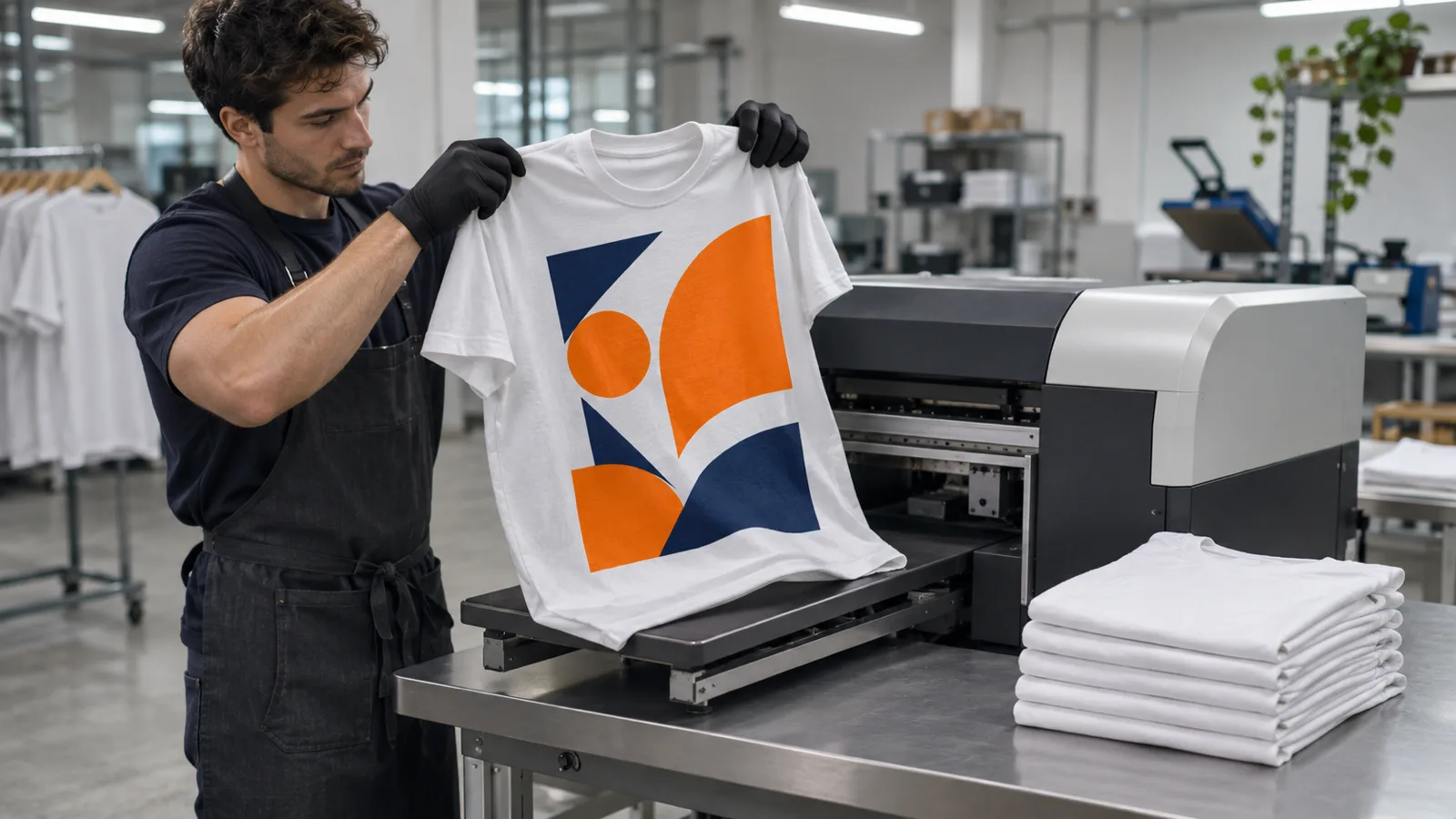
Print-on-demand is one of the easiest ways to start selling physical products online. An artist, a podcaster, a sports club or a small apparel label uploads designs, connects a storefront, and products are printed only when a customer orders them. No inventory, no upfront production run, no boxes in the basement.
For sellers whose customers are in Canada, there is a catch that often appears a few weeks after launch. Many popular print-on-demand services produce most orders in the United States. A shirt ordered in Saskatoon is printed in a US facility, shipped across the border, cleared by the CBSA, and handed to a Canadian carrier for final delivery. Delivery can take longer than shoppers expect, and some customers are surprised by sales tax or brokerage charges at the door. The resulting emails tend to land in the seller's inbox, not the print provider's.
That is why more Canadian sellers are looking at domestic production, either through print-on-demand providers that print in Canada or through hybrid models that combine on-demand printing with stocked inventory. This article compares the options and explains how to decide which one fits your business.
How print-on-demand works
The basic flow is the same across most providers:
- A customer places an order on your store.
- The order passes automatically to the print provider through an app or integration.
- The provider takes a blank product, such as a t-shirt, mug, poster or tote, from its stock and prints your design using direct-to-garment printing, sublimation, screen printing or another method.
- The finished item is packed, labelled and shipped to the customer.
- Tracking flows back to your store.
Where step three happens determines almost everything about the customer's experience: delivery time, cost, and whether the parcel crosses a border.
Producing abroad versus producing at home
When production happens in the United States
US-based production can offer a wide product catalogue and competitive base prices. For Canadian customers, though, it introduces a few issues:
- Longer transit. Orders must cross the border and clear customs before entering a Canadian carrier network. Delivery to major Canadian cities may take noticeably longer than domestic shipping, and longer still to rural and northern addresses.
- Taxes and possible fees on delivery. Imports into Canada attract GST or HST, and sometimes provincial tax, above a low value threshold. Depending on how the shipment is sent, the customer may also be charged a brokerage or handling fee by the carrier. Those charges are often a surprise.
- Duty questions. Many garments are made in third countries before being printed in the US. Printing alone does not necessarily make a product qualify as North American under NAFTA rules of origin, so some apparel may attract duty when it enters Canada.
- Returns friction. Sending an item back across the border is slow and expensive, so returns and exchanges are often handled by simply reprinting, which adds cost.
When production happens in Canada
Domestic production removes the border from the equation for Canadian orders. The main benefits are:
- Shorter delivery times. A product printed in Ontario or Quebec and shipped by ground can reach much of central Canada in a few business days after production. Western and Atlantic destinations take longer, but there is no customs step.
- No surprises at the door. Sales tax is charged at checkout based on the customer's province, and there are no import charges collected on delivery.
- Simpler returns. Exchanges and returns never cross a border.
- A stronger story. Some customers like knowing a product was made close to home.
The trade-offs are usually a smaller product catalogue and, in some cases, higher base costs per item. For many sellers, the reduction in support tickets and the improvement in delivery speed outweigh those differences.
The hybrid model: on-demand plus stocked inventory
Print-on-demand is ideal for testing designs and carrying a wide range of low-volume products. It becomes less efficient once a few designs start selling consistently. At that point, printing each item one at a time costs more per unit than producing a batch.
Many growing sellers move to a hybrid model:
- Best-sellers are produced in batches, for example through screen printing, which usually costs less per unit at volume, and then stored at a fulfilment centre.
- The long tail stays on demand, so the store can still offer hundreds of designs without holding stock of each.
- Orders are routed automatically: stocked items ship from the warehouse, on-demand items go to the printer.
The challenge is orders that contain both. A customer who buys a stocked hoodie and an on-demand poster may receive two parcels, which costs more and can confuse them. Some sellers accept split shipments. Others have the on-demand item sent to the warehouse and combine it with the stocked item before shipping, which adds a day but delivers one parcel. ShipCarte's e-commerce fulfillment can store your batch-produced best-sellers, and our order management tools route orders according to rules you set.
Working out the real cost per order
Comparing print-on-demand options on the base price of a printed shirt alone can be misleading. To see the real difference between producing at home and abroad, add up everything that goes into getting one order to one customer:
- Base product and print cost, which depends on the blank, the print method and the number of print locations.
- Shipping to the customer, including any cross-border leg and the domestic carrier's final delivery.
- Taxes and fees, either charged at checkout or collected from the customer at the door. Charges collected at the door do not appear on your invoice, but they show up in refused parcels and customer complaints.
- Reprints and refunds for misprints, damage and lost parcels.
- Customer service time spent answering delivery and fee questions.
Once these are included, the gap between a slightly cheaper base price abroad and a domestic option often narrows, and sometimes reverses. Run the numbers on a sample of your actual orders, with real destinations across Canada, rather than relying on a single example order to a major city.
Also consider what happens at volume. If one design sells hundreds of units a month, the cost per unit of a batch print run stored in a Canadian warehouse may be well below the on-demand price, even after storage and fulfilment fees. That is usually the point at which the hybrid model starts to make financial sense.
Questions to ask a print-on-demand provider
Before choosing or switching providers, get clear answers to these questions:
- Where exactly will orders for Canadian customers be printed?
- What is the typical production time, and how does it change in busy periods such as November and December?
- Which carriers do you use for Canadian deliveries, and is tracking provided to the customer?
- If production happens in another country, who pays import taxes and brokerage fees, and how are they shown to the customer?
- Which blank products and brands are available, and where are those blanks made?
- Can you add packing slips, inserts or branded packaging?
- How do you handle misprints, damage and size exchanges?
- Does your integration support my storefront, whether Shopify, WooCommerce, Etsy or another platform?
Labelling and compliance for apparel
Apparel sold in Canada must meet the Textile Labelling Act, which generally requires a permanent label showing fibre content in English and French and the identity of the dealer, either by name and address or by a CA identification number issued by the Competition Bureau. Blank garments usually come with a manufacturer's label, but if you relabel or brand garments as your own, you need to make sure the labels remain compliant. Care labelling is voluntary in Canada but widely expected by customers. Our post on apparel fulfillment covers more of the practical side of shipping clothing.
Delivery expectations across Canada
Even with domestic production, distances here are large. Set expectations by region on your shipping page: production time plus transit time, with realistic ranges for Ontario and Quebec, the Prairies, British Columbia, Atlantic Canada and the territories. Remember to include production time, which many shoppers do not realise exists with print-on-demand. Our guide to the real cost of slow shipping explains why getting this right matters for repeat purchases.
Carrier networks also carry heavier residential volumes during peak periods such as the holiday season, and delivery times can stretch. Communicating that honestly at checkout builds trust.
Selling to customers in the United States
If a meaningful share of your customers are in the United States, the logic flips. US-based production may make sense for those orders, while Canadian orders are printed domestically. Some providers route orders automatically based on the destination. If you stock inventory in Canada and ship to US customers, cross-border shipping services can consolidate parcels and simplify customs.
When to move beyond pure print-on-demand
A few signs that it might be time to add stocked inventory or switch to domestic production:
- Customers regularly ask where their order is, or complain about fees at delivery.
- A small number of designs account for most of your sales.
- Your margin per item is thin because of on-demand unit costs.
- You want custom packaging, inserts or bundles that your provider cannot offer.
- You are planning a launch or promotion that will create a sudden spike in orders.
Build a faster supply chain for your Canadian customers
Print-on-demand is a great way to start, and domestic production or a hybrid model is often the way to grow. ShipCarte helps Canadian sellers store their best-selling products, combine them with on-demand items, and ship quickly to customers across Canada and beyond. Schedule a consultation to look at how your orders flow today and where delivery could be faster.