
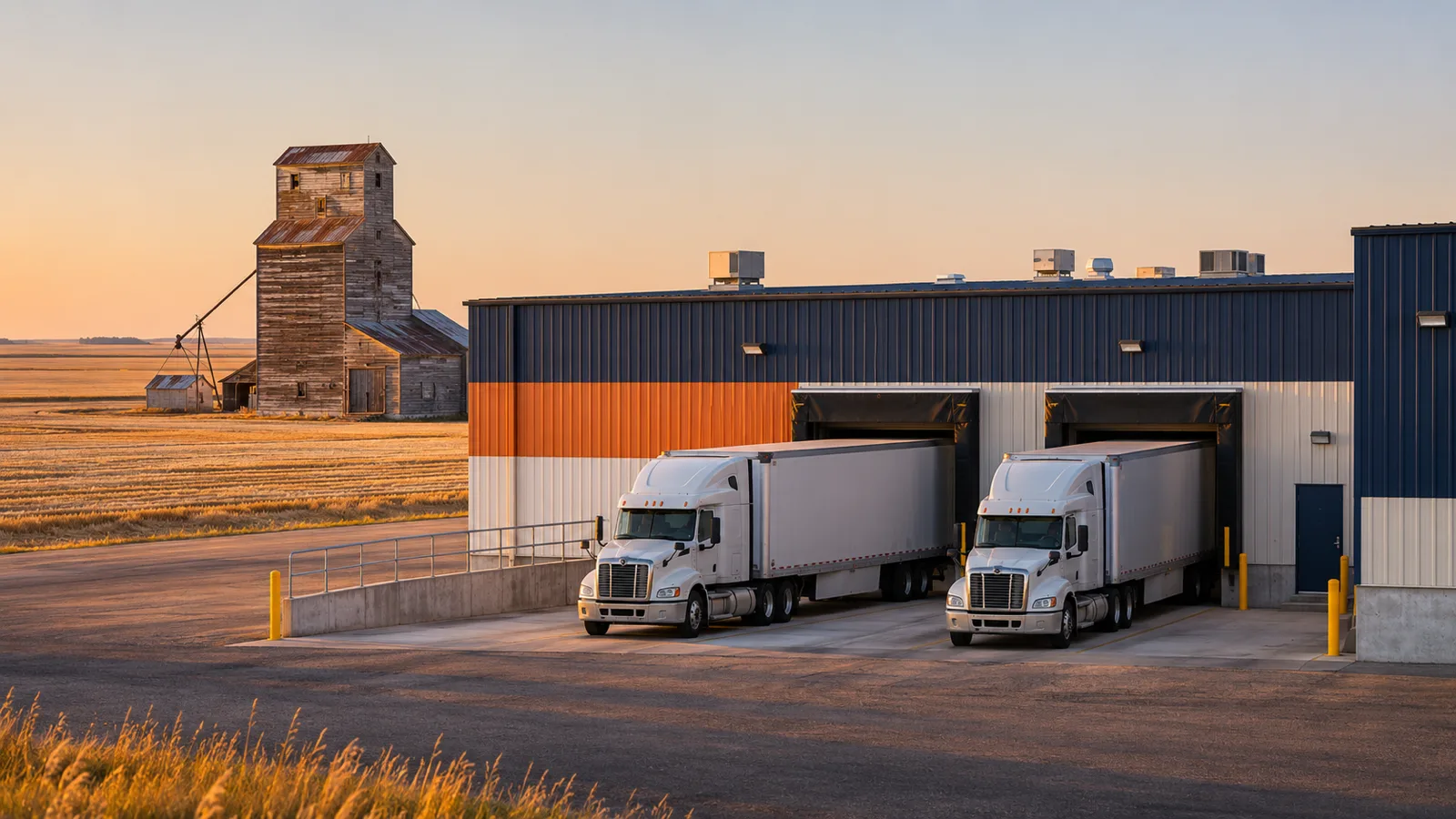
Picture a consumer goods company based in central Canada that has done well in Ontario and Quebec and is now seeing steady orders from Winnipeg, Regina, Saskatoon, Calgary and Edmonton. A few independent retailers in smaller Prairie towns have started carrying the product too. Every week, someone in the warehouse is booking LTL shipments to a dozen different Prairie destinations, and every month the freight bill gets harder to explain.
That is a common moment for growing businesses. The three Prairie provinces together cover a vast area with a handful of large cities separated by hundreds of kilometres of highway, farmland and small communities. Serving them well is less about any single shipment and more about designing a distribution approach that fits the geography.
This article walks through that design process: how the Prairie freight network works, where to position inventory, how to reach rural customers, and what seasonal factors to plan around.
Understanding the Prairie freight network
The Prairies are tied together by a few major corridors. The Trans-Canada Highway (Highway 1) runs east to west through Winnipeg, Brandon, Regina, Moose Jaw, Medicine Hat and Calgary. The Yellowhead Highway (Highway 16) takes a more northerly path through Portage la Prairie, Yorkton, Saskatoon, Lloydminster and Edmonton. Between Alberta's two biggest cities, Highway 2 carries one of the busiest freight flows in Western Canada.
Both national railways run main lines across the region, with intermodal terminals serving Winnipeg, Regina, Saskatoon, Calgary and Edmonton. Winnipeg has developed an inland port area, CentrePort Canada, aimed at linking road, rail and air freight. Regina has the Global Transportation Hub, an inland logistics zone near the city. Calgary and Edmonton both have large concentrations of distribution centres serving Western Canada.
Most LTL carriers maintain terminals in the major cities and reach smaller towns either directly on scheduled routes or through partner carriers, often described as "beyond" or interline points. Knowing which communities a carrier serves directly versus through a partner is one of the most useful pieces of information you can collect.
Step one: map where your Prairie demand actually is
Before choosing a strategy, look at the data. Pull a year of shipments to Manitoba, Saskatchewan and Alberta and group them by destination city or postal code region. Many businesses find that a large share of volume goes to the Calgary–Edmonton corridor, with Winnipeg as a second cluster, and then a long tail of smaller cities and towns.
Look at three things for each cluster:
- How many shipments, and how big they are (parcels, single pallets or multi-pallet orders).
- How quickly those customers expect delivery.
- What you are currently paying per shipment, including accessorials.
This analysis will usually point you towards one of the three approaches below.
Step two: choose a distribution model
Option A: ship everything direct from central Canada
This is where most businesses start. Every order leaves your main warehouse in Ontario or Quebec and travels across the country by parcel, LTL or truckload. It keeps inventory in one place and is simple to manage. The trade-offs are longer transit times and higher per-shipment costs on long LTL and parcel moves. It works well when Prairie volume is modest or when products are high-value and light.
Option B: one western hub
When Prairie volume is meaningful, consolidating it into regular truckloads to a single western hub and distributing from there can lower costs and shorten delivery times. The main candidates are:
- Calgary, which sits close to the largest Prairie population and also offers good access to British Columbia via the Trans-Canada.
- Edmonton, which is a gateway to northern Alberta, the oil sands region and the Northwest Territories, and serves Saskatchewan via the Yellowhead.
- Winnipeg, which is the closest major Prairie city to central Canada, serves Manitoba and eastern Saskatchewan well and connects strongly to US Midwest routes.
- Regina or Saskatoon, which are central within the region and can make sense for businesses with heavy Saskatchewan demand, such as agricultural suppliers.
For many consumer and retail brands, Calgary or Edmonton covers the largest share of Prairie and western demand. Businesses with strong Manitoba sales may lean towards Winnipeg.
Option C: hub plus regional pool points
Larger shippers sometimes combine a main western warehouse with pool distribution, sometimes called zone skipping. A full truck travels to a regional point, then the freight is broken down and delivered locally by a regional carrier. This approach can reduce the number of terminal handlings and speed up delivery to clusters of customers, such as a group of retailers in Saskatchewan. It requires enough consistent volume to fill trucks regularly.
Whichever model you choose, distribution services that combine warehousing and transportation planning make it easier to adapt as volume shifts between cities.
Step three: plan for rural and small-town delivery
Rural customers are a big part of the Prairie economy. Farms, acreages, agricultural dealers, small-town retailers and industrial sites all need deliveries, often to addresses far from the nearest carrier terminal.
A few practical points:
- Expect longer transit times and extra charges for points outside a carrier's regular service area. Ask carriers for their direct-service maps.
- Farm and rural addresses often use legal land descriptions or rural route numbers. Make sure your order system can capture them and pass them clearly to the carrier, along with a phone number.
- Many rural consignees have no loading dock. Book delivery appointments and liftgate service where needed to avoid redelivery charges.
- For parcels, Canada Post reaches every community, while private couriers are often strongest in the cities. Comparing both by destination usually pays off.
The northern edge of the Prairies
Northern Manitoba, northern Saskatchewan and northern Alberta add another layer. Communities such as Thompson, Flin Flon, La Ronge, Fort McMurray and Peace River are served by highway, but distances from the southern hubs are long and carrier options narrower. Some remote First Nations communities and northern settlements depend on winter roads that only open for part of the year, or on air freight. Edmonton in particular acts as a staging point for freight heading to northern Alberta and on to the Northwest Territories. If you have customers in these areas, talk to carriers well in advance about schedules, seasonal access and consolidation, and expect transit times measured in days rather than hours.
Connections south of the border
The Prairies also connect directly to the United States, through crossings such as Emerson in Manitoba, North Portal in Saskatchewan and Coutts in Alberta. For businesses that source from or sell into the US Midwest and Mountain states, a Prairie hub can double as a cross-border gateway, though customs documentation and brokerage need to be built into the plan.
Step four: plan around Prairie seasons
Winter cold
Prairie winters bring extended periods of extreme cold, blowing snow and highway closures. Liquids, paints, adhesives, beverages, some foods and many health products can be damaged if they freeze. Heated or protective service is available from many carriers, usually as an accessorial, and products that need tight temperature ranges may require temperature-controlled warehousing and transport.
Spring road restrictions
Each spring, as the ground thaws, Prairie provinces and municipalities place seasonal weight restrictions on many secondary highways and local roads to protect them from damage. During this period, heavy trucks may be limited in what they can carry on certain routes. For shippers delivering to rural areas, this can mean smaller loads, longer routes or delays. Ask your carriers how they handle spring restrictions for your destinations, and avoid scheduling time-critical rural deliveries in that window where possible.
Harvest and agricultural peaks
Late summer and autumn bring harvest, when agricultural freight competes for trucks and rail capacity across the region. Shippers of farm inputs, equipment parts and related products feel this most, but general freight capacity can tighten too.
Step five: get the tax and paperwork details right
The Prairie provinces have different sales tax set-ups. Alberta has no provincial sales tax, so only the 5 per cent GST applies. Saskatchewan and Manitoba each charge their own provincial sales tax on top of GST, administered separately from the federal tax. If you sell directly to consumers or businesses in those provinces, check whether you need to register and collect provincial tax there, and make sure your systems apply the right rates by destination.
On the freight side, consistent documentation, from accurate bills of lading to clear consignee contact information, prevents most of the delivery problems that show up in rural areas.
How to know your Prairie set-up is working
Once your model is in place, track a few measures by province and by city versus rural destination: average transit time, cost per order or per pallet, damage and claim rates, and on-time delivery to retail customers. Reporting and analytics that break these out by region make it much easier to see whether a hub is paying off, whether a particular carrier is struggling with rural deliveries, or whether it is time to add a second stocking point.
The past year has also shown that flexibility matters. Shifts in demand during the pandemic pushed some businesses to rebalance inventory between regions at short notice. A distribution set-up with more than one option, whether that is a western hub or a strong carrier mix, made those adjustments far easier.
Build a Prairie network that fits your business
Serving Manitoba, Saskatchewan and Alberta well comes down to matching your distribution model to where your customers really are, choosing carriers who reach the communities you need, and planning around the seasons. There is no single right answer, but there is almost always a better one than shipping every order the same way.
ShipCarte works with businesses across Canada on warehousing, freight and fulfillment, including distribution to the Prairie provinces. If you are rethinking how you serve the region, schedule a consultation and we can work through the options with your data.