
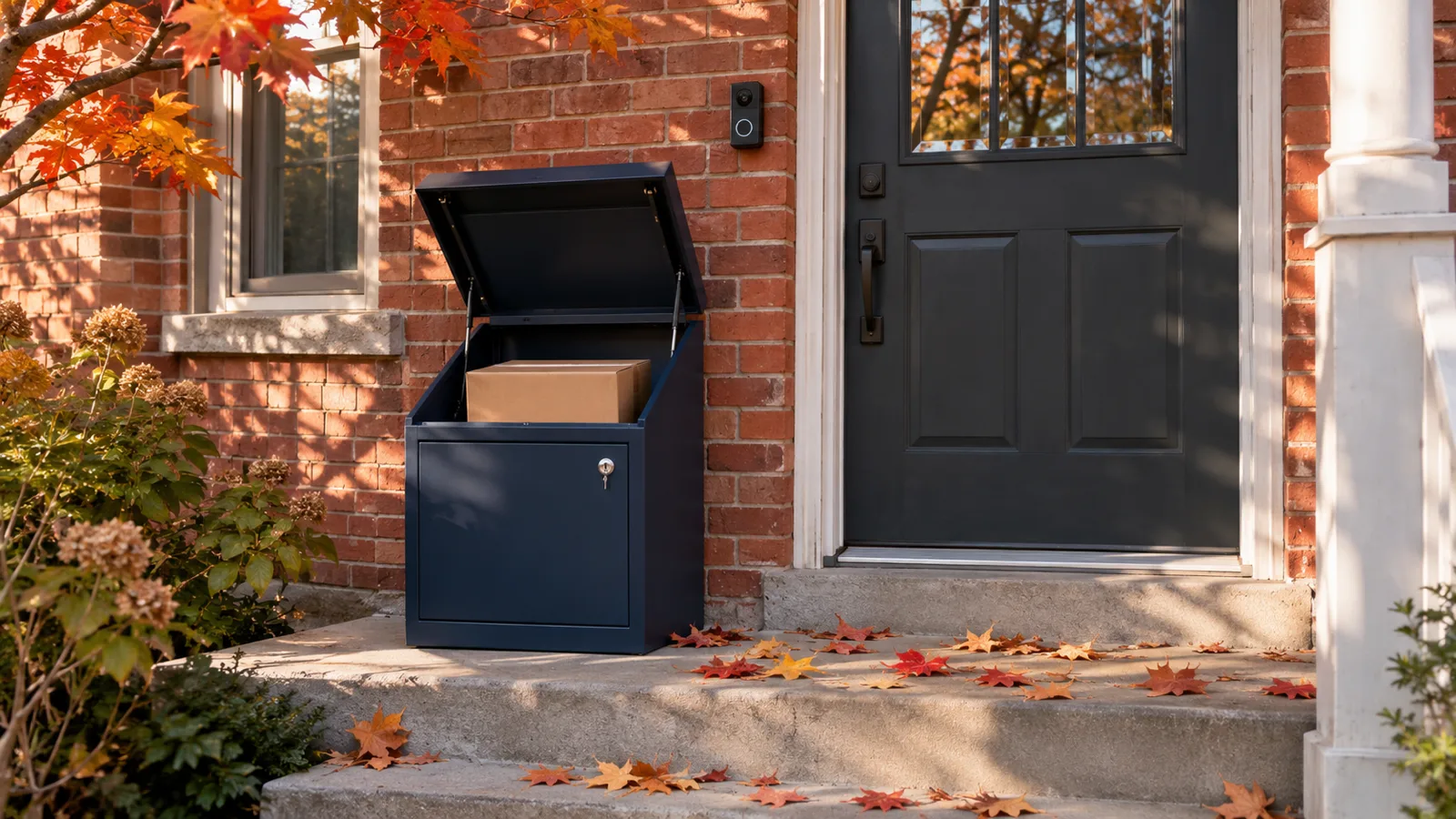
The email arrives on a Monday morning: "Tracking says my order was delivered Friday, but there's nothing here. My neighbour's camera shows someone walking up my steps right after the courier left." The customer is upset, the product is gone and your support agent now has to decide whether to reship, refund or open a claim, knowing that the same thing happened twice last month in the same part of town.
Porch theft is a familiar frustration in cities and suburbs across Canada. Parcels left on steps, in building lobbies or at mailboxes are easy targets, especially in the busy months leading up to the holidays. For online retailers, every stolen parcel is a cost: the product, a second shipment, support time and sometimes a lost customer who blames the store rather than the thief.
The good news is that retailers have more influence over porch theft than they might think. This article looks at the problem from three angles: what you can do before an order ships, how delivery choices change the risk, and how to handle theft claims fairly when they happen.
Why parcels go missing
Not every "delivered but not received" report is theft. Before building a prevention plan, it helps to recognise the usual causes:
- Theft from porches, steps and mailboxes after a legitimate delivery.
- Theft from shared spaces, such as apartment lobbies and mailrooms with weak access control.
- Misdelivery to a neighbour or the wrong unit, often because of an incomplete address.
- Early delivery scans, where a parcel is marked delivered before it actually arrives.
- Hidden deliveries, where a driver leaves the parcel at a side door, behind a planter or in a garage, and the customer has not yet found it.
- Fraudulent claims by a small number of customers who received the parcel.
A good prevention plan reduces all of these, and a good claims process helps you tell them apart.
Before the order ships
Use discreet packaging
A box printed with a well-known electronics or luxury brand advertises its contents to anyone walking by. Plain outer cartons or mailers, with the brand experience saved for the inside, make a parcel less tempting. This is especially important for high-value products and for health and personal care items, where customers also care about privacy.
Keep the shipping label minimal
Labels should carry what the carrier needs and nothing more. Avoid product descriptions in reference fields that print on the label. For international and cross-border shipments, customs descriptions must be accurate, but they do not need to be marketing copy.
Get the address right
Misdelivery to the wrong unit is often mistaken for theft. Unit numbers, buzzer codes and clear delivery instructions reduce it. Our guide to address validation in Canada covers checkout checks that prevent many of these errors.
Flag high-risk orders
Your order management rules can identify orders above a set value, orders containing frequently stolen products or orders to addresses with past loss claims, and apply extra protection automatically, such as a signature requirement.
Delivery choices that reduce risk
Signature required
Requiring a signature means the parcel is handed to a person rather than left at the door. It is one of the most effective deterrents, but it adds cost and inconvenience: if nobody is home, the parcel goes to a depot or pickup point. Many stores apply signature requirements only above a certain order value or for specific products, and let customers opt in for other orders.
Pickup points and parcel lockers
Offering delivery to a post office, courier access point or parcel locker takes the doorstep out of the equation entirely. For customers in apartments or neighbourhoods where theft is common, this can be the most reliable option. Read more in our article on parcel lockers and pickup points in Canada.
Delivery instructions
A delivery instructions field at checkout lets customers ask drivers to leave parcels at a side door, with a building concierge or in a secure parcel box. Make sure your systems pass those instructions to the carrier and that they print where drivers will see them.
Delivery notifications
Customers who know a parcel is arriving today can plan to be home or ask a neighbour to collect it. Email or text notifications with the delivery window, and a final "delivered" alert, shorten the time a parcel sits unattended. Some carriers also offer delivery photos, which help resolve disputes.
Choosing the right service and carrier
Different carriers offer different options for signature, hold-for-pickup and redirection. A multi-carrier shipping platform and carrier management let you match the service to the order's value and destination rather than using one approach for everything.
Tips you can share with customers
Customers can do a lot to protect their own parcels, and a short section in your FAQ or shipping confirmation email shows you care. Suggestions include:
- Track your parcel and bring it inside as soon as it is delivered.
- Choose a pickup point or locker if you will not be home.
- Ship to a trusted address, such as a family member who is usually home.
- Use a lockable parcel box or a secure parcel room if your building has one.
- Add clear delivery instructions, including buzzer codes and safe drop locations.
- Ask a neighbour to collect parcels while you are away.
With many Canadians working from home this year, more people are around to receive deliveries during the day, but that is not true everywhere. Keep these tips visible, particularly in the run-up to Black Friday and the December holidays.
Seasonal and regional patterns
Porch theft risk is not the same everywhere or all year. A few patterns are worth building into your rules:
- Holiday peak. From late November through December, parcel volumes rise, doorsteps fill up and early darkness gives thieves more cover. Consider lowering your signature threshold for this period and promoting pickup options more prominently.
- Dense urban neighbourhoods. Busy streets with row houses and walk-up apartments, common in parts of Toronto, Montreal and Vancouver, offer plenty of visible, accessible porches. Shared lobbies without parcel rooms are another weak spot.
- Suburbs during the workday. Quiet residential streets where most homes are empty during business hours can leave parcels sitting for hours.
- Rural and community mailbox deliveries. In areas served by community mailboxes or the local post office, parcels are less likely to be left at a door, but larger items may still be dropped at the end of a long driveway. Clear instructions help here.
- Winter weather. A parcel buried under snow on a porch in Ottawa or Saskatoon is a different problem from theft but leads to the same complaint. Encourage drivers, through delivery instructions, to leave parcels in sheltered spots.
Your own claims data is the best guide. If losses cluster in certain forward sortation areas, apply extra protection to orders shipping there rather than to every order nationwide.
When a parcel goes missing: a fair claims process
Even with good prevention, some parcels will disappear. A clear process protects both the customer relationship and your margins.
- Ask the customer to check thoroughly. Side doors, garages, mailrooms, building management and neighbours. Many "missing" parcels turn up within a day.
- Review the tracking details. Look at the delivery scan time, any GPS or photo information the carrier provides, and the address used.
- Open a carrier trace or claim. Carriers have time limits for reporting loss, so act promptly. Note that many carriers will not accept liability once a parcel is scanned as delivered without a signature.
- Ask the customer to report theft to local police if they believe the parcel was stolen. A police report number can support insurance claims and helps communities track patterns.
- Decide on resolution. Reship, refund or offer pickup delivery for the replacement, according to your policy.
- Record the outcome. Tracking claims by postal code, product and carrier helps you spot patterns and adjust your rules.
Write the policy down
Your shipping policy should state what happens when a parcel is marked delivered but not received. Common approaches include replacing the first claim and requiring signature delivery on future orders, or replacing items when the order was shipped with insurance. Whatever you choose, apply it consistently. Our guide to writing a shipping policy for an online store in Canada covers this section in detail.
Consider insurance
Carrier declared value coverage often excludes parcels left at the door without signature. Third-party shipping insurance products may cover theft after delivery, depending on the terms. Check the fine print before relying on it. See our guide on the best shipping insurance for ecommerce stores.
Watch for patterns of abuse
Most customers are honest, but repeat claims from the same account or address deserve a closer look. Requiring signature or pickup delivery for future orders is usually a fair and polite way to handle it without accusing anyone. Our article on returns fraud discusses similar patterns on the returns side.
How fulfillment helps
Many porch theft defences are built into fulfillment: choosing plain outer packaging, applying signature rules by order value, passing delivery instructions to carriers and sending accurate tracking to customers. ShipCarte's ecommerce fulfillment and pick and pack teams can follow custom packing and shipping rules for each product or order type.
Keep orders safe from warehouse to doorstep
Porch theft will not disappear, but retailers in Canada can make their parcels harder to steal, easier to protect and simpler to resolve when something goes wrong. If you would like help setting up packaging, delivery and signature rules that fit your products and customers, request a quote or schedule a consultation with ShipCarte.