
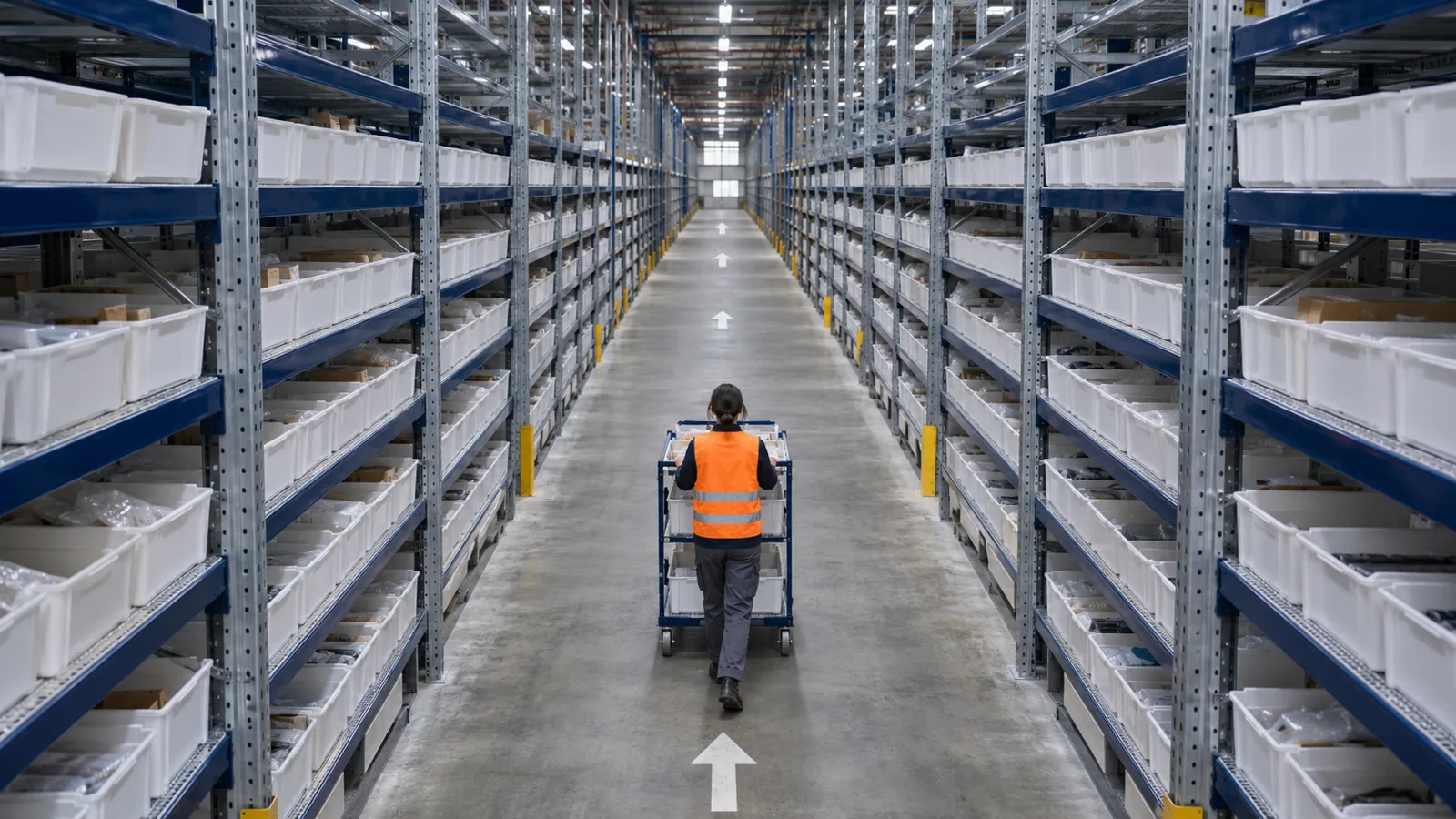
Stand at the end of an aisle in a typical fulfillment centre for ten minutes and watch the pickers. What you will mostly see is walking. A picker heads to the far end of the building for one item, comes back past three bays they will need on their next order, turns down another aisle, doubles back, and eventually arrives at the pack station. In many warehouses, travel is the largest single part of the picking process, often more than the time spent actually reaching for and scanning products.
That walking is pure cost. It does not add value for the customer, it tires workers out, and it limits how many orders a shift can handle. As ecommerce volumes in Canada build toward another holiday peak, many fulfillment operations are discovering that their old picking routines do not scale. Adding more people to the floor helps for a while, but eventually the aisles get crowded and productivity per person falls.
Pick path optimization is the discipline of reducing that wasted travel. It combines how orders are routed through the building, where products are stored, and how the layout itself is designed. This guide walks through each piece with practical steps you can apply whether you run a 15,000-square-foot space or a large regional distribution centre.
Measure Before You Change Anything
You cannot improve what you have not measured. Before redesigning anything, collect a baseline:
- Lines picked per labour hour, by picker and by shift.
- Average travel distance per order or per line, which some warehouse management systems can estimate from location coordinates. If yours cannot, a few days of observation with a pedometer or a timed walk gives a useful approximation.
- Order profile: how many lines per order on average, how many units per line, and how many single-line orders.
- SKU velocity: how often each product is picked over a recent period.
The order profile matters a lot. A business that ships mostly single-item orders, such as a phone accessory seller, needs a very different picking approach from one shipping large multi-line baskets, such as a grocery or pet supply brand.
Routing Strategies: How Pickers Move Through the Aisles
Routing is the order in which a picker visits locations. Even with the same layout and slotting, a smarter route can noticeably reduce travel. The main strategies are:
S-shape (traversal)
The picker enters every aisle that contains at least one pick and walks its full length, snaking through the building. It is simple, easy to teach and works well when there are many picks per aisle. It is inefficient when picks are sparse, because the picker walks entire aisles for one item.
Return
The picker enters each aisle from the same main cross aisle, goes as far as needed, and comes back out the same end. It works well when picks are concentrated near the front of aisles, which is exactly what good slotting tries to achieve.
Midpoint
The warehouse is divided in half. The picker picks the front half of each aisle from the front cross aisle and the back half from the back cross aisle. It often outperforms both S-shape and return when picks are spread out.
Largest gap
Within each aisle, the picker goes in from either end as far as the largest gap between picks, avoiding walking the longest empty stretch. It is more efficient but harder to follow without system guidance.
Optimised or combined routing
A warehouse management system can calculate a route for each pick list based on actual location coordinates, combining the best elements of the methods above. This is usually the most efficient option, provided the location data is accurate and the system displays the sequence clearly on the picker's device.
If your current system simply sorts pick lists alphabetically by location code, check whether the location codes actually follow the walking path. In many warehouses they do not, because aisles were numbered in the order they were built rather than the order a person walks them. Re-sequencing locations to match the walking route is one of the cheapest improvements available.
Slotting: Putting the Right Products in the Right Places
Routing decides how pickers walk. Slotting decides where they need to go. The principle is simple: put the products that are picked most often in the places that are easiest to reach and closest to the pack area.
Velocity-based slotting
Rank SKUs by how often they are picked (pick frequency, not units sold). Usually a small share of SKUs accounts for a large share of picks. Place those fast movers:
- In the aisles nearest the pack stations or the start of the pick path.
- At the front of aisles, so the return routing method works well.
- At waist to shoulder height, the "golden zone" where picks are fastest and safest.
Slow movers can go further away, on higher or lower shelves, or in reserve storage.
Affinity slotting
Some products are frequently ordered together: a phone case and a screen protector, a shampoo and its matching conditioner, a coffee maker and filters. Storing them near each other reduces travel for multi-line orders. Your order history will show which pairs appear together most often.
Size and weight considerations
Heavy items should be at lower levels and ideally picked first so they sit at the bottom of the cart or tote. Bulky items may need their own zone near the dock. Very small, high-value items may be better in a secure area with dedicated bins.
Re-slot regularly
Velocity changes. Seasonal products, new launches and promotions all shift which SKUs are fast. In Canada, where demand swings sharply between seasons, a slotting plan set in spring may be wrong by fall. Review slotting at least quarterly, and before major peaks such as back-to-school and the holiday season.
Layout Choices That Affect Travel
Layout changes take more effort but can deliver lasting gains.
- Cross aisles. Long aisles without breaks force pickers to walk around. Adding a cross aisle in the middle of long runs can cut travel considerably.
- Pack station location. Pack stations placed in the centre of the pick area, rather than at one end, shorten the average trip.
- Forward pick and reserve. Separate a compact forward pick area, replenished from bulk reserve storage, so pickers work in a small zone instead of the whole building.
- Mezzanines. In markets where industrial space is expensive, such as the Greater Toronto Area and Metro Vancouver, many operators add mezzanine levels for small-item picking. Place the fastest movers on the ground floor to minimise stair or lift trips.
- Dock placement. Keep receiving and shipping traffic out of the main pick aisles. In Canadian winters, cold air from open dock doors can also make nearby pick zones uncomfortable, which is another reason to keep pick areas away from docks.
Combine Path Optimization With Smarter Order Grouping
Routing and slotting reduce travel per pick list. Grouping orders reduces the number of pick lists. Picking several orders in a single trip, using a multi-tote cart or a put wall, means one walk covers many orders. Zone picking assigns pickers to a specific area so they never walk the whole building. Our companion article on batch, wave and zone picking in Canada explains how these methods work and when to use each.
A Step-by-Step Improvement Plan
- Measure current lines per hour and estimate travel.
- Pull a pick frequency report for the last 90 days.
- Check whether location codes follow the physical walking path; re-sequence if not.
- Re-slot the fastest movers to the front, the golden zone and near pack stations.
- Choose a routing method that suits your order profile, or let your WMS optimise routes.
- Introduce multi-order picking for small orders.
- Look at layout changes such as cross aisles and pack station placement.
- Measure again after a few weeks and compare against the baseline.
Technology That Helps
A capable warehouse management system makes nearly every step above easier. It holds location coordinates, calculates routes, produces velocity reports, suggests slotting changes, and directs pickers on handheld devices. Connected order management lets you group orders intelligently by shipping method, carrier cut-off or zone. Accurate location data is essential; if your inventory records do not match the shelves, no route will be efficient. Our article on the put-away process in a warehouse explains how disciplined put-away keeps location data trustworthy.
Common Pitfalls
- Slotting by product category instead of pick frequency, which looks tidy but spreads fast movers around the building.
- Letting fast movers drift to reserve locations because forward pick bins are too small.
- Re-slotting everything at once during a busy period, which confuses pickers and causes errors.
- Ignoring ergonomics; a shorter walk is no gain if it means more bending and reaching.
- Measuring only speed and not accuracy.
Faster Picking Without the Project Work
Pick path optimization is ongoing work, and it competes with everything else on a growing brand's plate. One option is to let a fulfillment partner handle it. ShipCarte's pick and pack services and ecommerce fulfillment combine warehouse technology with experienced teams serving brands across Canada. Request a quote to see how quickly your orders could be moving.