
A pet owner who runs out of dog food does not wait a week for the next delivery. They drive to the nearest store, buy whatever is on the shelf, and sometimes never come back to the brand they were using. That single fact shapes almost every decision in pet food and supply distribution in Canada: the product is a repeat purchase, the customer is loyal until the moment they are not, and a stockout costs more than one sale.
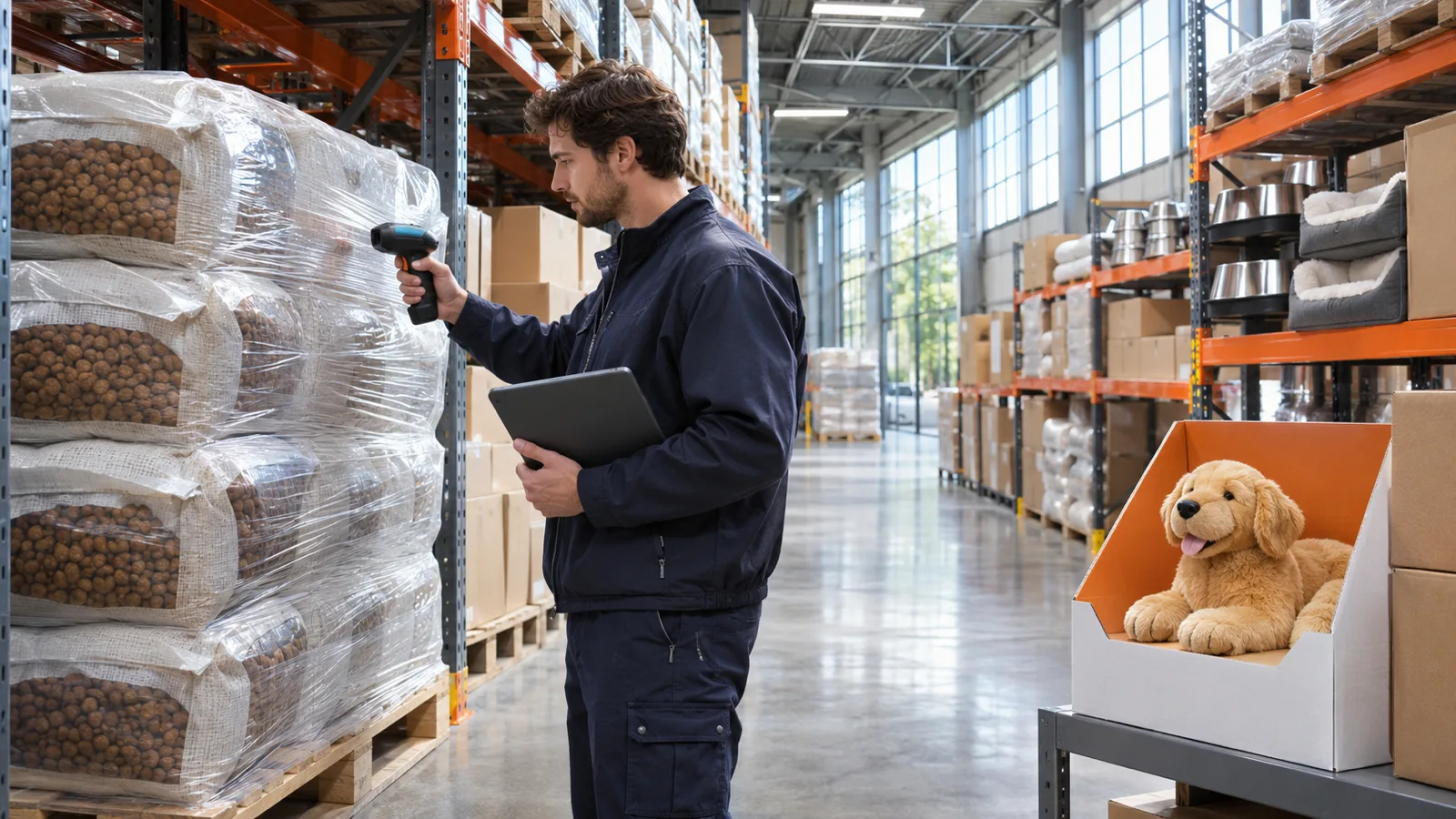
For pet brands, the logistics problem is also unusually physical. A 13 or 15 kilogram bag of kibble is heavy, awkward and prone to splitting. Wet food comes in cases of cans that weigh far more than their size suggests. Litter is dense and dusty. Then, on the other end of the catalogue, there are lightweight toys, collars, grooming tools and treats that move like any other ecommerce item. Running both kinds of product through one network, to independent pet stores, regional chains and online customers spread from Victoria to St. John's, takes some planning.
More Canadian households are ordering pet supplies online each year, often on autoship, and plenty of independent pet stores have started offering local delivery to keep up. That gradual shift is exposing which brands have their distribution sorted out and which are relying on a single channel. This guide walks through how pet food and supply distribution works in Canada, what rules affect your labels and imports, and how to set up warehousing and shipping that keeps bowls full.
How the Canadian Pet Supply Channel Is Structured
Most pet products reach Canadian consumers through some mix of four channels. Understanding which ones you sell into determines how your inventory needs to be stored and shipped.
- Independent pet specialty stores. Canada still has a strong network of independent shops, especially in smaller cities and towns. They usually order mixed cases through a distributor or directly from the brand, in quantities that range from a few cases to a pallet.
- Regional and national pet chains. Larger retailers expect pallets or full truckloads delivered to their distribution centres, with appointment booking, specific pallet configurations and advance ship notices.
- Grocery, mass and farm supply retail. These buyers often run strict routing guides and compliance programs, and some prefer to receive through their own warehouses rather than store by store.
- Direct-to-consumer and marketplaces. Your own online store, autoship programs and marketplaces such as Amazon.ca, where each order is a single parcel to a home address.
A brand that sells only through distributors can get away with simple pallet-in, pallet-out storage. A brand that sells into all four channels needs a warehouse that can ship a truckload to a retailer's DC in the morning and pick a single bag of treats for a subscriber in the afternoon, from the same inventory pool. That is the core of distribution warehousing for pet brands.
Rules That Affect Pet Food Labels and Imports in Canada
Pet food in Canada is not regulated the same way human food is. There is no single federal pre-market approval system for most commercial pet food sold in Canada, and that surprises brands coming from other markets. That does not mean there are no rules. Several different frameworks touch your product, and your distribution partner needs to understand them well enough not to break anything.
Labelling and advertising
Pet food packaging sold in Canada falls under the Consumer Packaging and Labelling Act and its regulations, which set out requirements for the product identity, net quantity in metric units and the dealer's name and principal place of business. The Competition Bureau administers that act and has published guidance specifically on the labelling and advertising of pet foods, covering things like how ingredient names and claims are presented. Labels generally need to carry the mandatory information in both English and French, and products sold in Quebec face the province's own French language requirements on packaging and marketing materials.
In practice, this affects distribution in two ways. First, if you import product that was labelled for the US market only, it may need relabelling or stickering before it can be sold here. Second, any value-added work like bundling, multipacks or promotional overwrap should not cover mandatory information. A warehouse that offers labelling as part of its value-added services can apply compliant bilingual stickers at receiving, but the content of those stickers is the brand's responsibility.
Animal health import controls
The Canadian Food Inspection Agency (CFIA) controls imports of pet food and treats that contain animal products, because those products can carry animal diseases. Depending on the ingredients and the country of origin, an import may need a permit, a certificate from the exporting country, or both. Commercial imports of products containing ingredients like beef, poultry or other animal by-products from some countries face restrictions. The CFIA's Automated Import Reference System (AIRS) is the standard place to check requirements for a specific product and origin before you book freight.
Plant-based products and many accessories face fewer controls, but they still clear through the Canada Border Services Agency (CBSA) with the usual duties and GST. Treats made from rawhide, bully sticks, pig ears and similar products deserve particular care, as these are the items most likely to be held for documentation questions. If you are bringing product up from the US, which is common for brands with American co-packers, work out the paperwork before the first truck crosses at Windsor, Fort Erie, Lacolle or the Pacific Highway, not while it is sitting at the border. Our cross-border shipping team can help coordinate brokers and documentation for regular lanes.
Recalls and traceability
Pet food recalls do happen in Canada, usually involving contamination concerns or formulation issues. Even where a recall is voluntary, retailers expect brands to identify affected lots quickly and pull them out of the supply chain. That is only possible if your warehouse records lot numbers and best-before dates at receiving and tracks which lots went to which customer. Treat lot tracking as a requirement from day one, not a feature you add later.
Warehousing Pet Food: What Good Looks Like
Dry pet food is ambient product, but "ambient" is not the same as "anything goes". Kibble contains fats that can go rancid with heat, and bags stored near dock doors in a Winnipeg winter or beside a sunny wall in a Kelowna summer can take a beating. Here is what to look for in a facility handling pet food in Canada.
Clean, pest-controlled storage
Pet food attracts rodents and insects. A facility storing it should run a documented pest control program, keep product off the floor on pallets, maintain clear space along walls for inspection, and quarantine any damaged or leaking bags immediately. If a split bag sits in a pick face for three days, you will hear about it from the next customer.
Date and lot control
Pet food carries best-before dates, and large retailers often set minimum remaining shelf life on receipt. The warehouse should pick on a first-expired, first-out basis, record lot numbers on outbound shipments and flag short-dated stock before it becomes unsellable. Good inventory management turns those dates into a report you can act on, rather than a surprise at the end of the quarter. If you are unclear on rotation methods, our explainer on what FIFO means covers the basics.
Slotting heavy and light items differently
Heavy bags belong in floor-level or waist-height locations close to the packing area. Treats, toys and accessories can live in shelving or carton flow racks deeper in the building. Mixing them carelessly leads to injured pickers and slow orders. A warehouse that handles both pallet-level wholesale and single-unit ecommerce should slot each SKU by velocity and weight, then revisit that slotting as seasonal demand shifts.
Temperature-sensitive lines
Raw and frozen pet food is a growing category, and it is a completely different logistics problem. Frozen raw diets need storage at freezing temperatures and an unbroken cold chain all the way to the retailer's freezer or the customer's door. If your range includes frozen or refrigerated products, look for temperature-controlled warehousing alongside your ambient storage so you are not juggling two unrelated providers.
Shipping Pet Food Across Canada: Matching the Mode to the Order
The heaviest decision in pet logistics, literally, is how each order should travel. Canada's geography makes this more important than in denser markets. A bag of kibble that costs very little to deliver within the Greater Toronto Area can cost far more to send to rural Saskatchewan, northern British Columbia or Newfoundland.
Parcels for direct-to-consumer orders
Single bags and small orders to consumers move as parcels. Carriers price these on the greater of actual weight and dimensional weight, so a large bag is often charged on its actual weight while a box of lightweight toys may be charged on its size. Packaging matters: an oversized carton for a squeaky toy wastes money, and a thin bag of kibble shipped without an outer carton or protective wrap may arrive split. Our guide to how package dimensions affect shipping costs explains how to avoid paying to ship air.
Many pet brands find that rate-shopping across carriers by destination is worth the effort. One carrier may be strong in urban Ontario and Quebec, while another serves rural Prairie addresses more affordably. A small parcel shipping program that compares rates per shipment can make the difference between profitable and unprofitable free shipping thresholds.
LTL for independent stores
An independent store ordering ten cases of wet food and a few bags of kibble is usually best served by a pallet moving less-than-truckload. Regional LTL carriers cover most of Canada, with consolidation through hubs like Toronto, Montreal, Winnipeg, Calgary and Vancouver. Build pallets carefully: heavy bags on the bottom, cases interlocked, stretch wrapped tightly, with corner boards if the load will be handled more than once. A collapsed pallet of kibble is a messy freight claim. See our LTL freight options for mixed-pallet store replenishment.
Full truckloads to retailer DCs
Chains ordering by the truckload need appointment booking, accurate ASNs and pallets built to their specifications. Missed appointments or poorly built pallets can result in refused loads and chargebacks. A truck heading from southern Ontario to a western DC typically travels via the Trans-Canada corridor or by intermodal rail, and transit times vary with season and weather, so build buffer into your promised delivery dates during winter.
Autoship and Subscriptions: The Pet Industry's Retention Engine
Autoship programs work well for pet food because consumption is predictable. A 15 kilogram bag lasts roughly the same number of weeks each time for the same dog. For brands, that predictability is a gift, but only if fulfillment is reliable. A missed or late autoship order breaks the habit that made the customer convenient to keep.
A few operational habits make autoship succeed:
- Forecast inventory from your subscription base, not just from last month's sales. If you know 2,000 customers are due a reorder next week, that stock should be in the building and slotted.
- Process recurring orders early in the day so they ship the same day, even when one-off orders spike.
- Send tracking automatically, and let customers see where their order is through a simple tracking page rather than emailing customer service.
- Watch for address changes and failed deliveries, which are more common with heavy parcels left at apartment buildings.
Brands running boxes of treats, toys and chews on a monthly cycle can borrow techniques from other subscription categories. Our page on subscription box fulfillment covers kitting, cut-off dates and shipping waves in more detail.
A Practical Checklist Before You Expand Distribution
If you are adding a new channel or region, run through these questions first:
- Are all packaging labels compliant for Canada, with bilingual mandatory information and metric net quantity?
- For imported products with animal ingredients, have you confirmed CFIA import requirements through AIRS for each origin?
- Does your warehouse record lot numbers and best-before dates at receiving and on every outbound shipment?
- Do you know your maximum pallet height, weight and configuration requirements for each retail customer?
- Have you modelled parcel costs to rural and remote postal codes before setting a national free shipping threshold?
- Is there a plan for damaged bags, returns and donation or disposal of unsellable stock?
- Can your systems connect your online store, marketplace and wholesale orders to one inventory record?
That last point is easy to underestimate. When wholesale and direct-to-consumer orders draw from separate inventory spreadsheets, you end up overselling online or shorting a retailer. Connecting your store and order sources through proper integrations keeps one source of truth.
Returns and Damaged Product
Pet food returns are tricky. Opened food generally cannot be resold, and even unopened bags returned by consumers may not be worth restocking if their condition is uncertain. Many brands choose to refund without requiring a return on low-value food items, and reserve physical returns for higher-value accessories like beds, crates and carriers. Decide your policy in advance and make sure the warehouse knows how to grade returned items, whether that means restock, refurbish, donate to a local animal shelter where appropriate, or dispose. A clear returns management process stops returns from piling up in a corner of the warehouse.
Keep Canadian Pet Owners Stocked
Pet food and supply distribution in Canada rewards brands that treat logistics as part of the product. Clean storage, lot tracking, compliant labels, sensible slotting and the right shipping mode for each order are what keep a customer buying the same bag month after month. Get those right, and you can serve independent stores, national chains and online subscribers from one network.
ShipCarte works with consumer brands across Canada on warehousing, fulfillment and freight, including heavy and mixed-catalogue products. If you are planning to expand your pet brand's distribution or bring online and wholesale orders under one roof, request a quote and tell us about your catalogue and channels.