
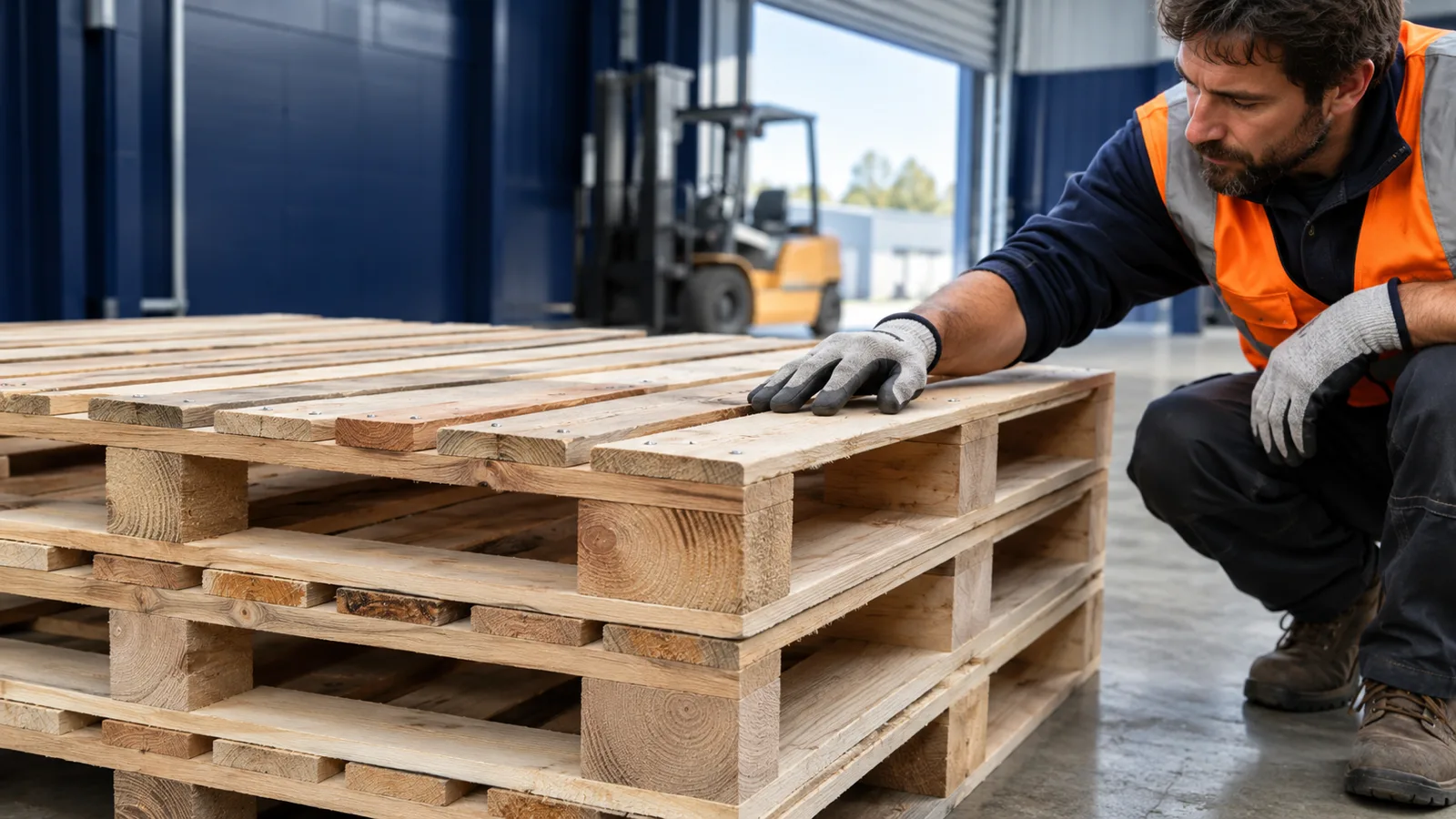
A shipper in Quebec loads twenty pallets of canned goods for a retailer's distribution centre in Ontario. Two of the pallets arrive with broken bottom boards, the receiver refuses them, and the carrier says the damage came from the pallet itself, not the trip. Nobody wins that argument, and the shipper ends up paying for the return, the rework and the lost sale.
The humble wooden pallet causes more trouble in Canadian freight than most people expect. Size, wood type, build quality and how the load is stacked on top all affect whether freight moves smoothly through a warehouse, rides safely on the Trans-Canada Highway in January, and gets accepted at the other end. Retailers, grocers and distribution centres increasingly publish their own pallet requirements, and carriers price and handle freight based on what the pallet looks like at the dock.
There is no single law that defines "the Canadian pallet," but there are clear industry norms. This guide covers the sizes you will see most often, when heat treatment matters, what good construction looks like and a checklist you can hand to your shipping team.
The size that dominates: 48 by 40 inches
In Canada, as across North America, the most common pallet is 48 inches long by 40 inches wide (roughly 1219 by 1016 mm). It is the default for grocery, consumer packaged goods, retail and general freight. Racking in most warehouses is designed around it, trailers are loaded with it in mind, and LTL carriers quote freight assuming something close to that footprint.
A standard 53-foot trailer typically fits around 26 of these pallets on the floor when loaded two across, and more if the freight can be double-stacked. Using a different size does not make your freight unshippable, but it can waste trailer space and cause problems in racking that was not built for it.
Other sizes you will run into
- 42 x 42 inches: common for paint, chemicals and some telecommunications equipment.
- 48 x 48 inches: used for drums, bulk bags and some agricultural products.
- 48 x 45 and 48 x 42 inches: seen in automotive and certain chemical supply chains.
- 40 x 48 inches (block style): same footprint, different construction, often used in pooled rental programs.
- 1200 x 800 mm and 1200 x 1000 mm: European and international sizes that arrive on imports and may need to be restacked onto North American pallets before entering domestic distribution.
- Half and quarter pallets: used for retail display programs, especially in big-box and club stores.
If you import from Europe or Asia, budget for the possibility that inbound pallets do not fit a receiving warehouse's racking. Restacking onto 48 by 40 pallets is a routine value-added service, but it takes labour and time.
Stringer pallets versus block pallets
The second big distinction is construction style.
Stringer pallets use three parallel boards (stringers) running the length of the pallet, with deckboards nailed on top and bottom. They are inexpensive and widely available. Forklifts can enter freely from the two ends; entry from the sides is possible only through notches cut into the stringers, which weakens them somewhat.
Block pallets use blocks of wood or composite at the corners, middle and edges instead of continuous stringers. They allow true four-way entry, which makes them faster to handle with pallet jacks and forklifts, and they tend to be stronger and longer-lasting. Pooled pallet programs typically use block designs.
For one-way shipments of light goods, a sound stringer pallet is usually fine. For heavy loads, frequent handling or customers that require four-way entry, block pallets are often worth the higher cost.
Pallet grades and the exchange question
Used and recycled pallets are commonly sold in grades. Grade A or "number one" pallets have few repairs and solid boards; Grade B pallets have more repairs, such as added companion stringers or replaced deckboards. Grade B is fine for many uses, but some retailers and grocers will only accept higher grades or new pallets.
Grocery and consumer goods supply chains in Canada also use pallet exchange programs, including the long-standing Canadian Pallet Council (CPC) system, where participants swap pallets of a recognised standard rather than buying new ones for every shipment. Separately, pooled rental pallets, often painted a distinctive colour and marked as the property of the rental company, are owned by that company, not by the shipper or receiver. Keeping, selling or reusing them outside the program can lead to charges, so make sure your team can recognise them.
When heat treatment matters
For shipments that stay inside Canada, there is generally no requirement for pallets to be heat treated. That changes when goods cross borders.
Most countries follow the international standard known as ISPM 15, which requires solid wood packaging used in international trade to be treated (usually by heat treatment, marked "HT") and stamped with a recognised mark. Canada enforces this on imports through the Canadian Food Inspection Agency (CFIA), and exporters need compliant wood packaging for most destinations. Canada and the United States have historically had special arrangements for wood packaging of Canadian or US origin moving between the two countries, but the details have changed over time and pallets often circulate far from where they were made, so many shippers simply use stamped heat-treated pallets for all cross-border freight. We cover the full rules in our guide to ISPM 15 and wood packaging for imports into Canada.
Plastic, metal and engineered wood (such as plywood or pressed wood) pallets fall outside ISPM 15 because they are not solid wood. They cost more but avoid the question entirely, which is why some exporters and food and pharmaceutical shippers prefer them.
What a well-built load looks like
A good pallet is only half the story. Freight claims and refused deliveries in Canada more often come from poorly built loads than from the pallet itself. The goal is a stable, square block that a forklift can move and a carrier can load without guesswork.
Stacking
Heavy cartons go on the bottom, lighter ones on top. Stack in columns when cartons are strong and need maximum compression strength; use an interlocking pattern when stability matters more. Keep the load inside the pallet edges: overhang lets carton walls carry weight they were not designed for, and even an inch or two can crush the bottom layer on a long haul.
Height and weight
Many carriers and receivers prefer pallets no taller than roughly 60 to 72 inches including the pallet, and loads that exceed a carrier's standard dimensions may be charged as oversized or require special handling. Weight limits vary by carrier and receiver, so check with them rather than guessing. Remember that a pallet labelled "do not stack" may be billed for the space above it as well.
Securing the load
- Stretch wrap from the pallet base up, tucking the film under the top deckboards so the load is tied to the pallet, not floating on it.
- Use corner boards on tall or heavy loads to spread strapping pressure and add vertical strength.
- Add a top sheet or tier sheets to keep layers flat.
- Fill voids with dunnage so cartons cannot shift.
- Strap very heavy or dense loads with poly or steel banding.
Labelling
Label at least two adjacent sides with the consignee, the bill of lading or PRO number and pallet count (for example, "pallet 3 of 8"). Retailers often require their own pallet labels with specific barcodes, so read the vendor guide before the first shipment.
Winter and climate considerations
Canadian freight spends a lot of time in cold trailers and on snowy docks. Wet pallets weigh more, can grow mould, and lose strength; frozen pallets can crack under a forklift's forks. Store empty pallets indoors where possible, avoid using pallets that have sat in snowbanks, and remember that stretch wrap becomes more brittle in extreme cold. For food, healthcare and other sensitive products, many shippers specify clean, dry pallets or plastic alternatives for exactly these reasons.
A pallet checklist for your shipping team
Print this and keep it at the dock:
- Is the pallet the size the receiver expects (usually 48 x 40)?
- Are all deckboards present, with no cracks, protruding nails or missing blocks?
- Is it a pooled rental pallet, and are we allowed to ship on it?
- If the freight crosses a border, is the pallet ISPM 15 stamped, or non-wood?
- Is the load inside the pallet edges with no overhang?
- Are heavy cartons at the bottom and the top level flat?
- Is the stretch wrap tied to the pallet base?
- Are height and weight within the carrier's and receiver's limits?
- Are labels on two sides, matching the bill of lading?
- Has a photo been taken before pickup, in case of a claim?
That last point is underrated. A clear photo of a properly built pallet at the shipping dock is often the best evidence you will have if damage is reported in Halifax or Edmonton a week later.
How pallets affect your freight bill
Pallet choices show up directly in what you pay. LTL carriers in Canada increasingly rate freight by density and dimensions, not just weight, so a poorly built load that takes up more space than necessary can cost more. Non-stackable pallets may be billed for the full trailer height. Damaged or refused pallets generate return freight, re-delivery fees and chargebacks from retailers. And imports on non-compliant wood packaging can be ordered re-exported at the importer's expense.
A warehouse that receives and ships on pallets every day can catch many of these problems before they leave the dock. Services like pallet-in, pallet-out storage, restacking inbound imports onto standard pallets, and building retailer-compliant loads are all part of good distribution warehousing.
Ship pallets that arrive the way they left
ShipCarte helps businesses across Canada build, book and track palletised freight, from a few LTL pallets to full truckloads heading coast to coast. If damaged pallets, refused deliveries or surprise reclass charges keep showing up on your invoices, request a quote and we will help you tighten up how your freight leaves the dock.