
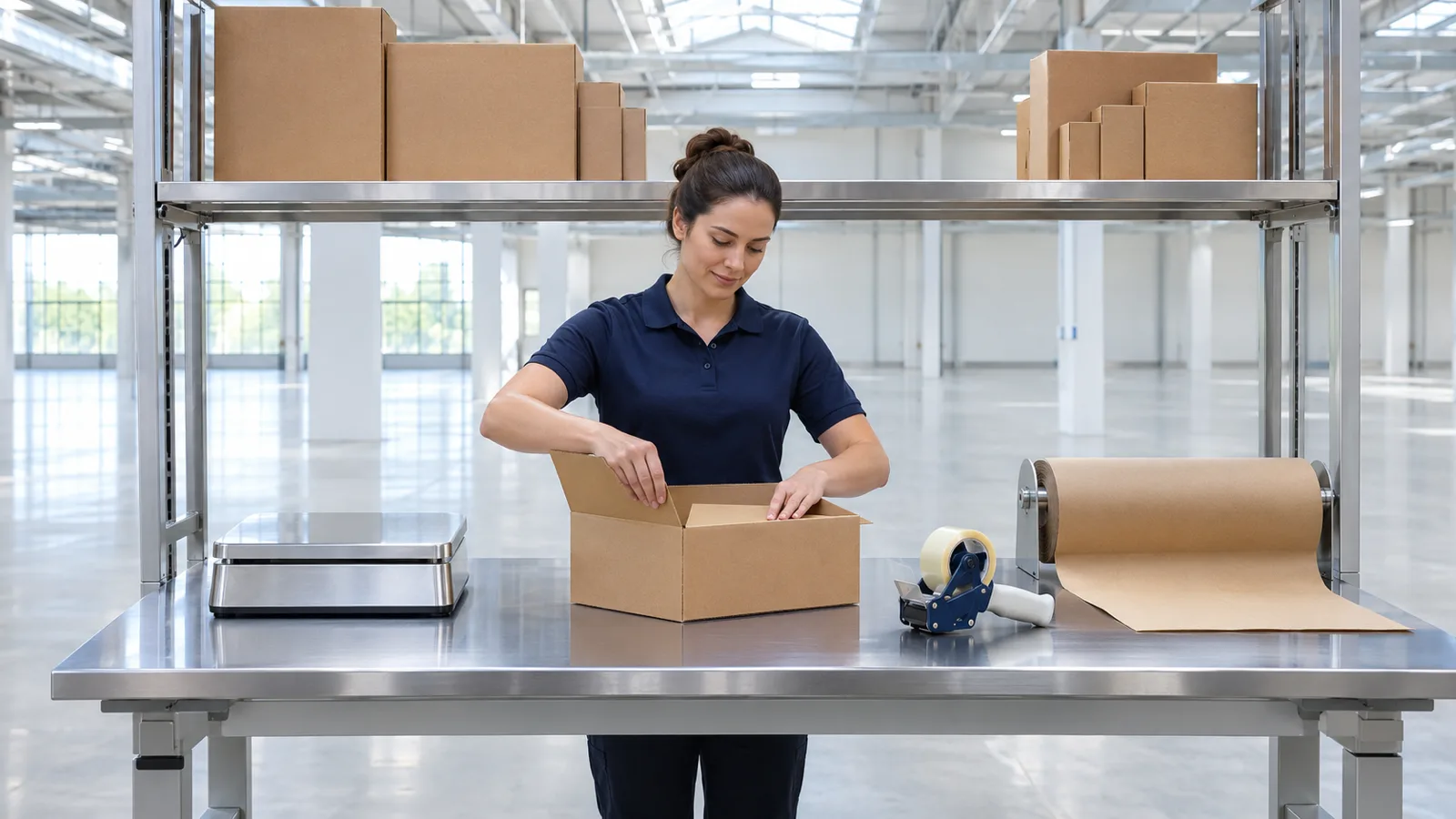
Walk into almost any growing ecommerce operation in Canada this spring and you will find the same scene: orders arriving faster than anyone planned for, packers reaching under tables for tape, someone hunting for the right box size, and a pile of finished parcels waiting by the door for a pickup that is already running late. Order volumes jumped for many online sellers once stores closed in March, and the packing area is usually where that pressure shows up first.
Picking gets most of the attention in warehouse design, but the packing station is where an order becomes a shipment. It is where the right product goes into the right box, the dimensions and weight are captured, the label is applied and the parcel is handed to a carrier. Every wasted second or wrong decision at that bench repeats hundreds or thousands of times a week. A badly designed station also creates problems you pay for later: oversized cartons that trigger dimensional weight charges, damaged goods, missing inserts and mislabelled parcels.
This guide walks through how to design packing stations that are fast, accurate and comfortable to work at, whether you are packing 50 orders a day from a back room in Halifax or several thousand from a distribution centre in the Greater Toronto Area.
Start With Your Order Profile, Not the Furniture
The most common mistake is buying benches first and figuring out the process later. Before you choose a single table, pull a few months of order data and answer some basic questions:
- How many units are in a typical order? Single-unit orders pack very differently from multi-item baskets.
- What are your ten most common product dimensions, and how many box sizes do you actually need to cover 80 to 90 percent of orders?
- How many orders need special handling: fragile items, liquids, cold packs, gift wrap, kits or promotional inserts?
- What share of orders go to Canadian addresses versus the United States or overseas, and which of those need customs paperwork?
- When are your daily carrier cut-offs, and how much of the day's volume arrives in the last two hours before them?
The answers determine how many station types you need. A brand selling phone accessories might run identical stations for everything. A health and wellness company shipping supplements, glass bottles and refrigerated items may need a standard lane, a fragile lane and a cold-pack lane, each with its own materials. Designing one generic station that tries to do everything usually means every packer is surrounded by supplies they rarely use.
The Five Zones of a Well-Designed Packing Station
A good station is organized around the order of the work. Think of it as five zones arranged so that the packer's hands move in one direction, from incoming product to outgoing parcel, without doubling back.
1. The Inbound Zone
This is where picked items arrive, whether in a tote, on a cart or down a gravity conveyor. Place it on the packer's dominant side so they can pull the next order across the bench naturally. Totes should sit at or slightly below bench height; lifting a heavy tote up onto a table hundreds of times a shift is a fast route to shoulder strain.
2. The Verification Zone
Directly in front of the packer is the work surface, with a scanner and a screen. Scan-to-verify is the single most effective way to stop mis-shipments: the packer scans each item, and the system confirms it matches the order before a label can print. If your current process relies on reading a paper pick list and eyeballing SKUs, adding a barcode check at the pack bench will usually pay for itself in avoided returns. A warehouse management system such as our WMS can drive this step and record who packed which order.
3. The Materials Zone
Boxes, mailers, void fill, tape and inserts belong within arm's reach, organized by how often they are used. The most common two or three box sizes should be directly overhead or on a shelf at shoulder height in front of the packer. Less common sizes can sit to the side or below. Void fill (paper, air pillows or crinkle) works best dispensed from above so it falls into the box rather than being grabbed from a bin on the floor.
4. The Labelling Zone
A thermal label printer, a scale built into or beside the bench, and if you measure parcels, a dimensioner. Ideally the scale is part of the work surface so the packer seals the box, sets it down once, and the weight flows straight into the shipping software. Every time a packer has to read a weight off a display and type it in, you introduce delay and the chance of a typo that becomes a carrier adjustment.
5. The Outbound Zone
Finished parcels should leave the station on the side opposite the inbound totes, ideally onto a takeaway conveyor or into carrier-specific cages or gaylords. If you sort by carrier at the bench, colour-code the outbound bins so packers do not need to read labels to know where a parcel goes.
Ergonomics Matter More Than Most Owners Expect
Packing is repetitive, standing work. Provincial occupational health and safety rules across Canada, from Ontario's Occupational Health and Safety Act to WorkSafeBC regulations in British Columbia, expect employers to identify and control ergonomic hazards such as repetitive reaching, awkward postures and heavy lifting. Beyond compliance, comfortable packers are faster and make fewer mistakes late in a shift.
Practical steps include:
- Adjustable bench height. A fixed table that suits one packer will be too high or too low for the next. Height-adjustable benches, or at least anti-fatigue platforms of different thicknesses, let each person work with elbows roughly at a right angle.
- Anti-fatigue matting. Concrete floors are hard on feet, knees and backs over an eight- or ten-hour shift.
- Reach envelope. Keep everything a packer uses on most orders within a comfortable forward reach. If someone is stretching or twisting for tape on every parcel, move the tape.
- Lighting. Bright, even task lighting helps packers spot damaged product, read small SKU codes and check that labels printed cleanly.
- Heavy items. If you ship heavier goods, add roller sections or a low-level packing area so cartons do not need to be lifted onto a standard-height bench.
Physical distancing has added another factor since March. Many operations have spaced benches further apart, added clear barriers between stations, or staggered shifts. If you are designing new stations now, leaving extra space between them gives you flexibility whatever public health guidance looks like in your province over the coming months.
Box Selection: The Hidden Cost Driver at the Bench
The packer's choice of box has a direct effect on what you pay carriers. Most Canadian parcel carriers bill on the greater of actual weight or dimensional weight, so a light product shipped in a box that is too big is charged as if it were much heavier. Multiply a few extra centimetres by thousands of parcels and the cost becomes significant.
There are two ways to keep box choice under control at the station. The first is to rationalize your box range so you stock a sensible set of sizes that fit your real products. The second is to let software recommend the box. A cartonization engine looks at the items in an order and suggests the smallest suitable carton, and it can display that recommendation on the packer's screen as soon as the first item is scanned. Our cartonization tools work this way. For a deeper look at this topic, see our guide to right-sizing boxes to cut dimensional weight charges in Canada.
Station Types Worth Considering
Not every operation needs the same set-up. Here is how common station designs compare:
Single-Item Express Stations
For orders containing one unit, a compact station with a narrow range of poly mailers or small boxes, a scanner and a label printer can move very quickly. Some operations batch-pick single-unit orders and route them all to one or two express benches, which keeps them away from the slower multi-item stations.
Multi-Item Stations
These need more bench space to lay out several items, a larger range of box sizes, and a put wall or sorting shelf if orders are batch picked. The verification step is especially important here because the risk of missing or swapping an item is higher.
Specialty Stations
Fragile goods, kits, subscription boxes and temperature-sensitive products each benefit from a dedicated area. A cold-chain station, for instance, needs insulated shippers, gel packs staged from a freezer nearby, and a clear process for packing quickly so product does not warm up on the bench. Kitting and assembly work, where several components are combined into one finished unit, is often better done upstream in a separate kitting area so the pack bench simply ships a ready-made SKU.
Cross-Border Stations
If you ship a meaningful volume to the United States or overseas, consider a station where packers can print commercial invoices or customs declarations along with the label. Grouping these orders reduces the chance that a parcel heading over the border leaves without the right documents, which can lead to delays at customs.
A Quick Checklist Before You Build
Before ordering benches or rearranging your floor, run through this list with the people who will actually do the packing:
- Does the flow run in one direction, from inbound tote to outbound parcel?
- Is every item used on most orders within easy reach without bending or twisting?
- Is there a scan-to-verify step before the label prints?
- Does the scale feed weight directly into your shipping software?
- Can packers see a recommended box size on screen?
- Is there a clear place for damaged or short-picked items to go, so they do not sit on the bench?
- How will supplies be replenished, and by whom, so packers are not leaving the station to restock?
- Are outbound parcels separated by carrier and service level before pickup?
- Can the layout scale up for peak season, either by adding stations or running extra shifts?
That last point deserves attention. Canadian peak season runs from late October through December, and in many categories it now starts earlier with Black Friday and Cyber Monday promotions. If your stations are designed tightly around today's volume, plan where temporary benches will go when volume doubles. Mobile packing carts, with their own printer and supplies, can be rolled into place for a few weeks and stored the rest of the year.
Measuring Whether Your Stations Work
Once stations are running, track a few simple numbers each week: orders packed per labour hour, mis-ship rate, damage claims, and the share of parcels where carriers adjusted the billed dimensions or weight. A rising carrier adjustment rate often points to packers choosing the wrong box or skipping the scale. Our reporting and analytics tools make these trends easier to spot, and our list of the top logistics KPIs covers other measures worth watching.
Talk to your packers regularly as well. They will tell you which box sizes are always running out, which supplies are awkward to reach, and where the process slows down. Small changes, such as moving a tape gun or adding a second label printer, can make a noticeable difference to output.
When to Hand Packing to a Fulfillment Partner
Designing and running efficient packing stations takes space, equipment, software and trained staff. For many Canadian brands, especially those growing quickly or dealing with unpredictable volumes this year, it can make more sense to use a third-party fulfillment provider that already has stations, systems and carrier relationships in place. A partner can also absorb seasonal peaks without you having to lease extra space or hire temporary staff.
ShipCarte offers pick and pack services and full ecommerce fulfillment for businesses across Canada, with scan-based verification, box recommendations and direct carrier integrations built into the workflow.
Get Help Designing Your Packing Operation
Whether you want to improve your own packing area or hand the whole process over, we are happy to look at your order profile and talk through options. Schedule a consultation with the ShipCarte team, or request a quote for fulfillment services in Canada.