
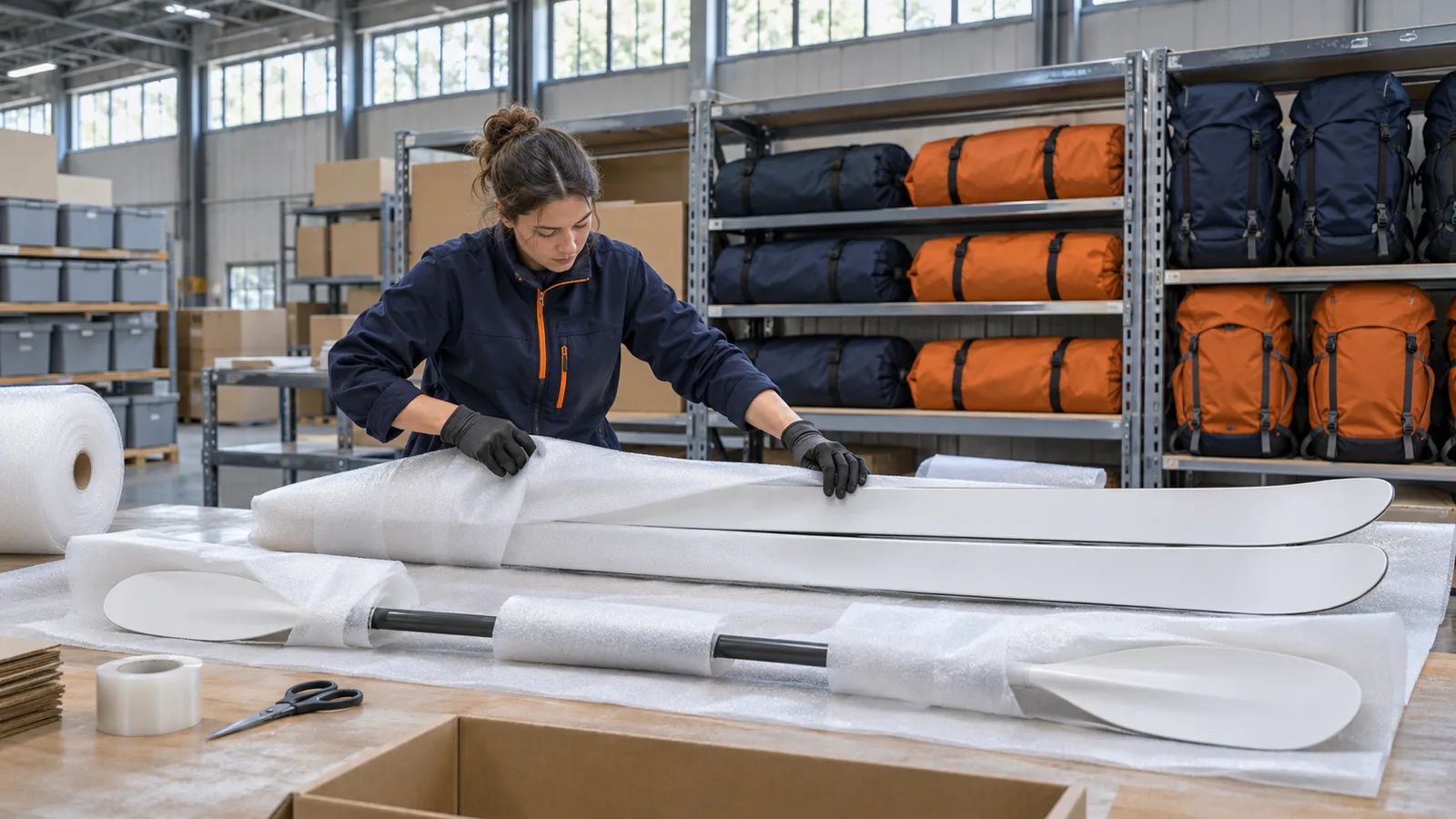
An online outdoor shop in Canada lives on two calendars at once. In April, customers in Vancouver want paddles and dry bags for the first warm weekend, while customers in Winnipeg are still waiting for the ice to leave the lakes. By late October, the same store is shipping avalanche probes to Revelstoke and snowshoes to Thunder Bay, and the warehouse that was full of canoe seats in June now needs space for skis that are almost two metres long.
That mix of long, awkward, sometimes hazardous and highly seasonal products makes outdoor gear one of the trickier ecommerce categories to ship well. A tent is light but bulky. A carbon paddle is light but fragile at the blade. A camp stove looks harmless until you remember the fuel canister that customers love to add to the cart. Get the packaging or the carrier choice wrong and the margin on a $400 order can disappear into dimensional weight charges, oversize surcharges and a replacement shipment.
This guide walks through how Canadian outdoor retailers can ship gear sensibly: product by product, season by season, and region by region. It is written for owners and operations leads who already sell online and want fewer damaged boxes, fewer surprise invoices and a smoother run through the year's peaks.
Why outdoor gear is harder to ship than it looks
Most outdoor products break at least one of the assumptions that parcel pricing is built on. Carriers in Canada price small parcels on the greater of actual weight and dimensional weight, and they add handling charges when a package is unusually long, heavy or not fully enclosed in a corrugated box. Outdoor gear tends to trigger all three.
- Length: skis, cross-country poles, fishing rods, paddles and tent pole sets often exceed the length thresholds where carriers start adding additional handling fees.
- Volume without weight: sleeping bags, inflatable kayaks and puffy jackets take up far more space than their weight suggests, so dimensional weight sets the price.
- Odd shapes: helmets, bike racks and stand-up paddleboards do not sit neatly in a standard box, and anything shipped in a bag or wrapped only in plastic can attract a non-standard packaging charge.
- Regulated items: fuel canisters, bear spray, lithium batteries in headlamps and GPS units, and some fire starters fall under dangerous goods rules.
The fix is rarely one thing. It is a combination of right-sized packaging, smart carrier selection by product type and destination, and inventory placed so that the heaviest and longest items travel the shortest distance. Our post on how package dimensions impact shipping costs explains the dimensional weight maths in more detail if you want to model it.
Product-by-product packing notes
Tents and shelters
Tents arrive from manufacturers in stuff sacks, often with poles inside. Shipping them in the stuff sack alone is tempting but risky: poles can puncture the bag, and a bag is not a box in a carrier's eyes. A snug corrugated box sized to the packed tent, with a little void fill at the pole ends, avoids non-standard packaging fees and protects the shock-corded poles. For larger family and wall tents, check whether the packed length pushes you into an oversize band and whether a slightly shorter, wider box is cheaper overall.
Paddles, poles and rods
Long, thin items are where most damage claims come from. Blades and tips need protection at both ends, so use end caps or foam blocks and a rigid tube or a long, narrow corrugated box. Avoid shipping paddles or rods in the same box as heavy items that can shift and crack a blade. If you sell multi-piece paddles or travel rods, shipping them broken down usually brings the package under length thresholds and saves money.
Skis, snowboards and splitboards
Ski boxes are long, but most skis and boards are not heavy, so the cost drivers are length and girth. Bindings mounted to skis add awkward bulk; shipping skis and bindings separately can be cheaper and reduces the chance of a binding being bent. Wrap edges so they cannot slice through the carton, and protect tips and tails, which take the hits when a box is dropped on its end. For customers in mountain towns that are a long way from a sortation hub, set realistic delivery promises because long packages sometimes move on slower linehaul routes.
Stoves, fuel and other regulated items
Camp stoves themselves are generally fine to ship once they are clean and unused. Fuel canisters, bear deterrent spray and some fire-starting products are dangerous goods under the Transportation of Dangerous Goods Regulations administered by Transport Canada. Many can travel by ground as limited quantities when packed and marked correctly, but they generally cannot go by air, and carriers have their own acceptance rules. Practical steps:
- Flag regulated SKUs in your store so they only offer ground services at checkout.
- Ship them separately from orders that need air service, or hold the whole order for ground.
- Train packers on the correct markings and keep the documentation for each SKU's classification.
- Do not include regulated items in cross-border shipments without confirming the carrier and destination rules first.
Lithium batteries in headlamps, GPS units and action cameras have their own rules, which differ depending on whether batteries are packed with or contained in equipment. Your carrier's dangerous goods guide is the best reference for current requirements.
Soft goods and apparel
Jackets, base layers and sleeping bags are lighter to ship, but they are prone to dimensional weight overcharges if packed loosely in big boxes. Compression bags or polybags sized to the item keep costs down. Remember the Textile Labelling Act when you are importing apparel under your own brand: fibre content and dealer identity labels need to be on the product, and bilingual information is required on consumer textile labels in Canada.
Planning around Canada's outdoor seasons
The peaks in outdoor retail are not the same as general ecommerce. Holiday shopping matters, but it lands on top of the winter sports season, and spring brings a second rush that many retailers underestimate. A rough calendar looks like this:
- Late winter (February to March): spring camping and paddling stock arrives from suppliers. Receiving capacity and putaway speed matter more than outbound volume.
- Spring (April to June): paddling, camping, cycling and fishing orders climb as the weather warms from the West Coast eastward. The Prairies and Northern Ontario often lag by several weeks.
- Summer (July to August): steady demand, lots of last-minute "we leave on Friday" orders, and the highest sensitivity to delivery speed.
- Autumn (September to October): hunting, hiking and early ski season pre-orders. Winter stock lands and summer stock needs to be consolidated.
- Winter peak (November to December): holiday gifting plus ski, snowshoe and winter apparel demand, all while carriers are at capacity and weather starts delaying linehaul.
This year, many retailers have also seen unusually strong demand for camping, cycling and home-based outdoor gear as Canadians stayed closer to home during the pandemic. It is hard to know how long that lasts, so build forecasts with a range rather than a single number, and keep the option to scale storage and labour up or down.
Where to keep your inventory
Canada is wide, and the cost and time to ship a long box from Ontario to British Columbia are substantial. Retailers usually face a choice between one central fulfillment point and a split network.
A single warehouse in Central Canada, for example in the Greater Toronto Area or around Montreal, reaches most of the population quickly by ground along the Highway 401 and Highway 20 corridors. Western customers will wait longer, often several business days, and pay more for expedited service. That is workable for apparel and small accessories, but it can hurt conversion on bulky gear like kayaks and skis, where the shipping charge is a large share of the order.
A split network places fast-moving bulky SKUs closer to the customers who buy them. Skis and splitboards may sell disproportionately in British Columbia and Alberta; canoe and fishing gear may skew toward Ontario, Quebec and Manitoba. Moving bulk stock west by LTL freight or full truckload before the season starts is usually far cheaper than shipping each long box individually across the country. The trade-off is more inventory to manage and a higher risk of stock being in the wrong place, which is where good inventory management and reporting become essential.
Choosing carriers for awkward gear
No single carrier is best for every outdoor product in every part of Canada. Rates, oversize rules and service quality vary by lane, so it pays to compare. Some general patterns retailers report:
- Canada Post often has strong coverage for rural addresses and remote communities, which matters when customers live near trailheads and lakes rather than in cities.
- Courier and regional carriers may be faster in urban corridors and offer better tracking for higher-value items.
- For very large items such as canoes, kayaks or bulk orders to retail partners, LTL freight with a residential delivery option may be cheaper than parcel, especially once oversize charges are added.
A multi-carrier shipping platform lets you set rules such as "ship anything over a certain length by the cheapest compliant ground service" or "ship regulated items ground only," and compare live rates on each order instead of defaulting to one carrier. Combined with carrier management, those rules can also cover rate negotiations and invoice audits for the surcharges outdoor gear tends to attract.
Remote and northern deliveries
Outdoor customers are more likely than average to live outside major cities. Addresses in the territories, coastal British Columbia, Northern Quebec, Labrador and northern parts of the Prairie provinces can add days to transit and may only be served by certain carriers. Some communities rely on air or seasonal sealift and winter roads, which makes long, bulky items particularly expensive.
A few practices help keep these customers happy without losing money:
- Show postal-code-specific shipping rates and delivery estimates at checkout instead of a flat promise.
- Exclude oversize items from free shipping offers for remote postal codes, and explain why.
- Offer pickup at a carrier location where home delivery is unreliable.
- Communicate clearly when winter weather is affecting highway or air service.
Returns, exchanges and the sizing problem
Ski boots, hiking boots, helmets and technical apparel all have fit issues, so returns and exchanges are a normal part of the business. The challenge with outdoor gear is that a returned item may be bulky and expensive to send back, and it must be inspected before going back into stock. A helmet that has been dropped, a stove that has been used or a paddle with a chipped blade should not be resold as new.
A clear returns policy, pre-paid label options for exchanges, and a defined inspection checklist go a long way. Good returns management separates items that can be restocked immediately from items that need repair, sale as open-box, or return to vendor. Our guide on building a hassle-free returns process covers the policy side in more depth.
Selling across the border
Many Canadian outdoor brands sell to American customers, particularly in states close to the border. Shipping gear south means customs documentation, accurate product descriptions and harmonized codes, and attention to rules of origin if you want to claim preferential treatment. CUSMA (USMCA in the US) replaced NAFTA on July 1, 2020, so make sure your certification of origin wording reflects the current agreement rather than the old NAFTA form. Regulated items such as fuel and bear spray may have additional restrictions in the US, so check before listing them for cross-border sale. If cross-border is a meaningful share of your sales, a partner experienced with cross-border shipping can help you choose between shipping direct, consolidating shipments, or holding stock in the US.
A pre-season checklist for outdoor retailers
- Measure and weigh every bulky SKU in its shipping carton, and record the dimensions in your store and shipping software.
- Identify SKUs that trigger oversize or additional handling fees and decide whether to repackage, break down, or price shipping accordingly.
- Flag all dangerous goods SKUs and confirm the ground-only rules are working at checkout.
- Stock long-item packaging (ski boxes, rod tubes, end caps) before you need it; supply can tighten in peak.
- Decide which SKUs should be positioned in the West versus Central Canada for the coming season.
- Set cut-off dates for holiday delivery by region, with extra buffer for remote addresses.
- Agree on a returns inspection standard for helmets, boots and technical gear.
Get your outdoor gear moving with ShipCarte
ShipCarte works with ecommerce brands across Canada on ecommerce fulfillment, multi-carrier shipping and freight, which suits product lines where a tent, a pair of skis and a fuel canister can all land in the same week. If you want help mapping your seasons, packaging and carrier rules before the next peak, request a quote and tell us what you sell and where your customers are.