
A picker in a Brampton warehouse reaches for a carton on the second level of racking, twists awkwardly and feels something give in her lower back. She finishes the shift, sees her doctor the next day and is off work for two weeks. On Monday, the warehouse manager realises nobody has filed anything with the WSIB, the supervisor did not write up what happened, and nobody is sure whether the racking layout that forced the reach has been flagged before. None of this was intentional. The operation simply never had a process.
Warehouses are busy, physical places. Forklifts share aisles with people on foot, heavy loads are lifted many times an hour, and pallet racking holds tonnes of product overhead. In Ontario, two pieces of legislation set out what operators must do about those risks: the Workplace Safety and Insurance Act, administered by the Workplace Safety and Insurance Board (WSIB), which provides no-fault insurance for workplace injuries, and the Occupational Health and Safety Act (OHSA), enforced by the Ministry of Labour, which sets the rules for preventing them.
This article sets out what a warehouse operator in Ontario needs to have in place today, why each element matters, and how to make it part of daily operations rather than a binder on a shelf.
Part 1: WSIB obligations
1. Register and pay premiums
Warehousing and distribution businesses in Ontario are generally required to register with the WSIB within ten days of hiring their first worker, including part-time and seasonal staff. Premiums are based on your insurable earnings and the rate group your business is classified in. Warehousing falls into rate groups that reflect its relatively high injury risk, so premiums are a material cost. Since 2020, the WSIB's rate framework has set premiums by class and adjusted them for each business's own claims history and size, so it pays to understand where your business stands and how your injury record moves your rate from year to year.
2. Report injuries on time
When a worker is injured and needs health care beyond first aid, or is off work, or earns less than their regular pay because of the injury, the employer must report it to the WSIB within three business days of learning about it, using the Employer's Report of Injury/Disease (Form 7). Late reporting can result in penalties. Your supervisors need to know this, because they are often the first to hear about an injury, especially on night and weekend shifts.
3. Pay for the day of injury
Employers must pay the injured worker their full wages and benefits for the day or shift on which the injury happened. This is an employer obligation, not a WSIB payment.
4. Support early and safe return to work
Employers are required to cooperate in the early and safe return to work of injured workers, which means contacting the worker soon after the injury, identifying suitable modified duties and keeping in touch with the WSIB. Employers with 20 or more workers also have re-employment obligations toward workers who had been employed continuously for at least a year before the injury. Warehouses usually have a range of lighter tasks, such as scanning, labelling, quality checks and inventory counts, which makes modified work practical to offer.
5. Check your contractors
If you hire contractors, for example racking installers, cleaning crews or a temporary staffing provider, request a WSIB clearance certificate. If a contractor is not in good standing, the WSIB can hold you responsible for their unpaid premiums.
Part 2: OHSA requirements
Insurance pays for injuries after they happen. The OHSA is about preventing them, and it sets duties for employers, supervisors and workers alike.
6. A written health and safety policy and program
If you regularly employ more than five workers, you must have a written occupational health and safety policy, review it at least annually, and maintain a program to implement it. You must also have workplace violence and workplace harassment policies, with programs for reporting and investigating incidents.
7. Joint health and safety committee or representative
Workplaces that regularly employ 20 or more workers need a joint health and safety committee, with at least one certified worker member and one certified management member. Workplaces with six to 19 workers need a health and safety representative chosen by the workers. The committee or representative inspects the workplace at least monthly, identifies hazards and makes recommendations. A good committee is one of the best early warning systems a warehouse can have.
8. Mandatory awareness training
Every worker and supervisor in Ontario must complete basic health and safety awareness training, using a Ministry-approved program or one that meets the same requirements. Keep records of completion. This applies to new hires, seasonal staff and, in practice, agency workers on your floor, who must also receive site-specific orientation.
9. WHMIS training
Most warehouses handle at least some hazardous products, whether cleaning chemicals, battery charging stations, propane cylinders for lift trucks or customer products classed as hazardous. Workers who handle or may be exposed to these products need WHMIS training, and safety data sheets must be available.
10. Post the required documents
Ontario workplaces must post a copy of the OHSA, the health and safety policy, the Ministry's "Health and Safety at Work: Prevention Starts Here" poster, and the names of committee members or the representative, along with the WSIB's "In Case of Injury at Work" poster.
Part 3: warehouse-specific hazards
The Industrial Establishments regulation under the OHSA contains specific rules that apply to warehouses. A few areas deserve particular attention.
Lift trucks
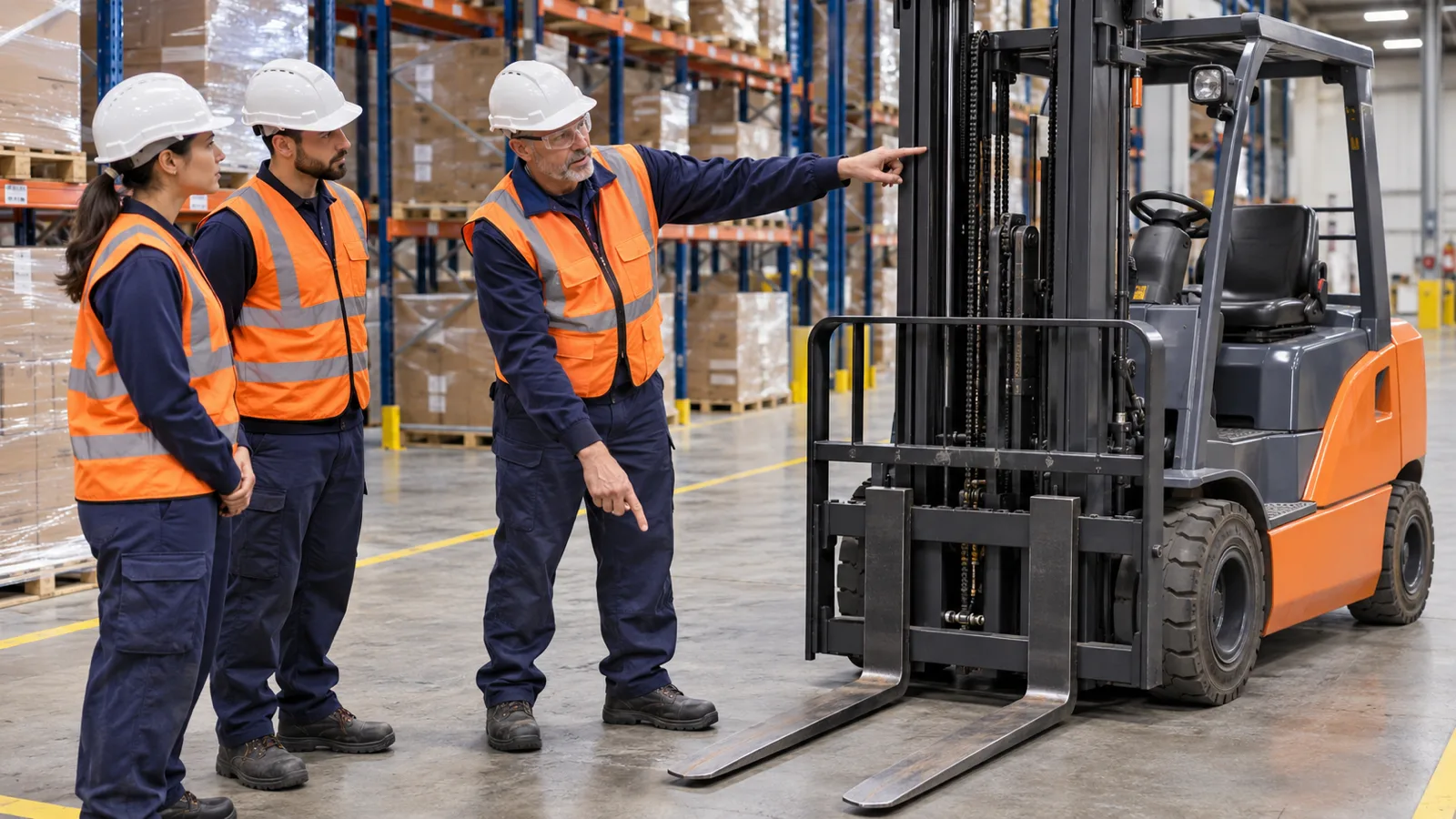
Ontario does not issue a government forklift licence. Instead, employers must ensure that lift trucks are operated only by competent workers, which in practice means formal training, a practical evaluation and periodic refreshers. Lift trucks must be inspected and maintained, and many operations use a written pre-shift checklist covering forks, mast, chains, brakes, horn, lights and fluid levels. The CSA standard for lift truck safety is widely used as a reference for training content.
Racking and material storage
Materials must be stored in a way that prevents tipping, falling and collapse, and racking must be able to carry the loads placed on it. Load capacity signs, column protectors at aisle ends, regular inspections for bent uprights and damaged beams, and a clear rule that damaged racking is unloaded and tagged out until repaired are all standard practice. Some racking installations and modifications may also trigger a pre-start health and safety review by a professional engineer. Our article on forklift and racking safety goes deeper on both topics.
Pedestrian and vehicle separation
Collisions between lift trucks and pedestrians are among the most serious warehouse incidents. Marked pedestrian walkways, designated crossing points, mirrors at blind corners, speed limits and rules about pedestrians in active aisles all reduce the risk.
Lifting and repetitive work
Musculoskeletal disorders, such as back injuries and strains, account for a large share of lost-time claims in Ontario warehousing. Slotting heavy, fast-moving items between knee and shoulder height, providing lift assists for heavy cartons, rotating tasks and training on safe lifting all help. So does good warehouse design: a well-slotted pick face reduces bending and reaching on every pick.
Docks and trailers
Loading docks combine heights, moving vehicles and heavy loads. Use wheel chocks or vehicle restraints, inspect dock plates and levellers, and check that trailer floors are sound before a lift truck drives in.
Part 4: when a serious injury happens
If a worker is critically injured or killed, the employer must immediately notify the Ministry of Labour, the joint health and safety committee or representative, and the union if there is one, and follow up with a written report within 48 hours. The scene must not be disturbed, except to save life, relieve suffering or prevent further damage, until an inspector gives permission. Supervisors should know these steps by heart.
Ministry of Labour inspectors also visit warehouses proactively, and the Ministry has run focused inspection initiatives on material handling and other industrial hazards. During an inspection, they may ask to see your policies, training records, committee minutes, lift truck inspection checklists and racking inspection records. Being able to produce these quickly says a great deal about how seriously safety is taken.
Making safety part of operations
The warehouses with the best safety records tend to treat safety as part of how work is done, not as a separate compliance task. Supervisors lead short safety talks at shift start. Near misses are reported and discussed, not punished. Injury data is reviewed alongside productivity and accuracy metrics. New and seasonal staff are paired with experienced workers for their first shifts. And the layout itself is designed with safety in mind, from aisle widths to the location of the heaviest SKUs.
Safety also connects to employment standards. Long peak-season hours, missed breaks and rushed onboarding of agency workers all increase injury risk. Our companion article on employment standards for warehouse staff in Ontario covers hours, overtime and rest periods.
Work with a warehouse that takes safety seriously
If you store or ship goods through a third-party warehouse, its safety culture affects you too: injuries slow operations, damage inventory and disrupt service. When evaluating a logistics partner, ask about its committee, training records and injury rates. ShipCarte's distribution warehousing and inventory management services operate with documented safety programs and trained equipment operators, and our warehouse management system supports slotting that keeps heavy picks at safe heights. Schedule a consultation or request a quote to learn more about how we can support your business across Ontario.