
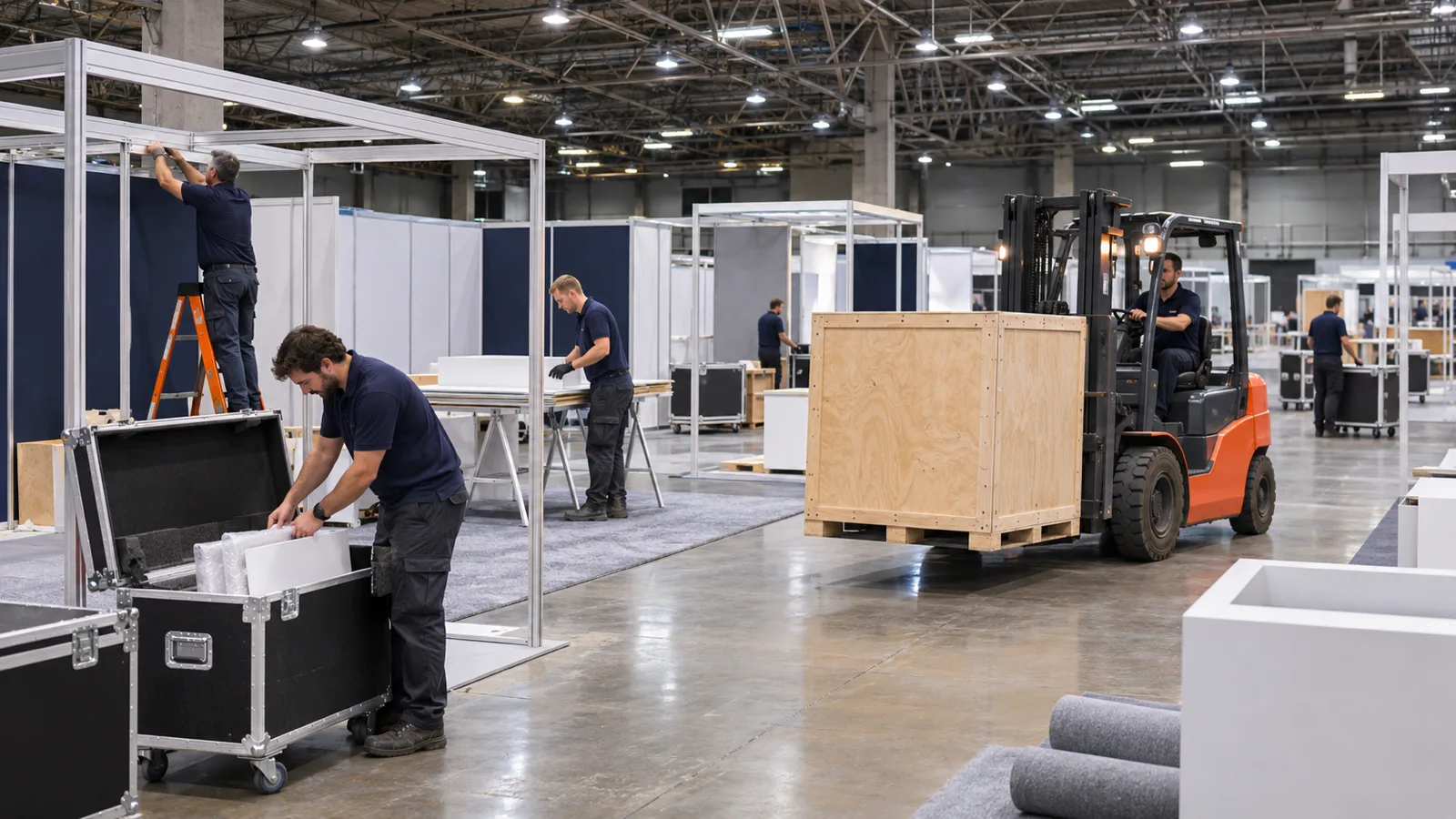
It is the night before the show opens. Your booth space at a Toronto convention centre is marked out with tape, your carpet is down, and the electrician has dropped the power. But the crates holding your display walls, product samples and brochures are not there. They are sitting on a dock somewhere, waiting for a slot in the marshalling yard, and the show's freight desk tells you they will "get to it." Anyone who has exhibited more than a few times has a version of this story.
Trade shows are expensive. Between the floor space, booth build, travel and staff time, a single exhibit at a major Ontario venue can cost more than a month of advertising. Shipping is usually a small slice of that budget, which is exactly why it gets planned last. Yet freight is the one piece that can make the rest of the investment worthless if it goes wrong.
This guide is for businesses exhibiting at shows in Toronto, Ottawa, London, Hamilton and other Ontario cities. It is organised as a countdown, so you can see what needs to happen and when. With in-person events starting to return to Ontario venues after a long pause, schedules, capacity limits and on-site rules can still change at short notice, so check the latest exhibitor updates from your show organiser as you plan.
Understand how show freight actually moves
At most large Ontario venues, including the Metro Toronto Convention Centre, the Enercare Centre at Exhibition Place, the International Centre near Pearson and the Toronto Congress Centre, as well as the Shaw Centre and EY Centre in Ottawa, exhibitors do not simply drive up and unload. The show organiser appoints an official general service contractor that controls the loading docks, moves freight to and from booths and handles empty crate storage during the show.
That contractor's services are paid for through material handling charges, sometimes called drayage. These are billed by weight, usually per hundred pounds with a minimum charge, and they are separate from what you pay your carrier to bring freight to the building. Surcharges can apply for freight that arrives outside target times, for small or uncrated shipments, and for overtime hours. The exhibitor manual sets out the rates, and it is the single most important document to read for your logistics planning.
Your freight can reach the booth in one of two ways:
- Advance warehouse. You ship to the contractor's warehouse before the show, usually within a window of a few weeks to a few days before move-in. They hold it and deliver it to your booth before you arrive. This costs a little more but removes most of the move-in risk.
- Direct to show site. Your carrier delivers to the venue during a specific target move-in time. This can be cheaper, but if the truck is late, stuck in traffic on the Gardiner, or arrives outside its slot, it may wait for hours in the marshalling yard or be charged a late surcharge.
For first-time exhibitors, or for anyone shipping from outside the GTA, the advance warehouse is almost always the safer choice.
Eight weeks out: plan the shipment
As soon as you have booked your space, download the exhibitor manual and note the advance warehouse address and receiving dates, the direct-to-show target times, labelling requirements and material handling rates. Then take stock of what you are sending.
- Measure and weigh every crate, case and carton. Material handling is billed on weight, so estimates matter.
- Decide what needs to travel crated and what can go in cartons. Display walls, monitors and fragile samples belong in hard cases or wooden crates; loose cartons are often charged at a higher "special handling" rate.
- Consolidate. Ten small cartons cost more to handle and are easier to lose than two palletised loads that are shrink-wrapped and clearly labelled.
- Check whether any of your product samples are perishable, liquid or regulated. Food exhibitors in particular need to plan for refrigerated storage.
If you exhibit at several Ontario shows a year, this is also the time to think about where your booth lives between events. Many companies keep their display at the office and lose a week to packing before every show. Storing it at a warehouse that can inspect, repack and ship it on demand is often cheaper once staff time is counted.
Four weeks out: book the freight
Choosing a carrier for trade show freight is not the same as booking regular LTL. You need a carrier that knows how convention centre deliveries work, will book the delivery appointment with the advance warehouse or show site, and will accept the reality that the outbound pickup after the show may not happen until late in the evening.
Your options, depending on volume:
- Small parcel is fine for a few cartons of brochures and giveaways sent to the advance warehouse. It is not appropriate for display hardware, and many shows charge minimums that make tiny shipments expensive anyway.
- LTL freight is the standard for one to several pallets or crates. Ask for liftgate and appointment service, and confirm the carrier is comfortable with trade show deliveries.
- A dedicated or exclusive-use truck makes sense for large booths or tight timelines. You control the departure time and the truck goes straight to the venue, with no terminal stops.
ShipCarte's LTL freight and full truckload options let you compare rates and transit for each show, while our carrier management team handles the appointment booking with the venue contractor.
Two weeks out: label, document and ship
The general service contractor receives freight for hundreds of exhibitors at once. Their labels exist for a reason, and freight without them can be delayed or misrouted.
- Print the official shipping labels from the exhibitor kit and attach at least two to every piece, on different sides.
- Include your company name, booth number and show name on every piece, plus "piece 1 of 6" style numbering.
- Prepare a packing list for each crate and keep a copy with your booth staff. If a piece goes missing, you will know exactly what was in it.
- Photograph each crate before it leaves. This supports any damage claim.
- Send tracking numbers and the bill of lading to the person who will be at the booth during move-in.
For advance warehouse shipments, aim to arrive early in the receiving window, not on the last day. Late arrivals may be charged a surcharge or redirected to the show site.
Exhibitors coming from the United States
Ontario hosts many shows that attract American exhibitors, who bring their displays across the Ambassador Bridge, the Peace Bridge or the Blue Water Bridge, or fly them into Pearson. Goods temporarily imported for display must be properly declared to the CBSA. Options include temporary importation under a CBSA form, an ATA Carnet for eligible goods, or full importation if samples will be given away or sold. Giveaways and brochures may attract duty and GST/HST. Our guide on trade show goods entering Canada walks through these choices in detail, and a customs broker should be engaged well before the ship date.
Move-in and show days
When you arrive, check in at the service desk and confirm that all your pieces have been delivered to the booth. Count them against your packing list immediately. If something is missing, the earlier you report it, the better the chance it is found in the marshalling yard or the warehouse.
Once the booth is built, your empty crates will be tagged with empty sticker labels and taken to storage. Keep a few extra labels on hand, since stickers go missing. Before the show closes, pick up your material handling agreement or outbound bill of lading from the service desk so you are ready to ship out.
Move-out: where most problems happen
Move-out is when trade show freight goes wrong most often. Hundreds of exhibitors are packing at once, the empty crates come back to booths slowly, and every carrier is trying to get onto the same docks.
- Book the outbound pickup before the show, not on the last day. Specify the show, booth and pickup window clearly.
- Do not leave freight unattended until it is fully packed, labelled and the bill of lading is handed in at the service desk.
- If your carrier does not show up by the deadline, the show contractor will typically ship your freight with their designated carrier at your expense, or return it to their warehouse. Either way, it costs more and you lose control of it.
- Decide in advance where the booth is going. Back to your office, to a warehouse, or straight to the next show?
Shows outside Toronto
Not every Ontario trade show happens in a downtown convention centre. Agricultural shows near Woodstock and in rural southwestern Ontario, home shows in London and Barrie, mining and forestry events in Sudbury and Thunder Bay, and industry conferences in Niagara Falls or Kitchener each have their own setup. Smaller venues may let you deliver directly with your own vehicle, but they may also have limited dock space, no forklift, and receiving hours that end early.
For these events, call the venue directly to confirm whether there is a loading dock, whether pallets can be received, and who will be on site to sign for freight. Outdoor shows add weather considerations, so pack displays for rain and plan for delivery onto grass or gravel, which often requires a truck with a liftgate and pallet jack rated for rough surfaces.
Keeping trade show costs under control
Exhibitors who show frequently tend to save money in the same few places:
- Lighter booths. Fabric graphics and aluminium frames weigh a fraction of traditional hard walls, which cuts both freight and material handling.
- Fewer, larger pieces. Consolidated crates are cheaper to handle than many cartons.
- Shipping literature and giveaways to the hotel or a local fulfilment centre and bringing them in by hand, where the show rules permit it.
- Storing the booth near the show circuit. If most of your shows are along the 401 corridor, keeping the display in a warehouse in the GTA reduces both transit times and the risk of last-minute delays.
A partner offering value-added warehousing services can inspect your booth after each show, replace damaged graphics, restock literature and have it ready for the next event, so your team only deals with it at the venue. If you are exhibiting at shows near Pearson specifically, see our notes on trade show shipping in Mississauga.
Get your next show off to a smooth start
The best trade show logistics are the ones nobody on your sales team ever thinks about. ShipCarte helps exhibitors across Ontario plan show freight, book carriers that understand convention centre rules, and store displays between events. Request a quote for your next show, or schedule a consultation to plan your trade show calendar for the year.