
A parts maker in Kitchener lands its first contract with an assembly plant outside Toledo. A food producer in London gets a listing with a grocery distributor in suburban Chicago. A furniture company in Vaughan starts selling to dealers across Michigan. On paper, each of these looks like a short hop: the Midwest is closer to most of southwestern Ontario than Montreal is. In practice, the first few loads often arrive late, sit at the border, or come with brokerage charges nobody budgeted for.
The Ontario to Midwest corridor is one of the most heavily travelled trade lanes on the continent. The automotive supply chain alone sends parts back and forth across the Detroit River several times before a finished vehicle rolls off a line. That volume is good news for shippers, because carriers, brokers and border infrastructure are mature. But it also means the system is built around shippers who already know the rules, and a newcomer who files late or uses the wrong crossing pays for it in hours and dollars.
This guide works through the corridor state by state, then covers the border mechanics, the choice between LTL and truckload, and the mistakes that most often slow down Ontario shippers heading to Michigan, Ohio and Illinois.
Why the Midwest is a natural first export market
For businesses along Highway 401 west of Toronto, the Midwest is simply the nearest large American market. Windsor sits directly across the river from Detroit, and Sarnia faces Port Huron. A truck leaving Cambridge or Guelph in the morning can be in suburban Detroit by lunchtime and in Chicago by evening, depending on the border wait.
The region also buys what Ontario makes. Michigan and Ohio are deeply tied to auto manufacturing, metal fabrication, plastics and industrial equipment. Illinois, and the Chicago area in particular, is a national distribution hub, so goods delivered there often move onward across the whole United States. For food and consumer packaged goods, the Midwest's grocery and retail chains run large distribution centres that are well used to receiving Canadian product.
The three main destinations, lane by lane
Michigan
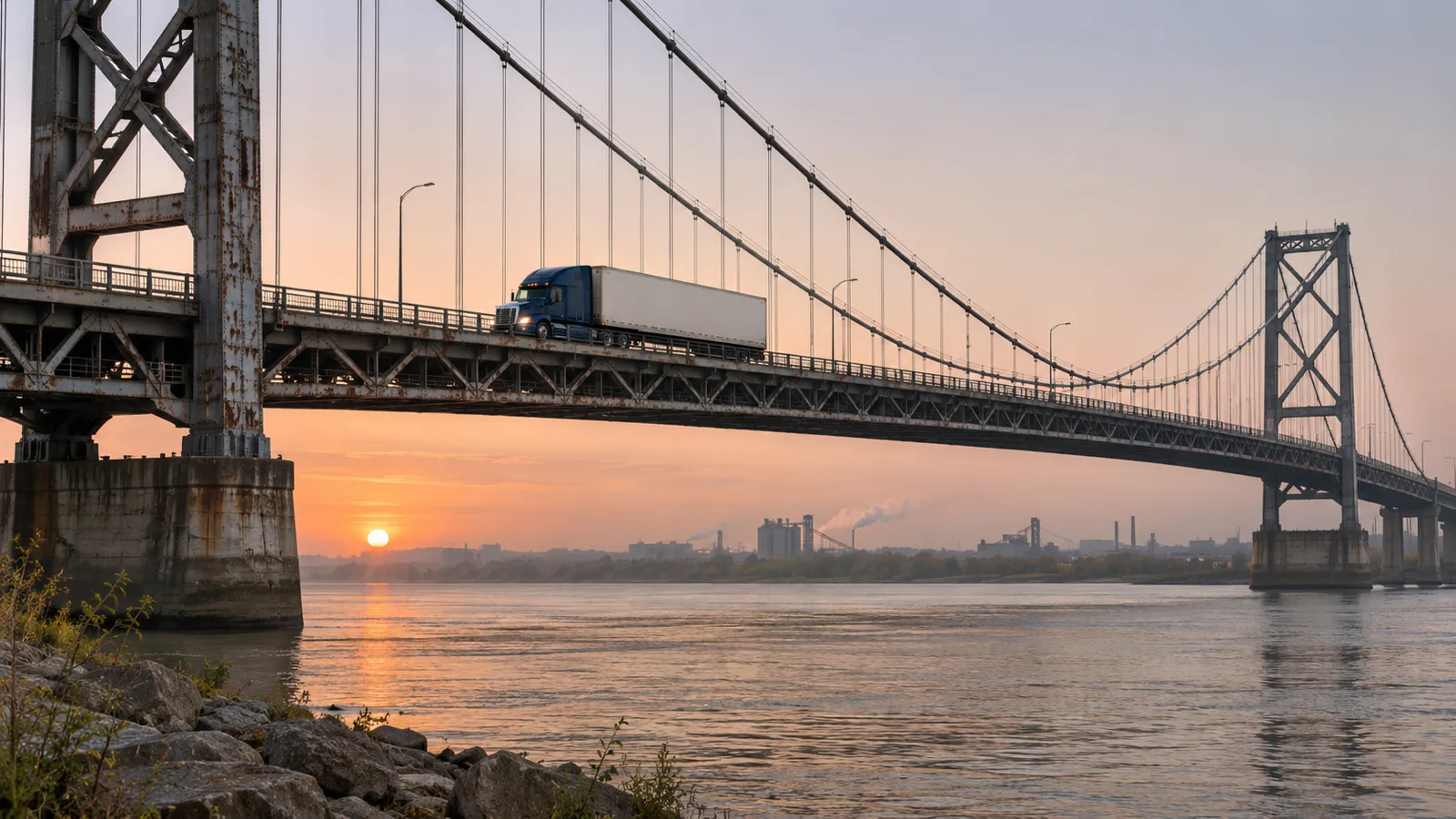
Detroit is roughly 370 kilometres from downtown Toronto, about four hours of driving before any border time. Most Michigan freight crosses at the Ambassador Bridge between Windsor and Detroit, the busiest commercial crossing between the two countries, or at the Blue Water Bridge between Sarnia and Port Huron. The Detroit-Windsor Tunnel has tight limits on truck size and the type of goods it can carry, so it is rarely a practical option for commercial freight.
Same-day delivery into the Detroit metro, Ann Arbor or Flint is realistic for a truckload leaving the GTA early. Grand Rapids and western Michigan usually work best via the Blue Water Bridge and Interstate 69, which avoids Detroit congestion entirely. For LTL, plan on one to three business days to most Michigan points, since the freight will typically pass through a terminal on each side of the border.
Ohio
Ohio has two natural approaches. Northwest Ohio, including Toledo and the auto supplier belt, is reached via Windsor and Detroit, then south on Interstate 75. Northeast Ohio, including Cleveland, Akron and Youngstown, can be reached either way, but freight from the Niagara Region, Hamilton or the eastern GTA often crosses at the Peace Bridge in Fort Erie or the Lewiston-Queenston Bridge and runs along Lake Erie through Buffalo and Erie, Pennsylvania.
Columbus, Dayton and Cincinnati are deeper runs. A truckload from the GTA to Columbus is usually a one-day move for a single driver if the border goes smoothly, with delivery the following morning being the safer promise. Cincinnati is a solid overnight trip.
Illinois
Chicago is roughly 850 kilometres from Toronto, most of it on Highway 401 and then Interstate 94 across Michigan. A single driver leaving the GTA in the morning can make Chicago the same day with a good crossing, but the honest commitment for most shippers is next-morning delivery. Chicago-area receivers frequently require booked appointments, and their docks are busy, so a truck arriving at 7 p.m. without an appointment will often wait until the next day anyway.
Southern and central Illinois points, along with destinations further west, are usually handled through Chicago-area terminals on LTL networks. If you are shipping to several Midwest customers at once, Chicago is often the natural place to break a consolidated load.
Choosing a border crossing
Crossing choice is not just about distance. Each bridge has its own patterns.
- Ambassador Bridge (Windsor to Detroit): the shortest route to Detroit, Toledo and most of Ohio and Indiana. Very high volume means wait times can swing sharply, especially weekday afternoons. The new Gordie Howe International Bridge is under construction downriver and is expected to add capacity in the coming years, but for now the Ambassador remains the main option.
- Blue Water Bridge (Sarnia to Port Huron): often a smoother crossing and a sensible choice for Flint, Lansing, Grand Rapids and Chicago via Interstate 69. It is the preferred crossing for many dangerous goods shipments.
- Peace Bridge and Lewiston-Queenston: natural for Niagara, Hamilton and eastern GTA shippers heading to Cleveland, Pittsburgh or western New York, though they are generally the long way round to Michigan or Chicago.
Experienced carriers watch posted wait times and shift crossings when one bridge backs up. If you specify a crossing in your instructions, make sure there is a good reason for it, such as a customs broker or bonded carrier arrangement tied to that port.
Border paperwork that has to be right
The single biggest cause of delay on this corridor is paperwork that is missing, late or inconsistent. Every commercial shipment entering the United States needs to be declared before the truck reaches the bridge.
ACE eManifest and PAPS
US Customs and Border Protection requires carriers to submit an electronic manifest through its ACE system before arrival, at least one hour ahead for trucks. Shipments cleared by a US customs broker are tracked under the Pre-Arrival Processing System, known as PAPS, which ties a barcode label on the paperwork to the broker's entry. If the broker has not received your invoice in time, or the PAPS number on the truck does not match the entry, the driver is sent to secondary inspection or turned around.
Commercial invoice and NAFTA documentation
Your commercial invoice should list the shipper, consignee, a plain-language description of each product, the Harmonized System code, quantity, unit value, total value, currency and country of origin. If the goods qualify under NAFTA and you want your customer to pay no US duty, a properly completed certificate of origin should be available to the importer. Keep in mind that CUSMA replaces NAFTA on July 1, 2020; from that date, preferential claims move to the new agreement's certification of origin, which has no prescribed form but must include a set list of data elements, so check with your broker about shipments that will cross after the switch. We cover that in detail in our guide to NAFTA certificates of origin for Ontario exporters.
Canadian export reporting
Shipments leaving Canada that are valued at $2,000 or more, or that are controlled or regulated, generally need to be reported to the CBSA through the Canadian Automated Export Declaration system, unless an exemption applies. Most goods going to the United States for consumption there are exempt from export reporting, but controlled goods and certain other categories are not, so confirm with your broker rather than assuming.
Regulated products
Food shipments need FDA Prior Notice filed before arrival, and the producing facility must be registered with the FDA. Some products, including certain plants, wood products, meat and dairy, also need USDA documentation. Dangerous goods must be classified, packaged and placarded to US DOT rules for the US portion of the trip, alongside Canada's TDG regulations on the Ontario side.
LTL or full truckload?
Most Ontario shippers going to the Midwest end up using both, depending on the order.
LTL freight makes sense for anything from one pallet to roughly eight or ten. Cross-border LTL carriers pick up across Ontario, consolidate at a terminal, clear customs as a combined load and then deliver through their US network. It costs less per shipment, but it adds handling and usually a day or two of transit compared with a dedicated truck. LTL rates on this lane depend heavily on freight class and density, so a lightweight bulky product can cost far more than you expect.
Full truckload becomes the better choice when you are filling most of a 53-foot trailer, when the freight is fragile or high value and you want minimal handling, or when the receiver has a strict delivery appointment. A dedicated truck from Ontario to Chicago or Columbus often costs less per pallet than LTL once you pass the halfway point on trailer space.
There is also a middle ground. Partial truckload, sometimes called volume LTL, places your freight on a truck with one or two other shippers' loads without terminal transfers. It is worth asking about for shipments in the ten to eighteen pallet range.
Carriers, drivers and rules of the road
Only carriers authorized to operate in both countries can haul your freight across the border. On the Ontario side, trucks need a valid CVOR certificate from the Ontario Ministry of Transportation. In the United States, carriers need US DOT registration and operating authority, and drivers must meet US hours-of-service rules, which allow 11 hours of driving within a 14-hour window. These are tighter than the Canadian limits, so a schedule that works for a run to Montreal may not translate directly to a run to Chicago.
Cabotage rules also matter. A Canadian carrier delivering your load in Chicago generally cannot pick up a load in Chicago and deliver it elsewhere in the United States. That affects how carriers price backhauls, which is one reason Midwest rates fluctuate with the freight flowing north into Ontario.
Many cross-border carriers participate in FAST, the Free and Secure Trade program, which offers dedicated lanes at major crossings. FAST lanes require the carrier, the driver and the importer to be enrolled in the relevant security programs, so they are not available to every shipment, but they can cut border time considerably for regular movements.
Seasonal factors to plan around
- Winter weather: lake-effect snow along Interstate 94 in Michigan and around Buffalo can stall freight for hours. Build a buffer day into January and February deliveries.
- Construction season: spring through fall brings lane closures on the 401 between London and Windsor and on Michigan interstates.
- Auto plant shutdowns: summer and holiday shutdowns at assembly plants change truck availability across the corridor.
- Holiday mismatches: Canadian and US holidays fall on different dates. Victoria Day, Civic Holiday and Canadian Thanksgiving are normal working days in Michigan, while US Thanksgiving and Memorial Day shut many American receivers. Brokers and customs still operate, but receivers often do not.
- Month and quarter ends: capacity tightens as shippers push volume to hit targets.
Common mistakes on the Midwest lane
- Sending invoices to the broker after the truck leaves. The broker needs documents before the driver reaches the bridge, ideally when the pickup is booked.
- Vague product descriptions. "Parts" or "samples" invites questions. Describe what the item is, what it is made of and what it is used for.
- Forgetting who the importer of record is. If your US customer expects goods delivered with duties paid, you need a plan for acting as non-resident importer or using a broker who can.
- Ignoring receiver requirements. Large Midwest distribution centres often require appointments, specific pallet types, and labels in particular positions. Rejected loads are expensive.
- Underestimating accessorial charges. Liftgate, inside delivery, residential delivery and detention time add up fast on cross-border LTL.
Where warehousing fits in
As Midwest volume grows, some Ontario businesses find it makes sense to keep a buffer of stock close to the border or to consolidate several orders into a weekly truck. Holding inventory in a distribution warehouse in southern Ontario lets you build full loads instead of shipping many small LTL orders, and gives you a staging point to prepare goods to each receiver's standards. If you also ship small parcels directly to US consumers, our post on Canadian brands shipping to US customers covers the parcel side of the border.
A simple planning checklist
- Confirm the consignee's address, receiving hours and appointment rules.
- Decide between LTL, partial and full truckload based on pallet count and handling sensitivity.
- Choose a US customs broker and share their contact details with your carrier.
- Prepare a complete commercial invoice and, where relevant, a NAFTA certificate of origin or, from July 1, 2020, a CUSMA certification of origin.
- Check whether FDA, USDA or dangerous goods rules apply.
- Send documents to the broker as soon as the pickup is booked.
- Build a buffer day for winter weather and border variability.
Ship to the Midwest with fewer surprises
ShipCarte helps businesses across Ontario plan and book cross-border shipping to Michigan, Ohio, Illinois and the rest of the United States, from single-pallet LTL to dedicated trucks. If you are planning your first Midwest shipments or want to tidy up an existing lane, request a quote and we will help you choose the right mode, crossing and paperwork for your freight.