
A specialty food producer in Niagara gets a call from a distributor in northern New Jersey who supplies independent grocers across Manhattan, Brooklyn and Long Island. The opportunity is real, the margins look good, and the distance seems manageable: Toronto to New York City is roughly 800 kilometres. Then the details arrive. The receiver needs a delivery appointment booked three days ahead, will refuse any pallet over a certain height, charges for late arrivals, and is located on the far side of some of the most congested roads in North America.
The US Northeast, from Buffalo and Rochester through New York City, Philadelphia and up into Boston and New England, is one of the richest markets an Ontario business can reach by truck. It is home to tens of millions of consumers and some of the largest retail and food distribution networks in the United States. It is also a region where freight costs, delivery windows and receiving rules can trip up a shipper who has only ever delivered within Ontario.
Rather than a general overview, this guide follows a typical shipment from an Ontario dock to a Northeast receiver, step by step, and then answers the questions Ontario shippers ask most often about the lane.
Step 1: Know which part of the Northeast you are really shipping to
"New York" can mean very different things for freight. Upstate cities such as Buffalo, Rochester, Syracuse and Albany are straightforward runs on the New York State Thruway. Buffalo is barely two hours from Hamilton. The New York City metro is another matter: much of the region's warehousing and food distribution sits in northern and central New Jersey, around Secaucus, Edison and the Meadowlands, while deliveries into the five boroughs face height restrictions, limited parking, tight receiving hours and heavy tolls.
New England, including Boston, Worcester, Hartford and Providence, is reached via the Massachusetts Turnpike or through central New York and Interstate 90. Pennsylvania destinations, from Erie and Pittsburgh in the west to Philadelphia and the Lehigh Valley in the east, each have their own natural routes.
Before you quote a price or a transit time to a customer, confirm the exact delivery address, whether it is a commercial dock or a storefront, and the receiving hours. The difference between a New Jersey distribution centre and a Brooklyn shop is often a full day and several hundred dollars.
Step 2: Pick the crossing that matches your origin
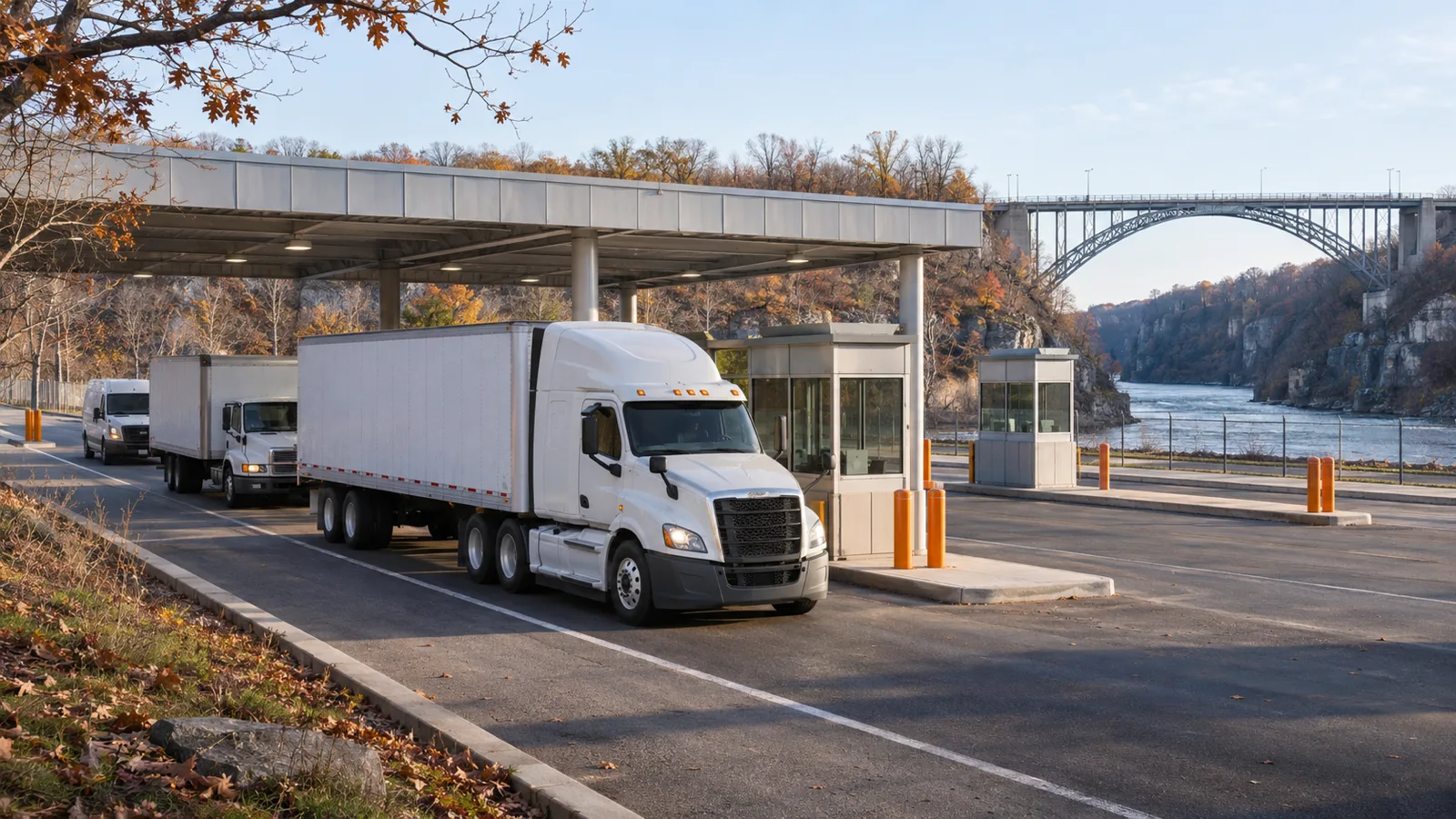
Ontario has several commercial crossings into New York State, and the right one depends on where in the province your freight starts.
- Peace Bridge (Fort Erie to Buffalo): the main crossing for freight from the GTA, Hamilton, Niagara and much of southwestern Ontario heading to the New York City area, Pennsylvania and New England via the Thruway.
- Lewiston-Queenston Bridge: an alternative for Niagara-area and GTA freight, often used when the Peace Bridge is backed up. The Rainbow Bridge at Niagara Falls does not take commercial trucks.
- Thousand Islands Bridge (Lansdowne to Alexandria Bay): the natural crossing for Kingston, Belleville and eastern GTA shippers heading south on Interstate 81 to Syracuse, Scranton, New Jersey and Philadelphia.
- Ogdensburg-Prescott International Bridge and the Seaway International Bridge at Cornwall: convenient for Ottawa and eastern Ontario freight, particularly toward Albany, Vermont and New England.
For an Ottawa manufacturer shipping to Boston, the eastern crossings can save hours compared with driving west to Niagara. For a London or Kitchener shipper heading to Philadelphia, the Peace Bridge or Lewiston-Queenston is usually best.
Step 3: Get the paperwork to the broker before pickup
Every commercial shipment into the United States must be declared electronically before arrival. The carrier files an ACE eManifest at least an hour before reaching the border, and the US customs broker handling your entry needs a complete commercial invoice to match. With most brokers on this lane, the shipment travels under a PAPS barcode that links the truck to the broker's entry.
Your invoice should include a clear description of each product, its HS code, quantity, value, currency and country of origin. If your goods qualify under NAFTA, the importer will want a valid certificate of origin so they can claim duty-free treatment. Our guide to NAFTA certificates of origin explains how Ontario exporters complete and keep those records.
Food producers have extra steps. The FDA requires Prior Notice for food shipments before they arrive, and the facility that made the food must be registered with the FDA. Missing Prior Notice is one of the most common reasons Ontario food shipments are held at the Peace Bridge.
Step 4: Choose the right mode for the order
For one to six pallets, cross-border LTL freight is usually the economical choice. Your pallets are picked up, cross-docked at a terminal in Ontario, cleared as part of a combined load and delivered from a US terminal near the destination. Expect two to four business days to the New York City area and similar times to Boston, depending on the carrier's network.
For larger orders, or anything going into a strict appointment window, a dedicated truck is often worth it. A full truckload from the GTA to northern New Jersey is commonly a next-day delivery, and the driver can be scheduled to hit a specific receiving slot. That predictability matters in a region where a missed appointment might not be rebooked for days.
Temperature-sensitive products, such as dairy, chilled prepared foods or certain health products, need refrigerated equipment and careful planning around border waits. A reefer unit can hold temperature through a long inspection, but the paperwork and the appointment still need to line up.
Step 5: Budget for tolls, congestion and accessorials
The Northeast is the most expensive region in the United States for final delivery, and Ontario shippers sometimes underestimate how much.
- Tolls: the New York State Thruway, New Jersey Turnpike, bridges and tunnels into New York City, and the Massachusetts Turnpike all charge trucks. Crossing into Manhattan by bridge or tunnel can add a significant toll on its own.
- Congestion time: a driver can spend hours in traffic around the George Washington Bridge or the Cross Bronx Expressway. Carriers price that in.
- NYC delivery surcharges: many LTL carriers apply a specific surcharge for deliveries in the five boroughs.
- Liftgate and inside delivery: smaller stores and restaurants rarely have loading docks.
- Detention and redelivery: if the receiver is not ready or the appointment is missed, the costs fall back on the shipper unless your terms say otherwise.
Ask your carrier or freight partner to quote with these charges included, rather than discovering them on the invoice.
Step 6: Plan around weather and the calendar
The route from Ontario to the Northeast runs through some of the snowiest terrain in eastern North America. Lake-effect snow from Lake Erie hits Buffalo and the Thruway, and the Tug Hill plateau north of Syracuse can shut Interstate 81 in heavy storms. Winter deliveries need buffer time, especially for loads with appointments.
Holidays also matter. US Thanksgiving in late November and the run-up to Christmas are peak periods for Northeast retail receivers, and appointment slots fill quickly. Canadian holidays such as Victoria Day and Canadian Thanksgiving are normal working days south of the border, which can work in your favour if you plan to ship while Ontario traffic is lighter.
Frequently asked questions
How long does freight take from Toronto to New York City?
A full truckload leaving the GTA in the afternoon can typically deliver in northern New Jersey or the city the next morning, assuming a smooth border crossing. LTL usually takes two to four business days because of terminal handling on both sides.
Do I need a US customs broker?
In practice, yes. The importer of record, which may be your customer or your own business acting as a non-resident importer, needs a licensed US customs broker to file the entry. Many cross-border carriers can recommend one or work with brokers they deal with daily.
Who pays duty and fees on the US side?
That depends on your sales terms. If you sell on terms where the buyer handles import, they pay any duty and the merchandise processing fee. Under NAFTA, qualifying Canadian goods typically enter duty-free, but fees and brokerage still apply. If you sell delivered duty paid, those costs are yours.
Can I ship small orders by parcel instead?
For cartons rather than pallets, parcel shipping is often faster and simpler. Shipments valued under the US de minimis threshold of $800 US can generally enter without formal entry, which is useful for direct-to-consumer orders. For wholesale orders, freight is usually the better fit. Our guide to shipping to US customers covers the parcel route.
What about NAFTA's replacement?
Canada, the United States and Mexico signed a new agreement in late 2018, known in Canada as CUSMA. It still needs to be ratified by all three countries. Until it takes effect, NAFTA rules and certificates continue to apply to your shipments.
When a staging warehouse makes sense
If your Northeast business grows into several orders a week, consider consolidating them through a warehouse in Ontario before they cross. A distribution warehouse lets you combine orders into fuller trucks, apply retailer-specific labels and build compliant pallets before the freight leaves the province. That reduces per-order costs and the risk of chargebacks from strict receivers. For retail accounts with detailed routing guides, our retail fulfillment team can handle the prep work.
Get your Northeast lane running smoothly
ShipCarte works with businesses throughout Ontario, from Windsor to Ottawa, to plan freight into New York, New Jersey, Pennsylvania and New England. We can help you compare carriers, choose the right crossing and keep paperwork moving ahead of the truck. Request a quote for your next Northeast shipment, or schedule a consultation to map out a regular lane.