
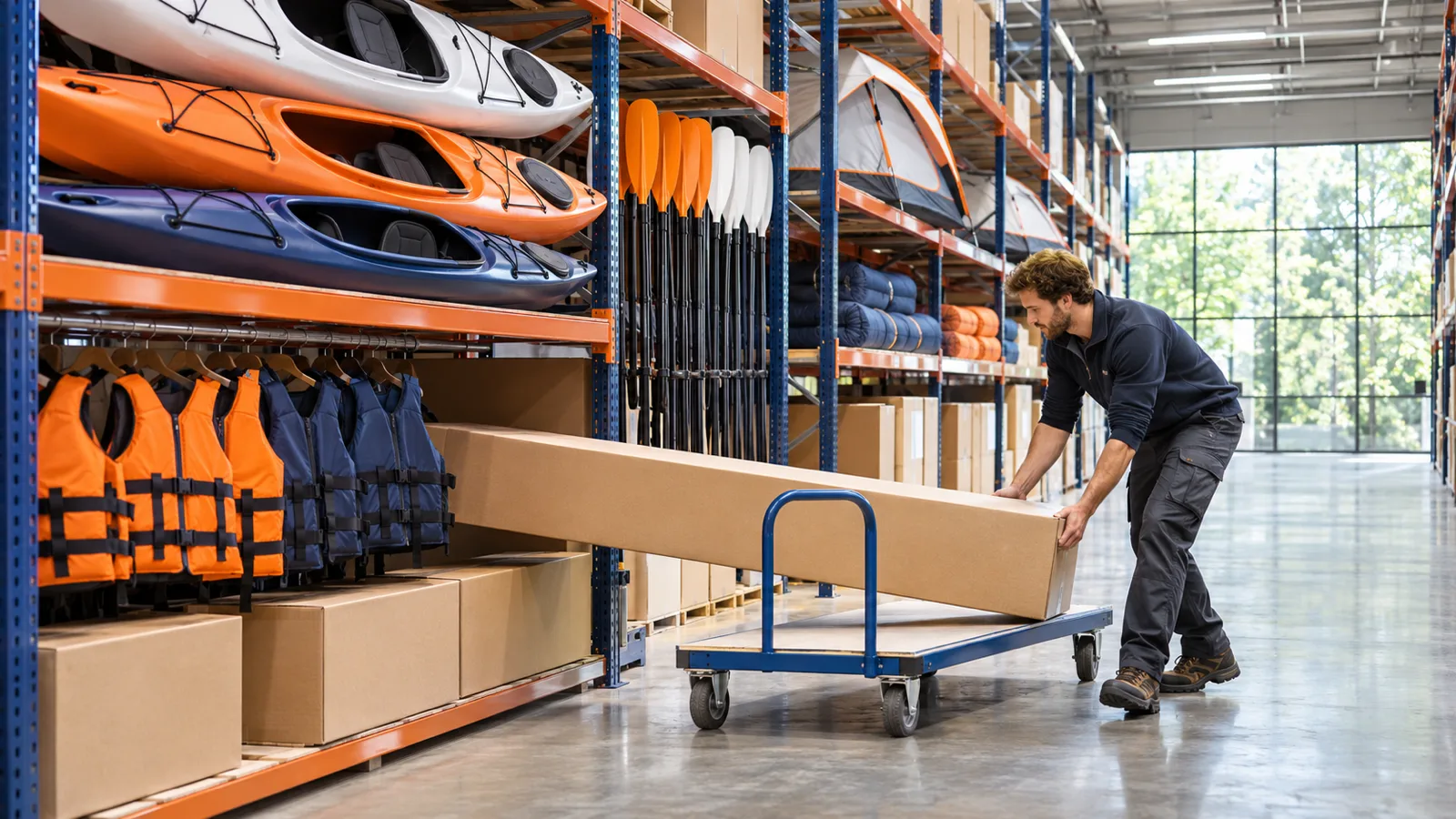
In late February, the snow is still piled high in Barrie and Peterborough, but the orders are already starting to change. Cottage owners are buying new dock lines and life jackets, anglers are stocking up for the spring opener, and families are pricing paddleboards for the summer. By the Victoria Day long weekend, when much of Ontario opens the cottage, an online retailer of outdoor gear can be shipping several times its winter volume, much of it bulky, awkward and headed to addresses that do not look like a typical city delivery.
Sporting goods and cottage gear are a natural fit for online selling in Ontario. The province has hundreds of thousands of lakes, a deep cottage culture from Muskoka and the Kawarthas to the Rideau Lakes and the Near North, and enthusiasts who will happily research and order the right equipment online. But the products themselves bring shipping challenges that a fashion or electronics retailer rarely faces: twelve-foot kayaks, fuel canisters, heavy cast-iron cookware, sized boots that come back, and customers who want delivery to a seasonal property at the end of a gravel road.
This guide walks through an Ontario outdoor retailer's year, season by season, and then sets out the operational choices that make the biggest difference.
Late winter: getting inventory in place
The busiest months for summer gear are April through July, but the work starts much earlier. Most paddling, fishing and camping products are manufactured months ahead, and many are imported. Ontario retailers who wait until April to receive their summer inventory often find themselves out of stock on the most popular items just as the long weekend arrives.
- Place orders with suppliers by late fall or early winter for spring arrival.
- Receive and count stock in March and April, before the order rush begins.
- Photograph and list new products early so they are indexed and searchable before customers start shopping.
- Plan storage for bulky items. A shipment of kayaks or canoes takes far more warehouse space than its value suggests.
If your own space cannot handle a seasonal surge in bulky stock, flexible inventory management with a third-party warehouse lets you scale space up in spring and back down in the fall.
Spring: cottage opening and the long weekend rush
From April to late May, orders spike for docks and dock hardware, life jackets, boat accessories, fishing tackle, outdoor furniture and cottage maintenance supplies. Many customers want their gear delivered before they drive north for the Victoria Day weekend, so delivery promises matter more than usual.
Delivering to cottage country
Cottage addresses are one of the most distinctive challenges for Ontario outdoor retailers:
- Rural and seasonal addresses: many properties use civic numbers on rural roads, some carriers apply rural or remote surcharges, and delivery days may be limited.
- Nobody home: a parcel delivered to a cottage that will not be opened until next weekend may sit unattended or be returned.
- Water-access properties: some cottages on Georgian Bay, Lake of Bays or the Kawarthas can only be reached by boat. Deliveries must go to a marina, a general store or a mainland parking area.
The practical solution is to ask the right questions at checkout. Let customers flag a seasonal or water-access address, choose to ship to their city home instead, or select a pickup location. Give realistic delivery estimates for rural postal codes in Muskoka, Haliburton, Parry Sound and beyond, and consider holding orders for a requested delivery date.
Summer: oversized items and peak volume
Summer is when the bulkiest products move. Kayaks, canoes, stand-up paddleboards, bike racks, inflatable toys and large coolers can all exceed standard parcel size limits or trigger oversize surcharges.
Parcel or freight?
Couriers have maximum dimensions and apply heavy surcharges for large packages, based on a combination of length and girth. A long, narrow kayak box can blow past those limits even if it is not especially heavy. Options include:
- Oversize parcel services for items just above the standard limits, with the surcharges built into your shipping price.
- LTL freight for very large items, such as canoes, docks and boats. Freight requires palletizing or crating and often residential delivery with a liftgate, but it can be cheaper and safer for long items.
- Local delivery partners in key regions, which some retailers use for high-value or very bulky orders.
- Store or warehouse pickup, popular with customers who drive past on their way north.
Whatever you choose, quote shipping accurately before checkout. Few things frustrate customers more than a cancelled order because the shipping cost was miscalculated.
Protecting long items
Kayak and paddleboard damage often happens at the ends. Use foam end caps, corner protectors and reinforced boxes, and mark the shipping box clearly with orientation. For fibreglass and composite boats, crating is usually worth the cost.
Bicycles and e-bikes
Bikes are another summer staple with their own quirks. A boxed bicycle is large, light and easily bent if crushed, so dimensional weight usually decides the price. Most retailers ship bikes partially assembled, with the handlebars turned, pedals removed and the front wheel strapped alongside the frame. Include clear assembly instructions, or offer a local assembly partner, because a poorly assembled bike is a safety risk and a common source of returns.
E-bikes add a large lithium battery to the mix, which brings dangerous goods rules into play and usually rules out air services. They are also subject to Ontario rules on power output and maximum assisted speed for road use, so make sure your product listings describe the specifications accurately for Ontario buyers.
Fuel, batteries and other dangerous goods
Many camping and cottage products are regulated as dangerous goods under Canada's Transportation of Dangerous Goods regulations. Common examples include:
- butane and propane canisters for camp stoves
- liquid camping fuel and fire starters
- bear spray and other aerosols
- lithium batteries in GPS units, fish finders, headlamps and power banks
- some cleaning chemicals for boats and docks
Some of these can ship by ground under limited quantity provisions if they are packaged and marked correctly. Others cannot go by air at all, and some carriers will not accept them for certain services. Train your packing staff, use the correct markings, and set up your store so dangerous goods ship only by approved ground services. If you are unsure, ask your carrier or fulfillment partner before listing the product.
Fall: hunting, shoulder season and closing the cottage
As summer ends, demand shifts toward hunting and fishing gear, cottage closing supplies, and outdoor clothing. This is also the season to clear summer inventory before it ties up storage over winter. Plan sales in late August and September, and review which bulky items sold slowly so you can adjust next year's orders.
Returns are worth watching in the fall. Many customers buy several sizes of boots, waders or wetsuits during the summer and return the ones that do not fit. A clear returns policy and efficient processing get those items back into stock quickly. ShipCarte's returns management service inspects and restocks returned gear so it is available for the next customer.
Winter: snow sports and the holiday peak
Ontario winters create a second peak. Snowshoes, ice fishing gear, cross-country skis, snowmobile accessories, toques and winter boots all sell strongly from November through January, and the holiday season adds gift orders. Winter weather also complicates delivery, particularly in the snowbelts east of Lake Huron and Georgian Bay and across northern Ontario. Build extra transit time into your delivery estimates and post holiday shipping deadlines early.
Operational choices that make the biggest difference
1. Carrier mix
No single carrier is best for everything an outdoor retailer ships. Small accessories go cheapest with one carrier, heavy parcels with another, oversized items by freight, and rural cottage addresses with whichever service reaches them most reliably. Carrier management and a multi-carrier shipping platform let you match each order to the right service.
2. Slotting and storage
Long, bulky items need their own storage zones, often on cantilever racks or floor locations. Fast-moving small items, such as lures, headlamps and paddling gloves, should be close to the packing area. Rearranging your warehouse by season can save significant walking time.
3. Product data
Accurate dimensions and weights for every product are essential for correct shipping quotes. Measure the boxed product, not the item, and update data when suppliers change packaging.
4. Customer communication
Clear shipping estimates for rural and northern postal codes, cottage delivery options and honest notes on oversized shipping charges reduce support calls and abandoned carts.
Seasonal checklist for Ontario outdoor retailers
- Summer stock ordered by early winter and received by April
- Oversized shipping options priced and tested before May
- Cottage and water-access delivery options at checkout
- Dangerous goods identified and shipping rules set
- Fall clearance plan for slow summer items
- Winter stock and holiday deadlines in place by November
For broader peak planning, see our guide to preparing for peak season. If you sell to customers further north, our post on shipping to northern Ontario covers longer routes and remote areas.
Get your gear to the dock on time
ShipCarte helps outdoor and sporting goods retailers across Ontario store seasonal inventory, ship oversized items and reach cottage country customers reliably. Explore our ecommerce fulfillment services, then request a quote for the coming season.