
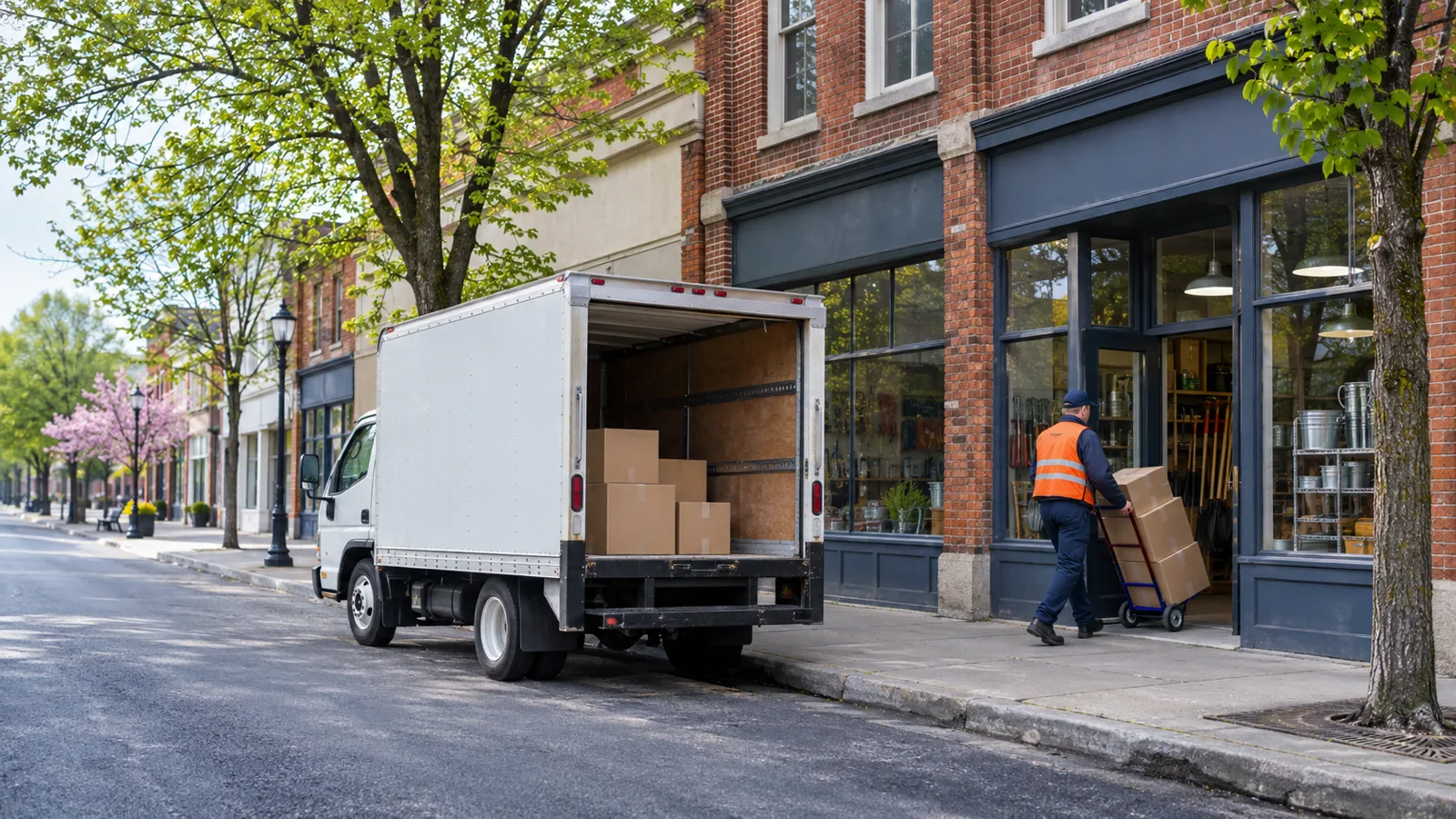
The owner of a gift shop in Bracebridge calls her supplier on the Thursday before the Victoria Day long weekend. The cottagers are arriving, the store is busier than it has been since Thanksgiving, and she is down to her last few units of the supplier's best-selling candle. The order goes in that afternoon. The shipment is picked in the GTA on Friday, interlined to a regional carrier on Monday, and reaches the store the following Thursday, after the rush has passed. She remembers that, and next spring she gives the shelf space to a supplier who can get there faster.
Small-town independents are the backbone of retail in much of Ontario. Hardware stores, pharmacies, gift shops, outfitters, bookstores and general stores in places like Owen Sound, Picton, Huntsville, Goderich, Pembroke and Kapuskasing sell a surprising volume of product, and they are often more loyal to good suppliers than big-box chains. But they are expensive and awkward to serve. Orders are small, the stores are far apart, many have no loading dock, and demand swings sharply with the seasons.
This article is for manufacturers, wholesalers and brands that sell to these retailers. It looks at why replenishment to small-town Ontario is harder than it looks, and how to build a distribution approach that keeps shelves full without letting freight costs swallow the margin.
What makes small-town replenishment hard
Small, frequent orders
An independent shop in a town of 10,000 people does not have room or cash to stock months of inventory. It orders little and often. A typical order might be two or three cartons, which falls into an awkward zone: too much for an economical courier shipment, too little for LTL to be cost-effective, especially once minimum charges are applied.
Distance and carrier coverage
National carriers cover most of southern Ontario well, but the further you get from the 401 and 400-series corridors, the more likely your freight is handed off to a regional partner for the final leg. That handoff, known as interlining, adds a day or more to transit and often comes with "beyond point" charges. Towns on the Bruce Peninsula, in Haliburton, in the Ottawa Valley and across Northern Ontario are commonly served this way.
Seasonality
Many small-town retailers do a large share of their annual sales between the Victoria Day weekend in May and Thanksgiving in October. Cottage country, the Kawarthas, Prince Edward County, Niagara-on-the-Lake and the shoreline towns of Lake Huron all follow this pattern. Some stores reduce their hours or close entirely in winter. A replenishment plan that treats every month the same will either leave stores empty in July or overloaded in November.
Receiving limitations
Many main-street stores occupy older buildings with no dock, a front door onto the sidewalk and a back door onto a lane. The owner may also be the only staff member. Deliveries need to be small enough to bring in by hand, during hours when someone is there to receive them.
Five strategies that work
1. Set order minimums and a delivery calendar
Rather than shipping every order the day it arrives, many suppliers set a delivery calendar by region. Stores in Grey and Bruce counties might receive deliveries every Tuesday, Muskoka and Parry Sound every Wednesday, the Ottawa Valley every Thursday. Retailers know exactly when to order and when stock will arrive, and you can build consolidated shipments rather than many small ones. Pair the calendar with a sensible order minimum, or a free-freight threshold, to encourage stores to order in amounts that make shipping worthwhile.
2. Consolidate into regional runs
Once orders are grouped by region and day, they can travel together. A single straight truck or LTL multi-stop shipment heading up Highway 11 can drop at Orillia, Gravenhurst, Bracebridge and Huntsville on one trip. Along Highway 7 and Highway 62, a run through Peterborough, Havelock and Bancroft serves a cluster of stores that would be costly to reach individually. This is the classic "milk run," and it often brings per-stop costs well below individual courier shipments. ShipCarte's distribution services are built to plan and book these runs.
3. Use courier for the urgent top-up
Consolidation is cheaper, but it is not fast. For the shop owner who sells out before the long weekend, an urgent courier shipment that arrives in one or two days is worth the higher cost, especially if you pass part of it on. Offering a clear choice, scheduled delivery at no charge or express delivery with a fee, keeps the retailer in control and protects your margin.
4. Pre-build the season
For highly seasonal retailers, the best replenishment is the one that happens before the season starts. Work with key accounts in April to agree on an opening order that fills the shelves for May and June, delivered in late April or early May, once spring load restrictions on many rural roads have eased but before the highways fill with weekend traffic. Then use scheduled top-ups through July and August, and a smaller final order in September. Our guide to shipping to cottage country covers transit on these routes in more detail.
5. Pick and pack for the store, not the warehouse
Main-street stores benefit from smaller cartons, clear labelling by department and packing slips that match what they ordered. Many prefer inner packs or mixed cartons over full master cases. A warehouse that can break case packs and build store-ready cartons saves the retailer time and makes your product easier to stock. Pick and pack services handle this efficiently at scale.
Winter in the north
Serving retailers in Northern Ontario adds another dimension. Towns along Highway 11 and Highway 17, from Cochrane and Hearst to Wawa, Marathon and Kenora, are hundreds of kilometres apart, and winter storms can close sections of highway for hours or days. Freight to these communities often travels through hubs in Sudbury, North Bay, Sault Ste. Marie or Thunder Bay.
Practical steps for northern accounts:
- Build longer lead times into your promises from November to March.
- Encourage stores to hold a little more safety stock in winter, especially on staple items.
- Choose carriers with terminals in the north rather than relying on long interline chains.
- Pack for cold. Liquids, paints and some cosmetics can freeze in an unheated trailer; ask for heated service when needed.
Make ordering easy for the retailer
Replenishment does not start in the warehouse; it starts when the shop owner notices a gap on the shelf. Many small-town retailers still order by phone or email, often after hours, and the order may sit until someone keys it in. Giving them a simple way to order, such as a wholesale web store, an order form with your delivery calendar printed on it, or a sales rep who takes standing orders, shortens the cycle by a day or more. Confirm every order with the expected delivery date, and tell the store promptly if anything is backordered so they can adjust displays. Small courtesies like these matter more to an owner-operator than to a chain buyer, and they are a large part of why independents stay loyal.
Keeping freight costs in proportion
Small-town accounts can be profitable, but only if freight is managed deliberately. A few principles help:
- Know your cost to serve. Calculate the true freight cost for each region, including beyond-point and residential charges where they apply. Some rural main-street addresses are classed as residential by carriers.
- Price freight into the account. Use free-freight thresholds that reflect real costs rather than a single province-wide number.
- Review carrier choice by region. The carrier that is cheapest to Hamilton may be expensive to Haliburton. A carrier management approach that compares options by lane keeps costs down.
- Measure delivery performance. Track transit times and damage rates by region and carrier. Retailers notice when deliveries slip, even if they do not complain right away.
A worked example
Consider a home décor wholesaler in the GTA with 140 independent accounts across Ontario. Before changing its approach, it shipped every order individually by courier on the day received. Freight averaged a high percentage of order value for stores outside southern Ontario, and northern stores often waited a week.
The wholesaler moved to a regional delivery calendar with weekly consolidated runs to five regions, a free-freight threshold set by region, and an express option for urgent orders. It worked with its key cottage country accounts to deliver opening orders in late April. Within a season, freight cost as a share of sales on rural accounts dropped noticeably, average transit times to Muskoka and the Kawarthas improved because freight no longer waited at interline points, and retailers began placing larger, more predictable orders because they knew when stock would arrive.
Why it is worth the effort
Independent retailers in small Ontario towns tend to stay with suppliers who serve them well. They carry a curated range, know their customers personally and often recommend products directly. For brands, that is valuable shelf space. Our article on retail store replenishment in Canada covers the national picture, but the opportunity in small-town Ontario is distinctive: hundreds of loyal stores within a day's drive of the GTA, if you can reach them reliably.
Reach every main street
ShipCarte helps suppliers store inventory centrally, build store-ready orders and route them to retailers across Ontario by consolidated run, LTL or courier, whichever fits the order. Schedule a consultation to map out a regional delivery calendar, or request a quote for your current retail shipments.