
A sausage maker in Wellington County lands a listing with a regional grocery chain. The product is good, the plant is clean and the price works. Then the questions start arriving: Is the plant provincially licensed or federally licensed? How will the product reach the chain's distribution centre in the GTA at 2°C on a July afternoon? Who holds the frozen safety stock? What happens if a trailer's reefer unit fails somewhere on Highway 401 near Cambridge?
For meat and poultry businesses, those questions are not paperwork. Temperature abuse turns a profitable truckload into a write-off, and a traceability gap can turn a minor quality complaint into a recall. The cold chain is the part of the business customers never see, but it is the part buyers and inspectors look at hardest.
This guide walks through how meat and poultry actually move in Ontario in 2020: the licensing tier that decides where you can sell, the temperature targets that matter, how to plan transport and storage, and how to pick a logistics partner that will not be the weak link.
Start With Your Licence: It Decides Your Market
Before any logistics plan, confirm which inspection system your plant operates under, because it sets the boundaries of your distribution network.
Provincially licensed plants
Ontario has a large network of provincially licensed abattoirs and free-standing meat plants operating under the Food Safety and Quality Act and its meat regulation, inspected by the Ontario Ministry of Agriculture, Food and Rural Affairs (OMAFRA). Product from these plants can be sold anywhere in Ontario, to butchers, restaurants, farm stores and retailers, but it cannot legally cross a provincial border or be exported. If a customer in Gatineau or a distributor in Manitoba asks for your product, a provincial licence alone will not get it there.
Federally licensed establishments
Since the Safe Food for Canadians Regulations came into force in January 2019, federally inspected meat establishments operate under a Safe Food for Canadians licence issued by the Canadian Food Inspection Agency (CFIA). That licence opens interprovincial trade and, with the right export certification, foreign markets. It also brings stricter expectations on preventive control plans and traceability, which carry straight into how you store and ship. If you are weighing the move to federal licensing, our overview of the Safe Food for Canadians licence covers the basics.
For logistics, the practical point is simple: your warehouse and carriers need to know which product is provincially inspected so it never ends up on a load bound for Quebec or Manitoba. Good inventory systems flag this at the SKU or lot level rather than relying on someone remembering.
Temperature Targets by Product Type
Meat and poultry are not one temperature band. Mixing them up is one of the most common sources of quality claims.
- Fresh red meat (beef, pork, lamb, veal): held at 4°C or colder, with many processors targeting -1°C to 2°C to stretch shelf life, particularly for vacuum-packed primals.
- Fresh poultry: similar or colder, typically 0°C to 2°C. Poultry is less forgiving than beef, and its shelf life is measured in days.
- Ground and further-processed meat: more surface area means faster bacterial growth, so the margin for error shrinks. Keep it at the cold end of the fresh range.
- Cured, smoked and fermented products: some shelf-stable items tolerate ambient storage, but most deli meats and sausages still need refrigeration. Follow the label your plant has validated.
- Frozen meat and poultry: -18°C or colder, held consistently. A frozen product that thaws partially and refreezes may still be safe, but the texture and drip loss will tell your customer something went wrong.
The key logistics consequence is that a single truck or a single cold room may not suit every product you make. If you ship fresh poultry and frozen burgers on the same run, you either need a multi-temperature trailer with a bulkhead or separate shipments.
The Five Handoffs Where Cold Chains Break
Most temperature failures do not happen on the highway. They happen at handoffs, where product is waiting for someone. Walk your own chain with these five points in mind.
1. Plant to dock
Product leaving a blast cell or chill room should go straight to a refrigerated dock with sealed dock doors, not a staging lane beside an open bay door. In an Ontario summer, a pallet left in a warm dock for 30 minutes can pick up several degrees at the surface.
2. Dock to trailer
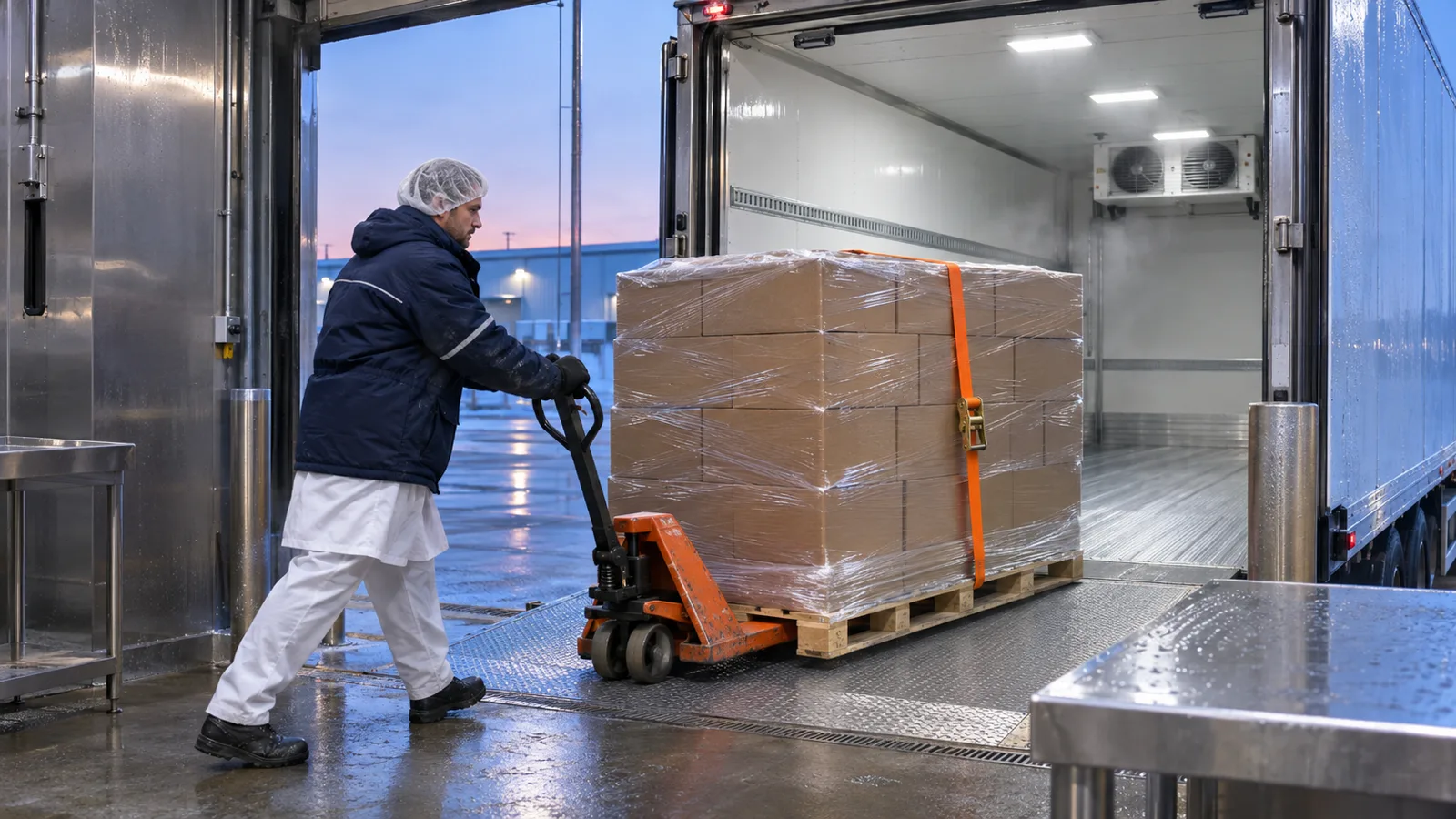
Reefer trailers should be pre-cooled to the set point before loading. Loading warm product into a cold trailer and expecting the reefer unit to pull it down is a misunderstanding of how the equipment works: reefers are built to maintain temperature, not to chill product. Record the product temperature at loading on the bill of lading.
3. In transit
Continuous temperature recording, either from the reefer unit's own download or an independent data logger in the load, gives you evidence if a dispute arises. On longer runs, such as Toronto to Thunder Bay along Highway 11 and 17, ask the carrier about fuel stops, driver changes and contingency plans if a unit faults in a stretch with little service coverage.
4. Cross-dock and consolidation
When a smaller processor's pallets are consolidated with other shippers' freight, the product may pass through a cross-dock. Ask whether that facility is fully refrigerated or just has a cooler on one side. Ask how long freight typically sits there.
5. Receiving at the customer
Grocery distribution centres and foodservice distributors take temperatures at receiving and reject loads that are out of range. Missed delivery appointments mean product sitting in a yard waiting for a door. Building realistic appointment windows, especially for deliveries into the GTA during rush hour on the 401 and the 400, avoids that dead time.
Transport Options Across Ontario
Meat processors in Ontario typically use a mix of three transport models.
Dedicated reefer truckload
For full loads to a single destination, such as a grocery chain's distribution centre or a large foodservice warehouse, a dedicated refrigerated truckload is the cleanest option. One temperature, one pickup, one drop, no rehandling. If you are moving whole loads from a plant in Guelph or the Niagara region into the GTA several times a week, full truckload service with reefer equipment is usually the most reliable route.
Refrigerated LTL
Smaller processors often ship a few pallets at a time to many customers: butcher shops in Ottawa, restaurants in Kingston, specialty grocers in London. Refrigerated less-than-truckload service consolidates those pallets with other temperature-controlled freight. It is cost-effective, but it means more stops, more door openings and longer transit time. Ask about the carrier's temperature ranges, since some refrigerated LTL networks run at a single setting that suits produce better than fresh poultry.
Parcel with insulated packaging
Direct-to-consumer meat sales, such as boxes of grass-fed beef or heritage pork shipped to homes, rely on insulated shippers with gel packs or dry ice. Within southern Ontario, next-day ground delivery is achievable to most addresses. Northern Ontario and rural routes are harder, and a two-day transit in July can defeat even well-packed boxes. Dry ice is regulated as a dangerous good (UN1845, Class 9) under Transportation of Dangerous Goods rules for some modes and carrier policies, so labelling and quantity limits apply. Our guide to shipping frozen foods for e-commerce covers packaging in more detail.
Storage: Where Your Safety Stock Lives
Many processors run out of space before they run out of production capacity. Freezer space in particular is expensive to build and expensive to run. Outsourced cold storage lets you hold frozen inventory, seasonal builds (barbecue season and the December holidays are the obvious ones) and buffer stock for major customers without investing in another freezer.
When comparing cold storage options, look at:
- Temperature zones available: cooler, freezer, and ideally a deep-freeze zone for products that need it.
- Monitoring and alarms: 24/7 temperature monitoring with alerts that reach a human, and documented responses to excursions.
- Lot and date control: the warehouse system should track lot numbers, production dates and best-before dates, and ship first-expired, first-out rather than relying on pallet position.
- Sanitation and pest control: written programs and records you can show your own auditors and customers.
- Location: a facility near the 401/400-series corridor shortens delivery times to the GTA, Hamilton and Kitchener-Waterloo, where most grocery and foodservice distribution is concentrated.
A dedicated temperature-controlled warehouse partner also gives you somewhere to receive imported ingredients, packaging materials and seasonal products without crowding your plant floor.
Traceability and Recall Readiness
Under the Safe Food for Canadians Regulations, federally licensed businesses must be able to trace food one step back and one step forward, and provide those records to the CFIA quickly when asked. Provincially licensed plants face their own record-keeping requirements, and grocery buyers increasingly ask for the same level of traceability regardless of licence type.
Your logistics records are a large part of that trail. Every pallet that leaves a warehouse should be tied to a lot number, a customer and a shipment date. Ask yourself whether you could answer these questions within a couple of hours:
- Which customers received lot 4417 of chicken breast, and on which trucks?
- How many cases of that lot are still in storage, and where?
- What were the recorded temperatures during the transport of that lot?
If the honest answer involves digging through paper bills of lading and email, it is worth fixing before a recall forces the issue. ShipCarte's recall management processes, built for highly regulated products, apply the same discipline to food.
Exporting to the United States
Ontario is well placed for exports to the US Midwest and Northeast, with the Ambassador Bridge at Windsor, the Blue Water Bridge at Sarnia and the Peace Bridge at Fort Erie all within a day's drive of most processing regions. Meat and poultry exports, however, involve more than a customs entry. Product must come from a federally licensed establishment eligible to export to the US, travel with CFIA export certification, and be re-inspected by the US Department of Agriculture at an approved import inspection facility after crossing. That extra stop needs to be built into transit times and delivery appointments.
Because NAFTA keeps most Canadian meat duty-free into the US, the main risks are documentation errors and delays at reinspection rather than tariffs. Brokers and carriers with meat-specific experience earn their fees here. For broader context on moving goods south, see ShipCarte's cross-border shipping services.
A Quick Checklist for Ontario Meat Processors
- Every SKU is flagged as provincially or federally inspected in your inventory system.
- Temperature set points are documented per product, not just "keep cold."
- Reefers are pre-cooled and product temperatures are recorded at loading.
- Carriers provide temperature downloads on request within 24 hours.
- Cold storage partner tracks lot and best-before dates and ships FEFO.
- Delivery appointments are booked with realistic GTA traffic buffers.
- You have run a mock recall in the past 12 months.
- Dry ice and gel pack shipments follow carrier and TDG requirements.
Keep Your Meat and Poultry in Spec With ShipCarte
ShipCarte supports food processors across Ontario with cold storage, refrigerated freight and order fulfillment, so you can focus on production while your product stays in range from the plant to the customer's dock. Whether you need overflow freezer space before the holiday season or a reliable way to move pallets into GTA distribution centres, request a quote or schedule a consultation with our team.