
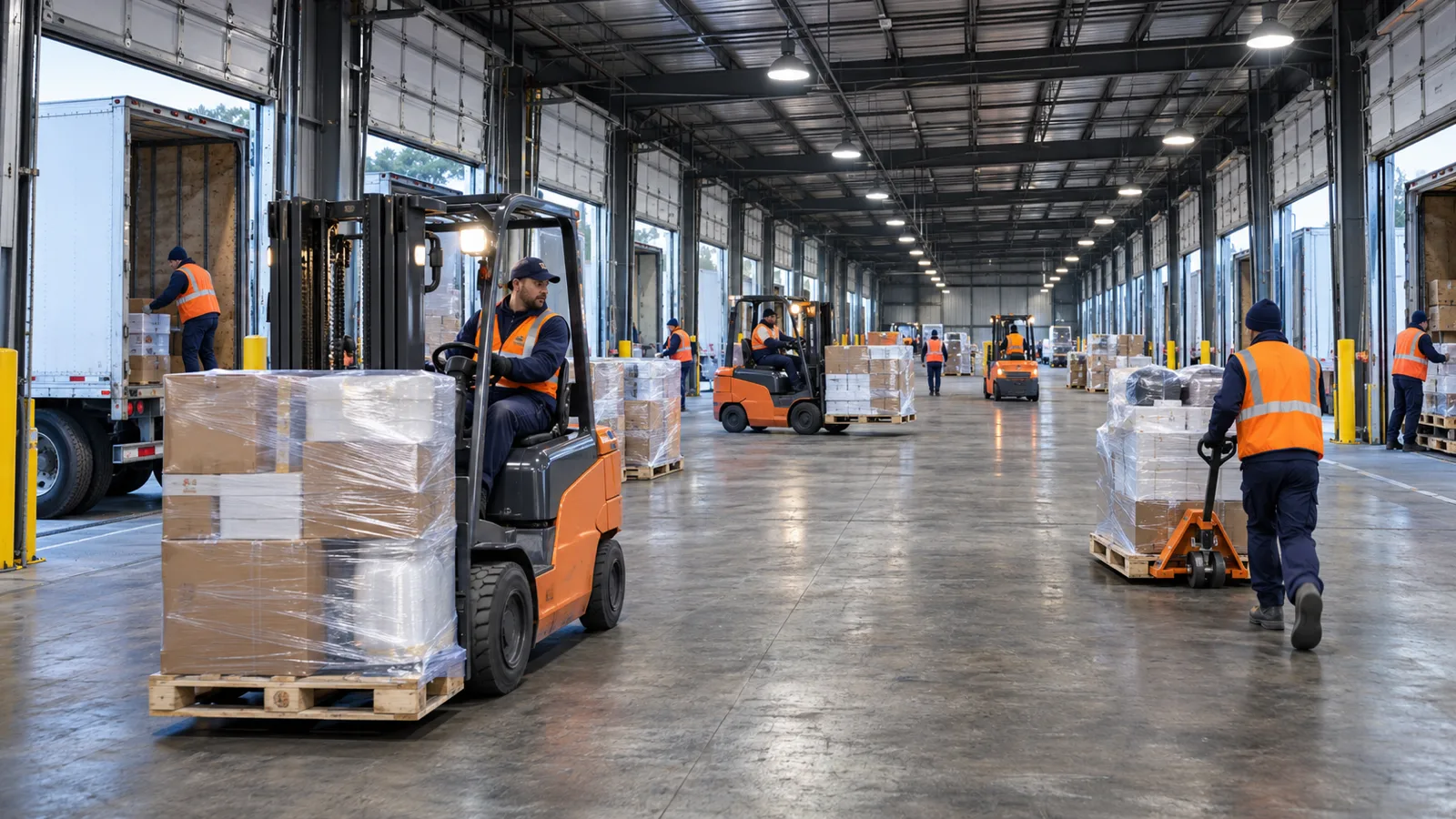
Two pallets leave a manufacturer's dock in Concord on the same Tuesday afternoon, on the same LTL carrier. One is going to a distributor in Ottawa; the other to a hardware store in Kapuskasing. The Ottawa pallet is delivered Wednesday morning. The Kapuskasing pallet arrives the following Monday. The customer in Kapuskasing calls to ask why their freight took "a week to go up the highway."
The answer has little to do with distance and a lot to do with terminals. Less-than-truckload freight doesn't travel directly from shipper to consignee. It moves through a network of terminals where it's unloaded, sorted and reloaded, sometimes more than once, and sometimes handed to a different carrier altogether. Where those terminals are, how often trucks run between them and whether your destination is a direct point or a partner point decides your transit time more than the kilometres on a map.
If you ship freight in Ontario, understanding this network helps you quote accurate lead times, pick carriers well and avoid the frustrated phone calls.
How an LTL Shipment Moves
Here's the path a typical LTL pallet takes, step by step.
- Pickup. A city driver collects your freight, usually in the afternoon, along with shipments from other customers on the route.
- Origin terminal. The driver returns to the local terminal, where freight is unloaded across a cross-dock and sorted by destination.
- Linehaul. Overnight, linehaul trailers carry freight from the origin terminal to destination terminals or to a larger hub for further sorting.
- Destination terminal. Freight is unloaded, sorted again by delivery route and loaded onto city trucks.
- Delivery. A city driver delivers to the consignee, often the morning after linehaul arrives.
Every handoff takes time. A shipment that goes straight from origin terminal to destination terminal on a nightly linehaul can deliver the next business day. One that has to stop at an intermediate hub, wait for a less frequent linehaul or transfer to a partner carrier picks up a day or more at each step.
The Shape of Ontario's Terminal Network
Ontario's LTL network is heavily concentrated in the GTA. Most carriers serving the province run their main Ontario terminals in Mississauga, Brampton, Vaughan, Etobicoke or Milton, close to the 401, 407, 427 and 400. These terminals are the hub of the provincial network, and for most carriers they're also the main gateway for freight moving east to Quebec and the Maritimes and west to the Prairies.
Around the GTA, carriers maintain regional terminals in the larger cities:
- Southwestern Ontario: London, Kitchener-Waterloo or Cambridge, and Windsor, with some carriers also in Sarnia.
- Eastern Ontario: Ottawa, plus Kingston or Belleville on the 401 corridor.
- Niagara and Hamilton: terminals in Hamilton or Stoney Creek and sometimes in the Niagara region.
- Northern Ontario: Sudbury, North Bay, Sault Ste. Marie, Timmins and Thunder Bay, depending on the carrier.
A carrier with terminals in all these places can serve most of southern Ontario on a next-day basis from the GTA. A carrier with only a GTA terminal will serve the rest of the province through longer city runs, partner carriers or both.
Direct Points Versus Partner Points
Every LTL carrier divides its coverage into points it serves directly and points it reaches through others.
Direct points
These are communities the carrier delivers to with its own equipment and drivers, from its own terminals. Transit times are faster and more predictable, and claims are simpler because only one carrier handled the freight.
Partner or interline points
For communities outside its network, the carrier hands freight to a partner carrier, often a regional specialist. That handoff happens at a terminal and usually adds at least a day, sometimes two. Northern Ontario is full of interline points, because the volume to places like Hearst, Kapuskasing, Marathon, Red Lake or Atikokan is too low for most carriers to justify their own operations. Specialist northern carriers fill the gap.
When you quote transit to a customer, ask the carrier whether the destination is direct or interline. The quoted transit time on an interline shipment is often optimistic.
Typical Transit Times From the GTA
These are typical business-day LTL transit times from a GTA pickup with a capable carrier. Pickup day isn't counted. Your carrier's own tables should always be your reference.
- Within the GTA, Hamilton and Niagara: next business day.
- Kitchener-Waterloo, Guelph, London, Barrie, Peterborough: next business day for direct carriers.
- Windsor, Sarnia, Kingston, Ottawa, Cornwall: generally next business day with carriers that run nightly linehaul; two days with some.
- Owen Sound, Bruce Peninsula, Muskoka, Haliburton, Ottawa Valley: one to two days, depending on the carrier's terminal coverage and delivery frequency.
- Sudbury, North Bay: one to two days.
- Sault Ste. Marie, Timmins: two to three days.
- Thunder Bay: two to three days.
- Northwestern Ontario beyond Thunder Bay, and the far northeast: three to five days or more, often interline.
Things That Add Days Without Anyone Noticing
Missing the linehaul
If your pickup is late, your freight may miss that night's linehaul departure and sit at the origin terminal until the next one. Book pickups early in the day, and make sure freight is ready and properly labelled when the driver arrives.
Less frequent service to small terminals
Linehaul to smaller terminals might run only on certain days. If service to a northern terminal leaves Monday, Wednesday and Friday, a Tuesday pickup waits a day.
Delivery appointments
Many retailers, distributors and hospitals require delivery appointments. If the consignee's next open slot is two days out, your freight sits at the destination terminal. Booking appointments early helps; our article on delivery appointments in freight explains how they work.
Accessorial needs
Liftgate, residential, inside delivery and limited-access deliveries are scheduled differently and may need special equipment that isn't on every truck.
Paperwork problems
A bill of lading with the wrong address, missing piece count or no consignee phone number can hold freight at a terminal while someone sorts it out. Keep your PRO number handy for tracking and inquiries; our explainer on PRO numbers covers what they're for.
Weather and seasons
Winter storms close Highway 11 and Highway 17 periodically, and lake-effect snow slows freight through the snowbelt. In spring, some township roads in rural Ontario have reduced load restrictions that limit heavy trucks.
How Terminal Handling Affects Damage
Every time a pallet crosses a dock, there's a chance it gets bumped, double-stacked or punctured by a forklift. A shipment that passes through three terminals and two carriers is exposed more than one that goes direct. For fragile or high-value freight to remote Ontario points, consider:
- Choosing a carrier with direct service, even at a slightly higher rate.
- Using sturdy pallets, corner boards and proper stretch wrap, with "do not stack" caps if needed.
- Consolidating multiple pallets into a single shipment or a dedicated run, or using full truckload when volume justifies it.
- Declaring value or buying freight insurance.
How Location of Your Warehouse Changes the Picture
If you ship from a GTA location close to the main carrier terminals, you'll typically get later pickups, more carrier choices and faster transit than from a smaller city. A shipper in Peterborough, Owen Sound or North Bay may find that every shipment goes first to the GTA terminal and then back out, adding a day. That's not a reason to move, but it's worth knowing when you quote lead times or choose a carrier.
For businesses shipping regularly into Northern Ontario, a carrier with strong northern terminals, or a dedicated northern LTL specialist, often outperforms a national carrier that interlines. And for freight heading east, carriers with strong Montreal operations can deliver into Quebec the next day; we cover that corridor in our article on Ontario to Quebec freight.
Pricing and Density
Canadian LTL pricing is usually based on weight, distance and lane, with many carriers applying a density or cube rule so that light, bulky freight is billed on the space it takes up. Pallets that are poorly built, overhanging or partly empty cost more. Building tight, well-cubed pallets helps both your rate and your terminal handling.
Lane matters as much as distance. A carrier with heavy traffic between its GTA and Ottawa terminals can price that lane aggressively because its linehaul trailers run full in both directions. A lane into Northern Ontario, where trailers often come back south lighter, tends to carry higher rates even for a similar distance. Partner-point deliveries may also include a beyond charge that covers the hand-off to the regional carrier. When you compare quotes, look at the all-in price, including fuel surcharge and accessorials, rather than the base rate alone.
A Walkthrough: Planning a Shipment to Thunder Bay
Let's say a Hamilton-area distributor needs four pallets of plumbing supplies at a contractor's yard in Thunder Bay by a Friday job start. Here's how an experienced shipper would plan it.
- Check direct coverage. Ask two or three carriers whether Thunder Bay is a direct point with their own terminal. Shortlist those that say yes.
- Check linehaul days. Find out which nights each carrier runs linehaul north. If a carrier departs the GTA on Monday, Wednesday and Friday, a Tuesday pickup gains nothing over Wednesday.
- Work backwards from Friday. With a two-to-three-day transit, the freight should be picked up no later than Monday, preferably the previous Friday for a buffer.
- Confirm receiving. A contractor's yard may have a forklift but limited hours. Get the receiving window and a site phone number on the bill of lading.
- Watch the weather. If a storm is forecast along Highway 17 north of Lake Superior, build in an extra day or consider a different route through the carrier's network.
The same steps applied to a shipment to Ottawa would take five minutes, because nearly every carrier serves it directly overnight. The planning effort scales with how far the destination sits from the core of the terminal network.
Using a Multi-Carrier Approach
No single LTL carrier is best for every Ontario lane. One might be fastest to Ottawa, another cheapest to London, a third the only direct carrier to Thunder Bay. Comparing rates and transit on each shipment is the best way to get both good service and good pricing. ShipCarte's LTL freight service and shipping platform let you compare carriers side by side, book pickups and track every shipment in one place. For regular multi-stop deliveries, our distribution services can build scheduled routes that bypass some terminal handling altogether.
Ship Smarter Across Ontario
If your freight transit times are unpredictable or your customers in certain parts of Ontario keep asking where their order is, let's look at your lanes together. Request a quote for your regular shipments, and we'll show you which carriers serve each destination directly.