
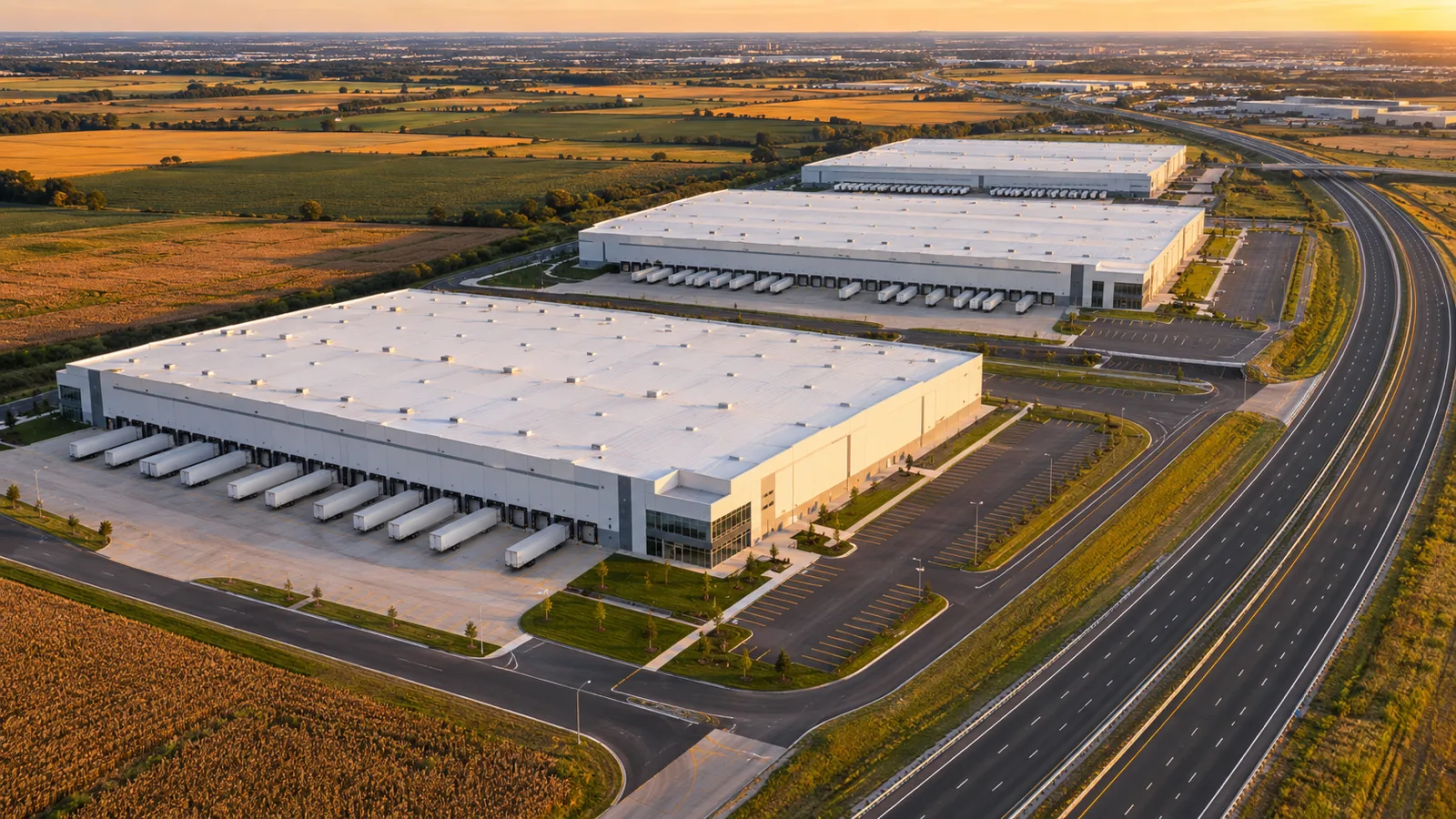
Ask anyone who has tried to lease a warehouse in the Greater Toronto Area in recent years and you'll hear the same thing. Good buildings in the right locations are hard to find, the best ones go quickly, and the rent on a renewal looks nothing like what was signed five years ago. A housewares importer whose lease is up in Etobicoke finds that its landlord has three other tenants waiting. A food distributor in Scarborough wants another 30,000 square feet and is told the nearest suitable building is in a town it has never shipped from.
The result is a steady push outward. New distribution buildings are going up in Milton, Halton Hills, Caledon, Cambridge, Kitchener, Brantford, Woodstock, Whitby, Oshawa and Clarington, and increasingly in places like Innisfil, Barrie, Belleville and the Niagara region. For businesses that have always operated close to the core of the GTA, the move raises hard questions about freight costs, delivery times and whether staff will follow.
This article looks at why Ontario's industrial space has become so scarce, where the growth is heading, and how to weigh the trade-offs if you're deciding where your next warehouse should be.
How Tight Is the Market?
For years the Toronto industrial market ran at availability rates in the low single digits, among the tightest of any major market in North America, and net rents for quality distribution space rose sharply. Availability has eased somewhat as new buildings have been completed, but rents remain far above where they were a decade ago. In practical terms, a tenant needing a modern building with good clear height, enough dock doors and a deep truck court in a central location often has only a handful of options at any one time, and sometimes none in the area they want.
Ottawa, Kitchener-Waterloo, Hamilton and London have their own tight conditions, though the scale is smaller. Even mid-sized Ontario cities that used to have spare industrial buildings have seen them absorbed by e-commerce, logistics and manufacturing users.
Why Space Has Become So Scarce
E-commerce needs more space per dollar of sales
Online retail requires more warehouse space than store-based retail for the same sales volume. Instead of shipping full pallets to stores, a fulfillment operation stores a wide range of SKUs in each-pick locations, holds safety stock to promise fast delivery, and needs room for packing, returns and sortation. As more Canadian shoppers buy online, retailers, brands and 3PLs are all competing for the same buildings.
Serviced land is limited
Much of the GTA's employment land is already built out. The Greenbelt and the Oak Ridges Moraine protect large areas around the region from development, and the Growth Plan for the Greater Golden Horseshoe directs municipalities to intensify within existing boundaries. New industrial land requires water, sewer and road servicing, which takes years and serious municipal investment. Developers can only build where the pipes are.
Industrial land is being converted
Older industrial pockets closer to downtown Toronto and along transit lines are being redeveloped for residential and mixed use. Each conversion removes buildings that served small distributors and light manufacturers, pushing those users outward too.
Older stock doesn't suit modern logistics
Many existing buildings have low clear heights, few dock doors and shallow truck courts. They're still useful for some operations, but a distribution user looking for 32-foot clear height and room to stage 53-foot trailers can't make a 1970s building with 18-foot ceilings work.
Where the Growth Is Going
The new development follows the highways. Distribution users want quick access to the 400-series network, and land prices fall as you move away from the core.
- West along the 401 and 407. Milton and Halton Hills have seen large new distribution buildings, and the corridor continues into Cambridge, Kitchener, Woodstock and London. These sites put you on the main artery toward Windsor, Detroit and the US Midwest.
- North along the 400 and 410. Caledon, Bolton and Vaughan's northern edges are attracting big-box distribution. Further up the 400, Innisfil and Barrie offer more land and room to grow.
- East into Durham. The 407 East extension has opened up Whitby, Oshawa and Clarington to distribution users, with the 401 continuing toward Belleville, Kingston and Montreal.
- Southwest to Hamilton and Niagara. Hamilton's airport employment area and lands near the QEW and 403 offer access to Niagara's border crossings and to the Port of Hamilton.
The Trade-Offs of Moving Out
Lower rent is the obvious draw, but a warehouse location shifts costs around rather than simply cutting them. Here's how the main factors compare between a central GTA site and one further out.
Rent and occupancy cost
Moving out usually lowers the cost per square foot and makes newer, more efficient buildings available. Modern buildings with higher ceilings also let you store more in the same footprint, which compounds the savings.
Inbound freight
If most of your inbound comes from the US by truck, or from Port of Montreal and Vancouver by rail via intermodal terminals in Brampton, Milton or Vaughan, a site west or north of the city may be no worse, or even better, than a central one. Containers that are drayed from a rail terminal travel shorter distances to a Milton or Caledon building than to one in eastern Toronto.
Outbound freight and delivery times
This is where location bites. If your customers are concentrated in the City of Toronto, every outbound truck now drives further, often through the 401 bottleneck between the 427 and the Don Valley Parkway. Same-day and next-day promises can get harder. For national shipments, though, the difference can be small: carriers pick up from outlying industrial parks every day, and the parcel will travel through a hub regardless.
Labour
Labour is the factor businesses most often underestimate. Warehouse staff in the GTA tend to live in Brampton, Mississauga, Scarborough and Etobicoke, and many rely on transit. A building in a newer industrial park on the edge of Caledon or Clarington may not have good transit service, which shrinks the labour pool and forces higher wages or shuttle programs. Smaller cities like Kitchener-Waterloo, Guelph and Barrie have strong local labour markets but competition from manufacturers.
Tolls and time
The 407 ETR is the fastest east-west route around Toronto for much of the day, but tolls for heavy vehicles add up quickly. A site that forces your trucks onto the 407 for every run carries a cost you should include in the comparison.
Running the Numbers: A Simple Scenario
Consider a business that needs 50,000 square feet and ships most of its volume to retailers' distribution centres in Brampton and Vaughan, with some parcel volume across Canada. It's comparing a central Toronto building with a newer one in Cambridge.
- Rent. The Cambridge building is newer, taller and cheaper per square foot. Annual occupancy saving is meaningful.
- Outbound truckload. Retail DC deliveries now travel 80 to 100 kilometres each way rather than 20 or 30. With a few loads a day, the added transportation cost absorbs a large share of the rent saving.
- Parcel. Carriers pick up daily from both sites, and parcel rates are largely unchanged. No major difference.
- Labour. Cambridge has a good labour pool and slightly lower wage pressure, but the existing team may not commute. Turnover in the first year is a real cost.
- Service. Retailer appointment times are easier to hit from a closer site. A missed appointment can mean chargebacks.
For this business, the answer might be to stay closer to its retail customers, or to split the operation: keep a smaller cross-dock near Brampton for retail deliveries and move slower inventory to a cheaper site. A different business, shipping mostly parcels across the country, would probably find the Cambridge building a clear win. There's no universal answer, which is why running your own numbers matters.
Approvals and Timelines Get Longer Too
Building new or expanding in a municipality you're unfamiliar with means learning its zoning, site plan and development charge rules. Some outer municipalities are keen to attract employment and move quickly; others have servicing constraints that slow everything down. We cover the approvals process in our guide to zoning and permits for warehouses in Ontario.
Infrastructure to Watch
Some infrastructure projects will change the calculus over the next few years. The Highway 427 extension north into Vaughan has opened new employment lands to distribution users. The 407 East extension continues to open up Durham. The province is pressing ahead with Highway 413 through the GTA West corridor, which could reshape access to sites in Halton, Peel and York. Transit improvements on GO lines can help labour reach outer sites. When choosing a location for a ten-year lease, it's worth thinking about where these projects will be in five years, not just where they are today.
Smarter Ways to Use Less Space
Before moving, ask whether you need all the space you think you do. Many Ontario warehouses hold more inventory than they need because forecasting is weak or slow movers never get cleared. Better inventory management can free up a surprising amount of room, and modern racking and slotting can add capacity within the same walls.
Network design can help too. Rather than one large central building, some businesses use a main warehouse in a cheaper location plus a small forward stocking point closer to customers. Others use zone skipping to cut transit times from an outlying site by injecting parcels deeper into carrier networks.
Shared Space as a Hedge
For businesses that can't find a building, or don't want to sign a long lease in an uncertain market, a 3PL offers a practical hedge. You pay for the space and services you use, and when volumes change, your footprint changes with them. You also gain access to the provider's carrier relationships for LTL freight, full truckload and parcel, which matters more as warehouses spread outward. If you're curious how location affects freight transit, our article on Ontario's LTL terminal network explains why a few kilometres can change delivery days.
ShipCarte's distribution warehousing serves businesses across Ontario that need flexible space, outbound shipping and visibility into stock without taking on a building of their own.
Let's Compare Your Options
If your lease is coming up or you've outgrown your space, we can help you compare a move, an expansion and an outsourced model side by side. Request a quote with your volumes and customer locations, and we'll show you what the numbers look like.