
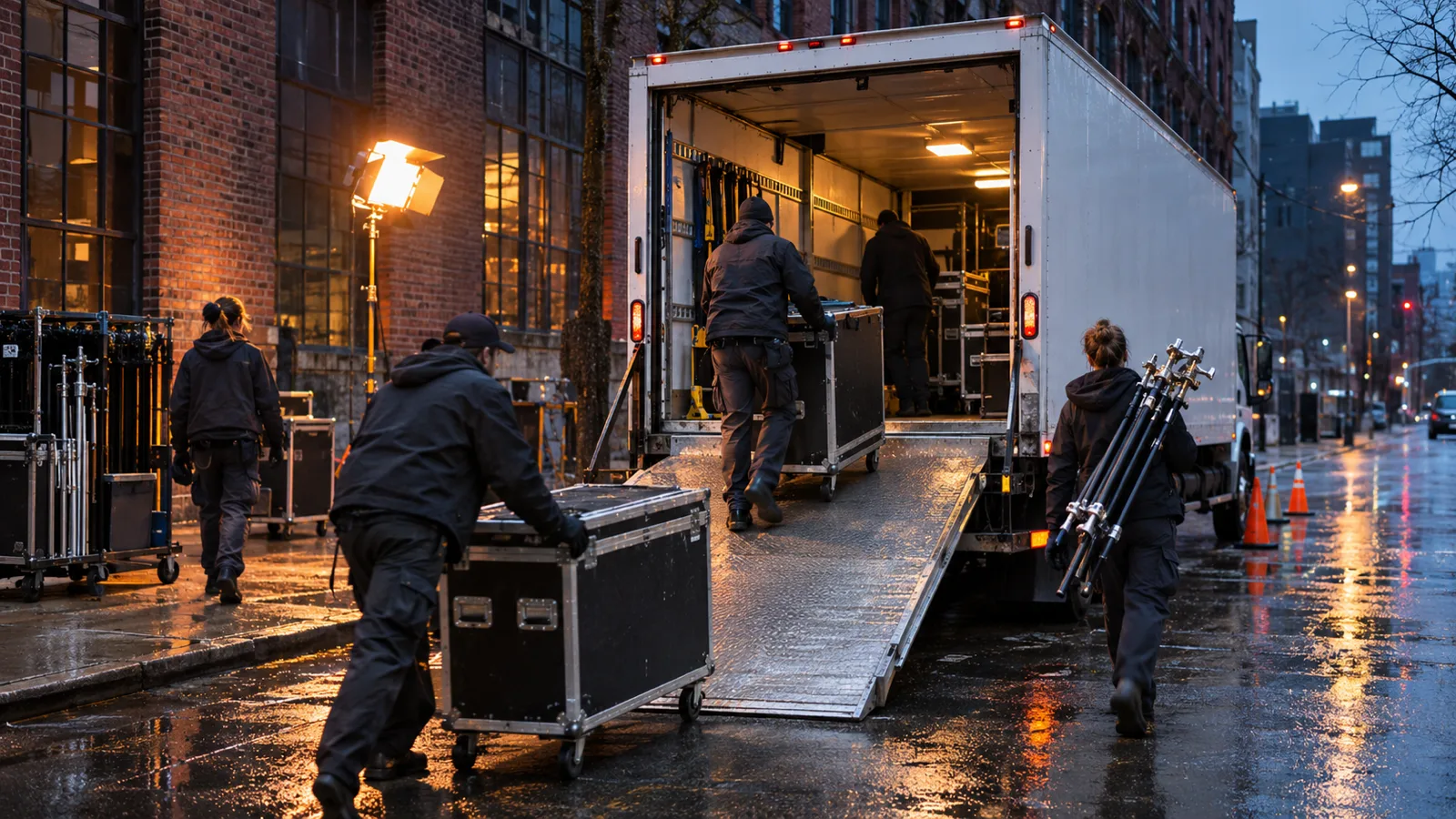
A production coordinator's phone rings at 5:40 a.m. The camera department has discovered that a replacement lens mount they need for the day's first set-up is still at a rental house across town, and the unit is shooting in a warehouse district in Hamilton. Call time was 6:00. Every minute the camera crew waits is a minute that dozens of people are being paid to stand around. By the time the part arrives, the courier bill will look trivial next to the cost of the delay.
Ontario has become one of the busiest places in North America to make film and television. Toronto's studio cluster in the Port Lands and the east end is booked solid, series shoot regularly in Hamilton and Ottawa, and Northern Ontario cities like Sudbury and North Bay have built a steady flow of productions drawn by regional funding and distinctive locations. All of that activity depends on a logistics chain that most viewers never think about: gear, sets, props, wardrobe and data moving between rental houses, studios, locations and post-production facilities, usually on very short notice.
This article looks at how logistics works across the life of an Ontario production, and where a shipping and warehousing partner can save time and money for production companies, rental houses and the suppliers who serve them.
How production logistics differs from regular shipping
Most shipping is built around predictability: a retailer knows roughly what it will ship next week. Productions are the opposite. Schedules change daily based on weather, cast availability and location permits. A scene planned for Thursday can move to Monday with a few hours' notice, and everything for that scene must move with it.
Three things set production logistics apart:
- Time sensitivity measured in hours, not days. Missing a call time is expensive because the cost of an idle crew is so high.
- High-value, irregular items. Camera packages, lighting, period furniture and custom-built set pieces do not fit neatly into standard cartons or pallets.
- Temporary everything. Productions build a full operation for a few weeks or months and then dismantle it. Storage, freight accounts and delivery addresses all have a short lifespan.
Phase one: prep
During pre-production, departments assemble everything they will need. Art departments buy and rent set dressing from vendors across southern Ontario, often making several pickups a day. Wardrobe sources clothing from retailers, costume houses and online suppliers, some of them in the United States. Construction orders lumber, hardware and specialty materials for sets.
Receiving purchases in one place
A common headache in prep is that dozens of online orders arrive at the production office, which may be a temporary space without a loading dock or anyone dedicated to receiving. Parcels go missing, get signed for by the wrong department or sit in a hallway. Routing all inbound purchases to a single receiving point that logs every delivery, checks it against the order and holds it until the department is ready can save a lot of chasing. For productions buying heavily from US retailers, a receiving point that also handles the customs side keeps clothing and props from being held up at the border.
Short-term storage for sets and props
Studios have limited space, and that space is expensive. Set pieces that are built ahead of time, or swing sets that are only used occasionally, can be stored off-site and brought in when needed. The same applies to vehicle props, period furniture and bulky set dressing. Short-term warehousing on a pallet-in, pallet-out basis is usually more flexible than signing a lease on a building for a single season. Our article on pallet-in, pallet-out services explains how that pricing works.
Phase two: the shoot
Once cameras are rolling, logistics becomes a daily rhythm of moving equipment between the studio, locations and suppliers.
Same-day courier runs
Replacement parts, expendables, wardrobe pieces and scripts all need to move across the city quickly. In Toronto, a courier that can get from a rental house near the Junction to a location in Scarborough in under two hours is genuinely valuable, especially given traffic on the Don Valley Parkway and the Gardiner during rush hour. For locations outside the core, such as a farm near Guelph or a historic street in Cobourg, plan for longer transit and consider whether a dedicated driver on standby is more reliable than on-demand bookings.
Moving data securely
Even with faster upload speeds, many productions still physically move hard drives from set to the post-production house, particularly when shooting high-resolution footage on location. These drives hold irreplaceable material and, often, unreleased content covered by strict confidentiality agreements. A secure courier chain should include a named driver, direct delivery with no stops, a signature at both ends and a record of handoff times. Insurance for the drive itself is easy; the footage on it cannot be replaced, which is why productions back up before anything leaves set.
Shooting in Northern and Eastern Ontario
Productions working in Sudbury, North Bay or around Ottawa still rely heavily on equipment from Toronto rental houses. That means daily or near-daily freight on Highway 400 and Highway 69, or the 401 and 416 to Ottawa. Overnight LTL can work for planned replacements, but urgent items often need a dedicated vehicle. Understanding realistic transit times on these routes, especially in winter, helps coordinators set expectations. Our guide on shipping to Northern Ontario covers those lanes.
Cross-border productions and equipment
Many of the series and features shot in Ontario are produced by American studios, and some equipment and props come from the United States. Bringing them in requires proper declarations to the CBSA. Equipment that will go back after the shoot can usually be temporarily imported rather than fully imported, using either a temporary importation process or an ATA Carnet for eligible professional equipment. Consumables, set dressing that will be left behind and wardrobe that will not return are generally treated as permanent imports and may attract duty and GST/HST.
The paperwork needs to be planned before the truck reaches the Ambassador Bridge or the Peace Bridge. Detailed equipment lists with serial numbers, values and countries of origin are essential, and a customs broker familiar with production equipment will save hours at the border. ShipCarte's cross-border shipping service coordinates carriers and brokerage for these moves.
Dangerous goods on set
Productions use more regulated materials than people assume. Lithium batteries for cameras, lights and drones are among the most common, and large battery packs are regulated under the federal Transportation of Dangerous Goods Regulations. Special effects departments may move compressed gases, fuels or pyrotechnics, which carry strict handling, transport and licensing requirements. Paint, solvents and adhesives used by the art and construction departments can also be regulated in quantity.
Not every courier can carry these items, and those that can need the correct documentation. When booking shipments that include batteries or chemicals, tell the carrier exactly what is in the package. A rejected shipment at the terminal costs a day; an undeclared one can cost much more.
Phase three: wrap
Wrap is where the logistics workload often peaks. Everything that was rented must go back on time to avoid extra charges. Everything purchased must be sold, donated, stored or disposed of. Sets must be struck, and the production office closes.
- Return rentals first. Late returns are usually billed by the day or week. Schedule returns by vendor and confirm receipt in writing.
- Decide what to keep. If a series may return for another season, sets, props and wardrobe are often stored rather than rebuilt. Proper inventory with photos and locations makes them easy to find a year later.
- Re-export foreign equipment. Temporarily imported gear must leave Canada within the permitted time, with documentation that matches what came in.
- Dispose of the rest responsibly. Building materials and set dressing can often be donated or resold. Ontario's waste diversion expectations, and the reputational cost of skips full of usable furniture, make this worth planning.
Season-to-season storage is where an organised warehouse partner pays off. ShipCarte's inventory management tools record each item by location with photos and notes, so the art department can find a specific chair or crate the following year without searching through a building.
Suppliers to the industry
It is not only production companies that need this support. Ontario's film and television industry relies on a network of businesses that serve it: equipment rental houses, prop and costume suppliers, catering companies, expendables vendors and specialty manufacturers. These businesses ship constantly, often to locations that change daily, and they need carriers that can cope with set addresses, on-site contacts and tight windows.
Rental houses in particular benefit from a reliable outbound and return process, with condition checks on return and quick turnaround so equipment can go back out. For suppliers who sell product to productions across Canada, combining small parcel shipping for urgent orders with LTL for larger ones keeps costs sensible.
Frequently asked questions
Can a courier deliver to a set rather than an address?
Yes, but give the courier precise directions, a named on-set contact with a mobile number and, ideally, the location of the base camp or truck parking. Productions often use landmarks rather than street numbers, and drivers cannot wander onto a working set.
How should high-value camera equipment be shipped between cities?
In hard cases, on a direct service with signature, and with declared value insurance. For very high-value packages, a dedicated vehicle with no transfers is the most secure option.
Is it worth storing sets between seasons?
Usually, if renewal is likely. Rebuilding a hero set costs far more than a year of pallet storage, and stored props preserve continuity for returning viewers.
Keep the production moving
On a set, logistics is invisible when it works and painfully visible when it does not. ShipCarte supports production companies and industry suppliers across Ontario with courier and freight booking, cross-border coordination and short-term storage built around shooting schedules. Schedule a consultation before your next prep period, or request a quote for upcoming freight.