
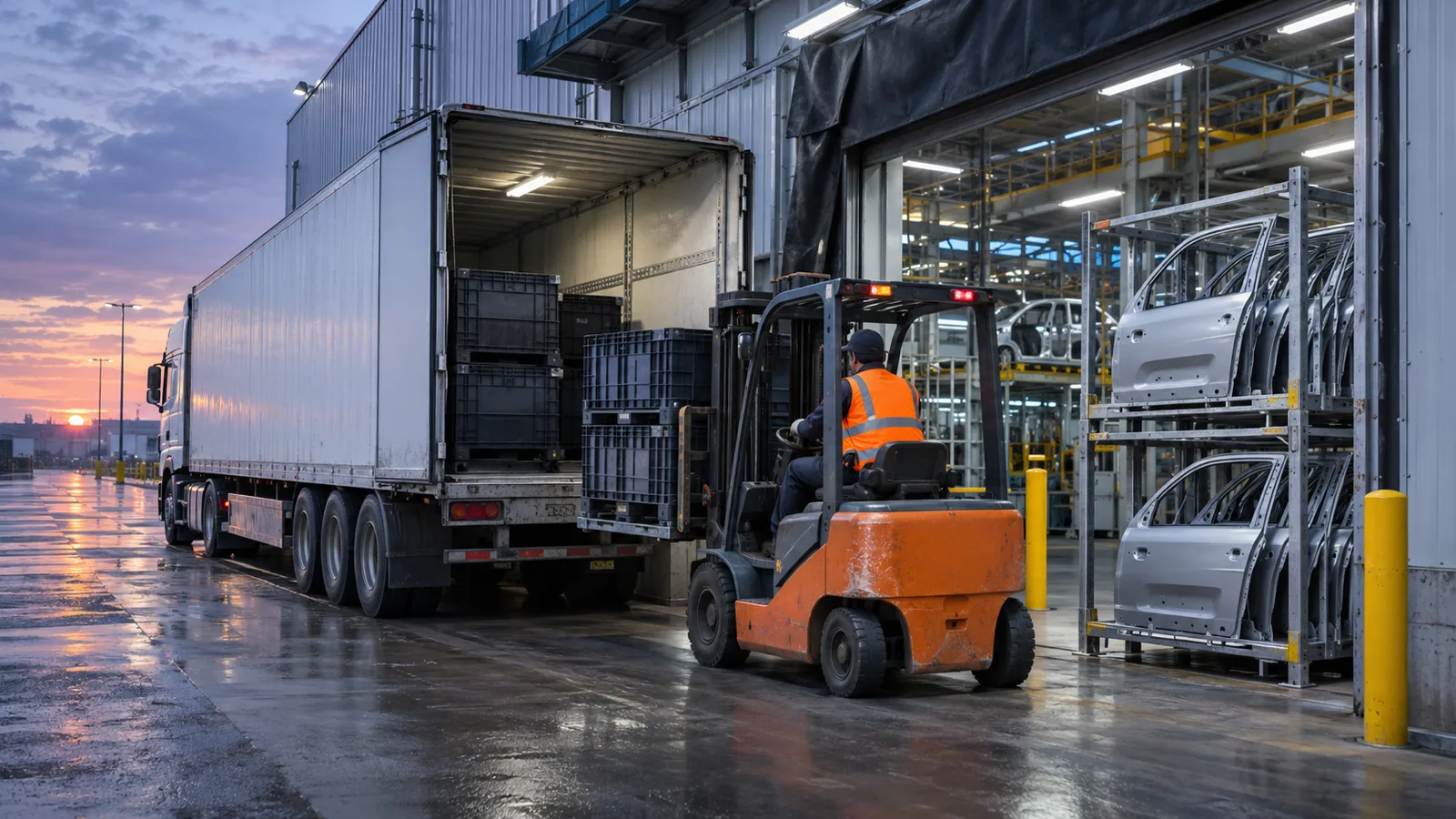
At 5:40 on a Tuesday morning, a trailer of seat components leaves a supplier's plant in the Kitchener-Waterloo area. Its delivery window at an assembly plant down Highway 401 is twenty minutes wide. If it arrives early, it waits in a marshalling yard. If it arrives late, the line that builds several vehicles an hour could run short of parts, and a supplier that stops an assembly line can expect a chargeback large enough to erase the profit on months of shipments.
That is the daily reality of just-in-time logistics in Ontario's auto sector. The province builds well over a million vehicles a year across plants in Alliston, Cambridge, Woodstock, Ingersoll, Oakville, Brampton, Windsor and Oshawa, and hundreds of suppliers feed them. Most of those suppliers carry very little finished inventory at the plant. Instead, parts flow in a carefully timed stream, often several deliveries a day, sometimes in the exact order the vehicles are being built.
This article follows a part through that stream, step by step, to show where the risks are and how warehousing and transportation can be set up to protect the line. It is written for supplier logistics managers and for companies trying to break into automotive supply in Ontario.
Just-in-time versus just-in-sequence
The two terms are often used interchangeably, but they mean different things on the plant floor.
- Just-in-time (JIT) means parts arrive close to when they are needed, in the quantities needed, with minimal inventory held at the plant. A supplier might deliver brackets or fasteners twice a day based on a production schedule.
- Just-in-sequence (JIS) goes further. Parts arrive in the exact order of the vehicles on the line. If the next six vehicles are a base model, a sport trim, two base models, a hybrid and a sport trim, the seats or bumpers or cockpit modules arrive in that same order, ready to be installed without sorting.
JIS is common for large, high-variety components such as seats, instrument panels, bumper fascias, tires and wheels, and door modules. Because the vehicle sequence is only locked a few hours ahead, JIS suppliers usually operate sequencing centres within a short drive of the assembly plant.
Following a part from supplier to line
Let's trace a hypothetical shipment of interior trim panels from a supplier in southwestern Ontario to an assembly plant, and look at the logistics decisions at each step.
Step 1: The release
The automaker sends the supplier material releases through EDI. A planning release gives a forecast for coming weeks, and a shipping schedule gives firm quantities and delivery times for the next few days. For a JIS part, a sequence broadcast arrives in near real time as each vehicle enters the paint shop or final assembly. The supplier's systems must read and act on these messages without manual re-keying, because a missed update means the wrong parts on the truck.
Step 2: Production and staging
Panels come off the moulding and assembly lines and are packed into returnable containers specified by the customer. These racks and totes belong to the automaker or the supplier and must be cleaned, tracked and sent back. Staging lanes hold completed containers in delivery order. If the supplier ships in sequence, a separate sequencing operation pulls panels in the order of the broadcast.
Step 3: The advance ship notice
When the truck is loaded, the supplier transmits an advance ship notice (ASN) with part numbers, quantities, container IDs and trailer number. The plant uses it to receive the shipment automatically. An inaccurate ASN is treated almost as seriously as a late delivery, because it breaks the plant's inventory records.
Step 4: The road
This is where Ontario's geography gets interesting. Highway 401 is the spine of the province's auto industry, linking Windsor, London, Woodstock, Cambridge, Kitchener, the GTA and Oshawa, and it is also one of the busiest highways in North America. A collision near the 401 and 400 interchange, a snowstorm in the snowbelt around London, or construction near Milton can wipe out a delivery window. Carriers serving auto plants plan routes with alternatives, such as Highway 7, the 403, or the 407 ETR when the time saving justifies the toll.
Step 5: The plant gate
The truck checks in, is directed to a door or a marshalling yard, and is unloaded within its window. Empty returnable containers are loaded for the trip back. Plants measure supplier delivery performance closely, and repeated misses lead to scorecards, meetings and eventually being placed on controlled shipping.
Why buffer warehousing exists
In theory, JIT means no inventory. In practice, suppliers keep a buffer somewhere, because their own production is not perfectly reliable and the road is even less so. The question is where to hold it.
A buffer warehouse near the assembly plant, often run by a third party, holds a few shifts or days of finished parts. It allows the supplier to:
- Make shorter, more frequent deliveries to the plant from a nearby site rather than from a plant several hours away.
- Absorb hiccups in production or long-haul transportation without missing a delivery.
- Consolidate parts from several plants into a single delivery.
- Handle sequencing close to the customer, where the broadcast lead time allows it.
- Manage the flow of empty returnable containers.
For suppliers based in the United States or Mexico, an Ontario buffer warehouse is particularly valuable. It moves the border crossing upstream of the critical delivery window, so a delay at the Ambassador Bridge or Blue Water Bridge hits the buffer stock, not the assembly line. ShipCarte's dedicated warehousing and distribution warehousing can play exactly this role.
The border: auto parts and NAFTA
Ontario's auto sector is deeply integrated with Michigan, Ohio and the rest of the American Midwest. Parts can cross the border several times before ending up in a finished vehicle. Under NAFTA, parts that meet the rules of origin move duty-free, but the paperwork still has to be right, and the crossing still takes time.
A few practices keep cross-border JIT running:
- Use carriers and drivers enrolled in FAST and companies enrolled in Partners in Protection and C-TPAT, which allow faster processing at the border.
- Submit customs data well before the truck arrives at the crossing.
- Know your alternate crossing. If the Ambassador Bridge is backed up, the Blue Water Bridge at Sarnia may be faster.
- Keep certificates of origin and part classification records current.
The new trade agreement signed in late 2018, CUSMA, would tighten auto rules of origin by raising regional value content requirements. As of mid-2019 it is still awaiting ratification, but suppliers would be wise to start reviewing their bills of materials now. Our cross-border shipping team works with suppliers on both sides of the border.
Managing risk across the season
Ontario's climate and calendar build predictable stress points into automotive logistics:
- Winter storms in the London and Woodstock snowbelt, along the 400 north of Toronto and around Windsor can close highways for hours. Increase buffer stock from December to March.
- Summer shutdowns in July let plants retool. Suppliers face a sudden drop in demand, followed by a ramp-up that tests every part of the supply chain.
- Model changeovers introduce new part numbers, packaging and sequencing logic, and are a common source of errors.
- Labour events at a plant or a supplier ripple quickly through the network, so contingency plans should be written down, not improvised.
- Plant closures and product changes, such as the scheduled end of vehicle assembly at Oshawa later this year, force suppliers to rebalance volume across their customers.
Technology that makes JIT work
The automotive sector was an early adopter of electronic data interchange, and it still expects suppliers and their logistics partners to exchange data accurately and quickly. A capable partner should offer:
- EDI or API integration for releases, ASNs and receiving confirmations, via system integrations.
- A warehouse management system that tracks inventory by part number, lot and container ID.
- Barcode scanning at every move so ASNs match what is actually on the truck.
- Real-time visibility of trucks in transit, so the plant and supplier know about a delay before the window is missed.
- Reporting on on-time delivery, ASN accuracy and returnable container counts.
What it costs to get it wrong
Automakers pass the cost of line disruptions back to the supplier responsible. Depending on the contract, that can include the cost of lost production, premium freight such as expedited trucks or even helicopters for critical parts, overtime, and administrative charges. Even without a line stoppage, premium freight to cover a late shipment can cost many times the normal rate. These costs make a strong case for investing in buffer stock, reliable carriers and good data.
Lessons for suppliers new to automotive
If you are a manufacturer in Ontario entering the automotive supply chain for the first time, perhaps moving over from industrial or consumer products, the logistics expectations can be a shock. A few lessons from experienced suppliers:
- Read the customer's logistics manual carefully. It specifies packaging, labelling, ASN timing and delivery windows in detail.
- Do not underestimate returnable container management. Lost racks are expensive and delay shipments.
- Invest early in EDI. Manual processes break down under JIT volumes.
- Choose carriers with automotive experience and the discipline to hit tight windows.
- Keep a buffer, even if the customer contract does not require it.
For more on how auto parts makers set up their wider warehouse networks, see our article on logistics for tier one and two auto suppliers in Ontario. If your inbound parts arrive by rail, delivery appointments are another discipline worth mastering.
Keep your line-side deliveries on time
ShipCarte supports manufacturers across Ontario with buffer warehousing, consolidated deliveries and cross-border coordination built around tight delivery windows. If you are supplying an assembly plant and want more margin for error between your production line and your customer's, schedule a consultation with our team.