
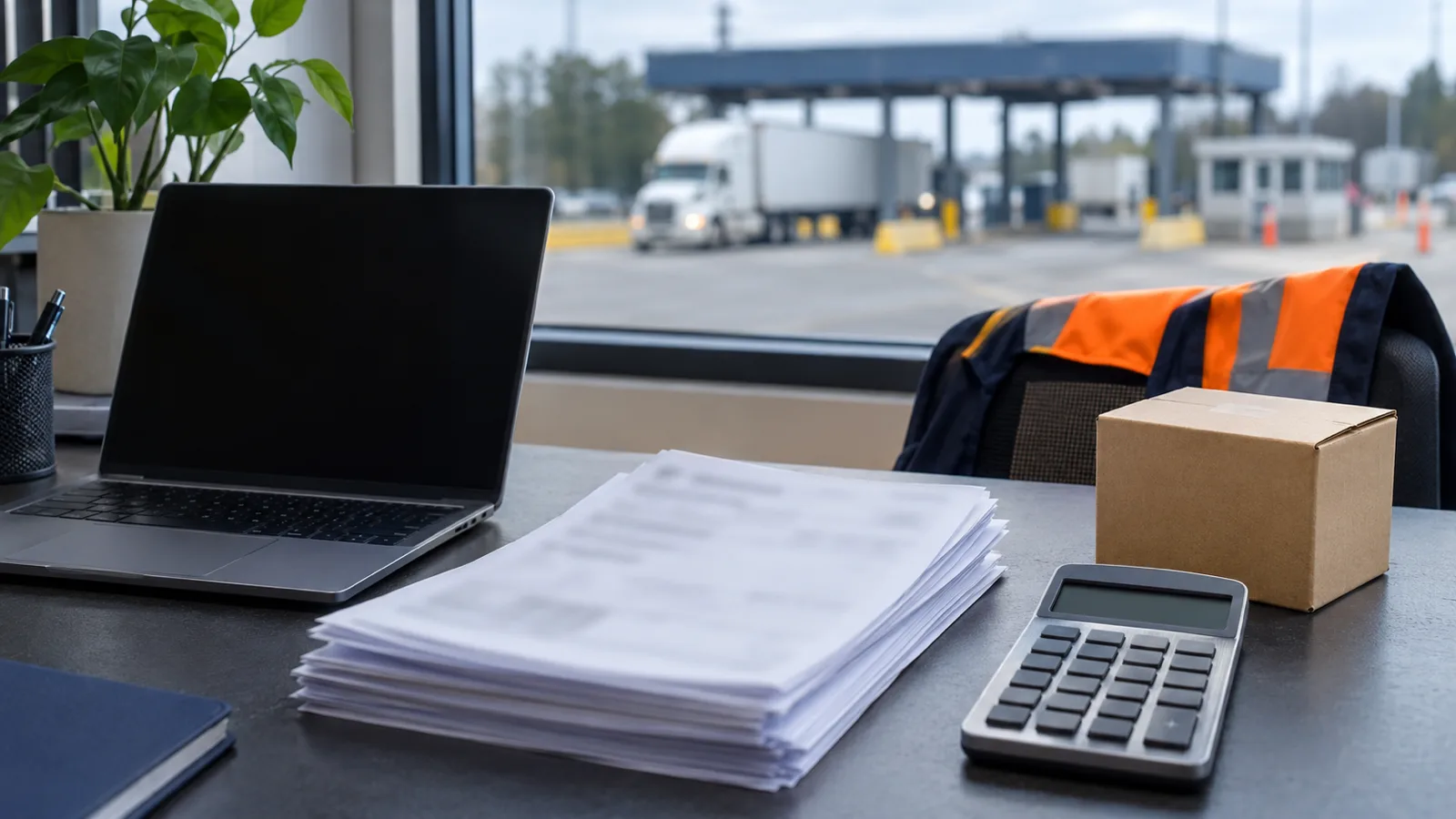
Picture an online retailer in Ohio or a manufacturer in Germany with a growing number of Canadian customers. They want to stock inventory in a Canadian warehouse so orders arrive quickly and without customs surprises. Then the broker asks a simple question: who is going to be the importer of record? The company has no Canadian office, no Canadian subsidiary and no Canadian employees. Does it need to set one up first?
In most cases, no. Canada allows foreign businesses to import goods in their own name as a non-resident importer, often shortened to NRI. It is a common and well-established arrangement used by companies around the world to sell into the Canadian market. It does, however, come with responsibilities that a foreign business needs to understand before the first truck or container arrives.
This article explains what a non-resident importer is, how to become one, what obligations come with the role, and how it fits with warehousing and fulfillment in Canada. It is general information, not legal or tax advice, so confirm the details for your situation with a licensed customs broker and a tax professional.
What is a non-resident importer?
A non-resident importer is a business located outside Canada that acts as the importer of record for goods entering the country. As importer of record, the company is legally responsible to the Canada Border Services Agency (CBSA) for the accuracy of the customs declaration and for paying any duties and taxes owed on the goods.
The alternative is to have a Canadian party take that role. That could be your Canadian distributor, a customer who buys from you on terms where they handle importing, or a Canadian subsidiary. When a foreign seller wants to keep ownership of the goods until they are sold to Canadian end customers, which is typical for ecommerce brands and companies using a Canadian 3PL, acting as an NRI is often the most straightforward option.
Why become a non-resident importer?
- Control over inventory. You own the goods while they sit in a Canadian warehouse and can sell them directly to Canadian customers.
- Better customer experience. Importing in bulk means you pay duties and taxes once per shipment, and customers receive domestic parcels with no fees at the door.
- Lower per-unit import costs. Duties and taxes are calculated on the value of the goods imported, and paying brokerage on one large entry rather than hundreds of individual parcels usually reduces the cost per unit.
- No need to create a Canadian entity just to import. That said, some businesses later decide a Canadian entity makes sense for other reasons.
Step-by-step: how to become a non-resident importer
1. Get a business number with an import-export account
Every commercial importer in Canada needs a business number (BN) issued by the Canada Revenue Agency, with an import-export program account attached. The account number typically looks like the nine-digit BN followed by "RM0001". Non-residents can apply to the CRA, usually by completing the business registration form and submitting it with supporting information about the company. Your customs broker can often help prepare the application.
2. Choose and appoint a customs broker
A licensed Canadian customs broker prepares and transmits your import declarations, calculates duties and taxes, and arranges release of your goods. You will sign an agency agreement or power of attorney authorising the broker to act on your behalf with the CBSA. Ask brokers about their experience with non-resident clients, their fee structure and how they handle payment of duties and taxes.
3. Arrange how duties and taxes will be paid
Many importers want goods released at the border before duties and taxes are paid, with payment following on a monthly cycle. This "release prior to payment" privilege generally requires security to be posted with the CBSA. Some importers post their own security; others rely on their broker's security arrangement. Talk to your broker about which approach applies to you and how deposits or prepayments may be required, which is common when a new non-resident client has no payment history.
4. Classify your products and confirm duty rates
Each product must be classified under Canada's Customs Tariff, which is based on the international Harmonized System. Classification drives the duty rate. Getting it right before the first shipment avoids corrections, penalties and delays. Provide your broker with clear product descriptions, materials, uses and, where possible, spec sheets.
5. Determine origin and trade agreement eligibility
Goods that originate in a country with a free trade agreement with Canada may qualify for reduced or zero duty. For goods from the US or Mexico, that means NAFTA today, with the signed CUSMA expected to replace it once ratified. For European goods, the Canada-EU Comprehensive Economic and Trade Agreement (CETA) may apply, and Canada also has agreements covering several Pacific countries through the CPTPP. Remember that preferential treatment depends on where the goods were made, not just where they were shipped from, and you need the proper origin documentation to claim it.
6. Prepare compliant commercial documents
Each shipment needs a commercial invoice, or a Canada Customs Invoice, with full details: seller and buyer, importer of record, description, quantity, unit price, currency, country of origin and terms of sale. For an NRI shipping its own goods to its own Canadian stock, the value for duty is not always obvious because there is no sale to a Canadian buyer at the time of import. Valuation rules for these situations can be technical, so agree a valuation method with your broker in advance.
7. Check product-specific regulations
Customs clearance is only one part of compliance. Depending on what you import, other government departments may have requirements:
- Food, plants and animal products fall under the Canadian Food Inspection Agency, which may require licences and specific labelling.
- Cosmetics, natural health products, drugs and medical devices fall under Health Canada.
- Textiles must meet the Textile Labelling Act, including a Canadian dealer identity or CA number on the label.
- Consumer products generally need bilingual labels under the Consumer Packaging and Labelling Act.
- Certain goods, including some electrical products, vehicles and controlled items, have permits or standards of their own.
8. Set up record keeping
Importers must keep records supporting their import declarations, such as invoices, origin documents, proof of payment and correspondence, for a set number of years. Non-residents generally have to make those records available to the CBSA on request, and there are specific rules about where non-residents can keep them. Ask your broker to explain the current requirements and set up a filing system from day one.
GST, HST and other taxes for non-resident importers
When goods are imported, the CBSA collects GST at the border, and in participating provinces the provincial portion of HST may also be collected. The importer of record pays these amounts.
Whether you can recover that GST depends on your tax status. A non-resident business that registers for GST/HST may be able to claim input tax credits for the GST paid on import, which can be significant. Registration may also bring an obligation to charge and remit GST/HST on sales to Canadian customers. Some provinces have separate provincial sales taxes with their own registration rules. These are questions for a tax adviser familiar with Canadian indirect tax, and it is wise to settle them before you start importing rather than afterwards.
Your responsibilities as importer of record
Taking on the NRI role means accepting responsibility for:
- The accuracy of classification, valuation and origin on each entry, even when your broker prepares it.
- Paying duties and taxes, plus any penalties or interest if amounts are found to be wrong.
- Correcting errors you discover after the fact, usually within a set time frame.
- Responding to CBSA verifications or audits.
- Meeting other departments' product requirements.
A good broker reduces the workload, but the legal responsibility stays with the importer. That is why accurate product data and well-prepared invoices matter so much.
NRI vs other ways to get goods into Canada
Selling to a Canadian distributor
Your distributor imports and pays duties and taxes. You give up control of pricing and customer relationships, and sell at wholesale margins. It is simpler, but less flexible for direct-to-consumer brands.
Shipping parcels directly to consumers
Each order clears customs individually. This works for low volume, but customers often face duties, taxes and brokerage fees at delivery, and per-parcel costs are high. See our article on duties and taxes in cross-border ecommerce for how those charges arise.
Setting up a Canadian subsidiary
The subsidiary becomes the importer and the seller. It can make sense for larger operations or companies hiring in Canada, but involves corporate, tax and accounting overhead.
Acting as a non-resident importer
You import in your own name, keep inventory in Canada, and sell directly. For many foreign ecommerce and B2B brands, this is the balance between control and complexity.
How an NRI works with a Canadian warehouse
Once you are set up as an NRI, the day-to-day flow usually looks like this:
- Your supplier or US warehouse ships pallets to Canada, with your broker pre-filing the customs entry.
- Goods clear at the border and are delivered to your Canadian 3PL.
- The warehouse receives, counts and puts the inventory away, flagging any discrepancies against the invoice.
- Orders from your online store or retail partners flow into the warehouse through integrations, and are picked, packed and shipped domestically.
- Your broker sends a monthly statement of duties and taxes owing.
The warehouse is not your importer of record, but it plays an important supporting role. Accurate receiving counts help you reconcile what was declared with what arrived, and inventory management reports give you the data you need for reordering and tax reporting. If your goods need bilingual stickers or Canadian dealer labels on arrival, value-added services can apply them before stock goes live.
For brands moving freight from the US, cross-border shipping support helps coordinate carriers, brokers and appointment times so pallets do not sit at the border. If you are an American company considering the move, our roadmap for US brands expanding into Canada covers the wider picture.
Common pitfalls to avoid
- Shipping before the BN and import-export account are active.
- Using vague product descriptions like "parts" or "samples" on invoices.
- Claiming NAFTA or other preference without proper origin support.
- Forgetting that GST paid at import is a real cash cost until you can recover it.
- Assuming the broker or the warehouse is responsible for compliance errors.
Ready to stock inventory in Canada?
Becoming a non-resident importer is a manageable process for most foreign businesses, and it opens the door to faster, cheaper delivery for Canadian customers. ShipCarte works alongside your customs broker to receive, store and ship your goods across Canada. Request a quote for Canadian ecommerce fulfillment, or schedule a consultation to plan your first inbound shipment.