
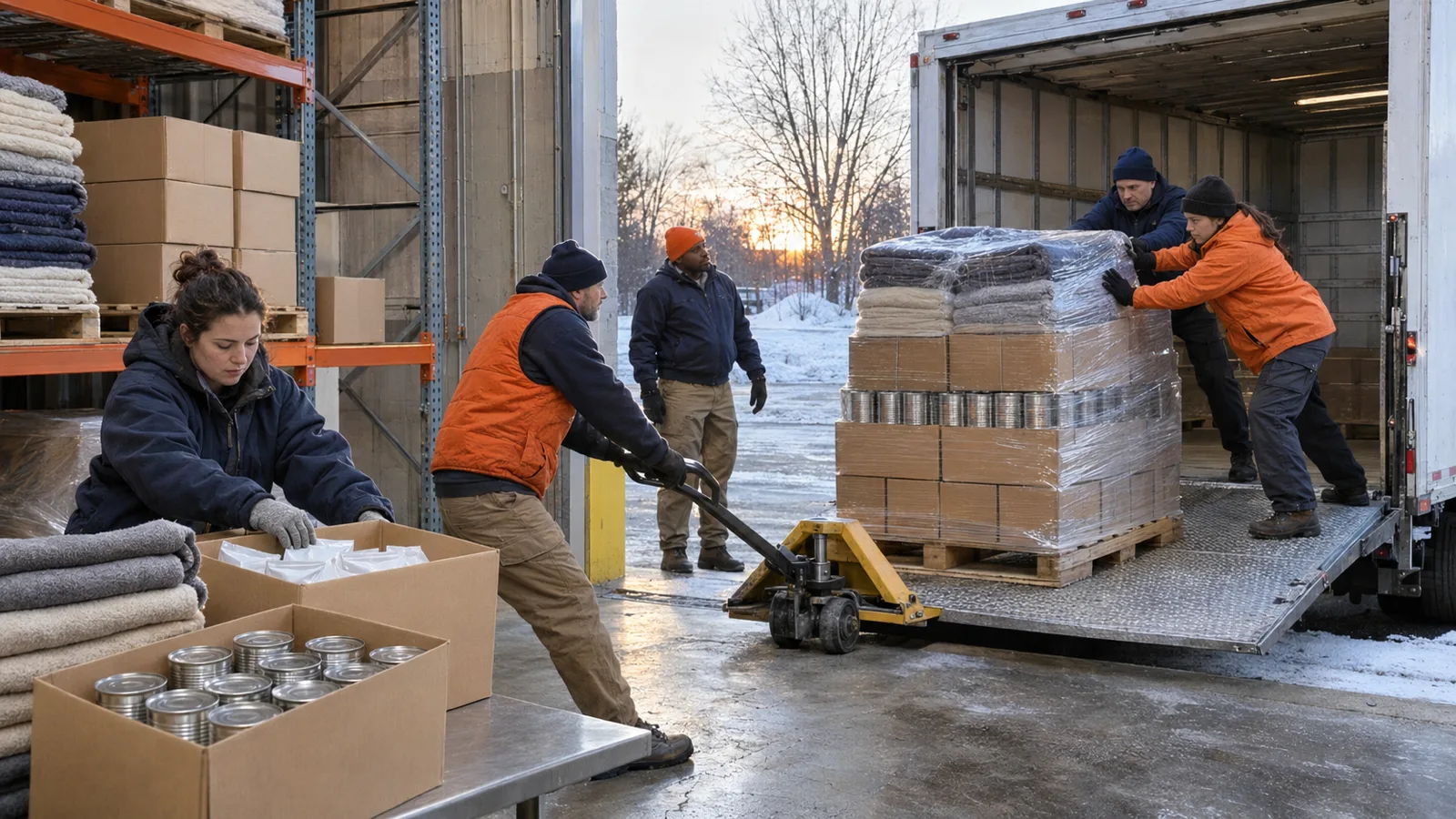
A food bank network in the Prairies gets a call from a national grocery donor: forty pallets of shelf-stable food are available, but they are sitting in a distribution centre in Ontario and have to be collected within the week. A disaster-response charity in Atlantic Canada needs hygiene kits in a remote community after a spring flood, and the closest stock is in a church basement two provinces away. A clothing drive in Calgary has produced a garage full of bags that nobody has sorted. Every one of these situations is common, and every one is, at its heart, a logistics problem.
Charities in Canada are very good at generating goodwill and donations. Where many of them struggle is the unglamorous middle part: getting donated goods from the place they were given to the place they are needed, in usable condition, at a cost that does not eat into the program budget. Volunteers can do a lot, but a borrowed cube van and a parking lot are not a supply chain.
This guide looks at how non-profits, relief groups and community organisations can move donated goods across Canada more efficiently. It covers intake, sorting, storage, choosing between parcel and freight, timing around Canadian weather and geography, and how to work with a logistics partner without losing control of your mission.
Why charity logistics is harder than it looks
A commercial shipper usually knows exactly what it is sending: a fixed set of SKUs, packed to a standard, going to known addresses. Charity shipments rarely look like that. Donated goods arrive mixed, irregular and unpredictable. One week brings a single corporate pallet of identical boxes; the next brings hundreds of household donations in every size of bag and carton.
Canada's geography adds another layer. Moving goods from the Greater Toronto Area to Winnipeg is a long haul, and reaching fly-in or seasonal-road communities in the North can involve air freight, barge schedules or winter roads that are open only for part of the year. A charity that ships to Nunavut, northern Manitoba or Labrador has to plan around those windows rather than around a donor's timeline.
Then there is the cost question. Every dollar spent on freight is a dollar not spent on programs, and donors increasingly ask how their gifts are used. Efficient logistics is not just an operational detail; it is part of how a charity demonstrates stewardship.
Step 1: Control what comes in the door
The most effective way to cut charity shipping costs happens before anything is shipped. Unsorted, unwanted or damaged donations cost money to move, store and eventually dispose of. A few intake rules make a large difference:
- Publish a needs list. Tell donors exactly what you can use, in which sizes or formats, and what you cannot accept. Update it as needs change.
- Separate corporate and individual donations. A manufacturer donating overstock usually ships on pallets with consistent cartons. Treat these as freight from the start, and ask the donor for a packing list, pallet count and approximate weights.
- Check condition at the door. Expired food, recalled products and broken items should be screened out at intake, not after you have paid to move them across the country.
- Record what you receive. Even a simple spreadsheet listing item type, quantity, location and best-before dates prevents the familiar problem of finding forgotten stock months later.
For food donations, intake also needs to respect basic food safety. Shelf-stable goods should arrive with intact packaging and readable labels. Perishables need temperature control from the moment they leave the donor, which is where specialised food and beverage logistics becomes important.
Step 2: Sort and pack for the journey, not for the shelf
Many charities sort donations into categories that make sense for distribution: children's clothing, winter coats, canned vegetables, baby supplies. That is useful at the destination, but it is only half the job. Goods also have to be packed in a way that survives a truck ride from Montreal to Moncton or a transfer between carriers in Winnipeg.
Practical packing habits for donated goods include:
- Use sturdy, uniform corrugated cartons rather than reused boxes of every shape. Uniform cartons stack well and make pallets stable.
- Keep carton weight manageable for the people unloading at the other end, especially if they are volunteers without equipment.
- Put heavy items such as canned food at the bottom of a pallet and lighter items like clothing on top.
- Stretch wrap pallets tightly and add corner boards if the load will be handled several times.
- Label every carton with its contents category and destination program, so the receiving team can distribute without opening everything.
If you regularly assemble kits, such as school supply bags, hygiene packs or newborn bundles, consider whether the assembly step could happen in a warehouse rather than at a volunteer event. Kitting and assembly services can build consistent kits at scale, which is particularly useful when a corporate partner donates components in bulk.
Step 3: Choose the right shipping mode
Charity shipments span a wide range, from a single box of medical supplies to a full trailer of food. Matching the mode to the shipment is where real savings are found.
Small parcels
Individual cartons going to many addresses, such as kits mailed to families or supplies sent to small community partners, usually move best as parcels. Parcel carriers price heavily on dimensional weight, so a large, light box of clothing can cost far more than its actual weight suggests. Packing tightly and choosing box sizes carefully keeps small parcel shipping affordable.
LTL freight
When you are moving one to several pallets between two locations, less-than-truckload freight is usually the most cost-effective option. Your pallets share a trailer with other shippers' goods, and you pay for the space and weight you use. Accurate pallet dimensions, weights and freight class information help avoid reclassification charges after the fact. Liftgate service and appointment delivery may be needed if the receiving location is a community hall or church without a loading dock. ShipCarte's LTL freight service is built for exactly this kind of partial load.
Full truckload
Large corporate donations, seasonal campaigns and regional redistribution between food banks may fill an entire trailer. A dedicated truck goes directly from origin to destination, which reduces handling and transit time. For a campaign that consolidates donations from several cities into a central hub, full truckload moves along Highway 401 or the Trans-Canada can be considerably more efficient per pallet than many separate LTL shipments.
Rail, air and northern routes
For very long, non-urgent moves, such as from Ontario to British Columbia, intermodal rail can be worth considering. For remote and northern communities, options may include air cargo out of hubs such as Winnipeg, Edmonton, Yellowknife or Montreal, and seasonal sealift or barge services. These routes have firm booking deadlines, so northern programs should plan months ahead.
Step 4: Consolidate, then distribute
One of the most common inefficiencies in charity logistics is moving goods too many times in small amounts. A donation travels from a donor to a volunteer's garage, to a church basement, to a regional office, and finally to a program site. Each move costs time and money and raises the chance of damage.
A consolidation model works better. Donations flow into one or a few central points, where they are sorted, stored and recorded. From there, outbound shipments are planned in efficient loads to the places that need them. For a national charity, that might mean a hub in the GTA serving Ontario and Quebec, with a second point in Western Canada for the Prairies and British Columbia.
Not every charity can lease its own warehouse, and many do not need to. Distribution warehousing with a third-party provider can give a non-profit access to racking, dock doors, forklifts and trained staff only for the space and services it uses. That can be especially helpful for seasonal programs, such as winter clothing drives or holiday toy campaigns, where volumes spike for a few months each year.
Step 5: Plan around Canadian seasons and timing
Weather affects charity logistics more than many teams expect. A few timing considerations to build into the plan:
- Freeze protection. Liquids, some canned goods and certain hygiene products can be damaged by freezing in unheated trailers during winter. Ask for heated service when moving these between November and March, particularly across the Prairies.
- Heat in summer. Some food items, medications and personal care products can degrade in hot trailers. Temperature-controlled service may be worth the extra cost for sensitive goods.
- Peak season capacity. Carriers are busiest in the weeks before the holidays, which is also when many charities run their biggest campaigns. Book early and expect less flexibility.
- Northern windows. Winter roads and sealift seasons are fixed. Missing a deadline can mean waiting months for the next opportunity.
Step 6: Track what you send and prove what arrived
Donors and funders want to know their contributions reached the people they were meant for. Good logistics records make that easy to show. For each shipment, keep the bill of lading or parcel tracking number, the contents, the destination program and proof of delivery. If you need a refresher on how a bill of lading works, our guide to bill of lading benefits and purpose covers the basics.
Tracking also helps you catch problems early. If a pallet is sitting at a terminal because the receiving site could not accept delivery, you want to know that the same day, not when an angry program coordinator calls. A shipping platform that shows every shipment in one place reduces the time staff spend phoning carriers.
Handling special categories of donations
Food
Food donations should be handled under the same basic principles that commercial food distributors follow: clean storage, pest control, rotation by best-before date and temperature control where needed. First-in, first-out rotation matters a great deal when donated stock arrives with varied dates.
Medical and health supplies
Donated health products such as first aid supplies, mobility aids or personal protective items deserve careful handling. Some products carry storage requirements or expiry dates, and anything regulated by Health Canada should be accepted only from reliable sources with clear labelling. Charities moving these goods regularly may benefit from a partner with healthcare distribution experience.
Dangerous goods
Some donated items count as dangerous goods under Transport Canada's Transportation of Dangerous Goods regulations: aerosol cans, certain cleaning products, lithium batteries in donated electronics, and fuel-containing equipment, among others. These can be shipped, but they need proper classification, packaging and documentation. When in doubt, screen them out at intake or ask your carrier before shipping.
International relief
When Canadian charities send goods abroad, export rules and the destination country's import requirements apply. Many recipient countries have specific rules for donated used clothing, food and medical supplies. Working with a freight forwarder or broker who understands those requirements avoids shipments being held at a foreign port.
Keeping costs down without cutting corners
Freight costs for charities are driven by the same factors as for any business: distance, weight, dimensions, freight class, accessorial services such as liftgate or appointment delivery, and how much notice you give. A few habits help keep them under control:
- Batch outbound shipments rather than sending many small, urgent loads.
- Give carriers accurate weights and dimensions to avoid adjustment charges.
- Ask whether receiving locations have docks and forklifts; if they do, you can avoid liftgate fees.
- Be flexible on pickup dates where you can, especially outside of peak season.
- Ask carriers and logistics providers whether they offer any non-profit programs or in-kind support. Some do, though it varies widely.
Comparing carriers manually for every shipment takes staff time that most charities do not have. Using a provider with carrier management capability means rates can be compared across several carriers and the best fit chosen for each lane.
A quick readiness checklist
- Do you have a written needs list and intake rules?
- Is there one central place where donations are recorded and stored?
- Do you know the dimensions and weights of a typical outbound pallet?
- Do your receiving sites have docks, or will they need liftgate and appointment delivery?
- Have you planned around winter freezing and peak holiday capacity?
- Are dangerous goods screened out or handled properly?
- Can you show donors proof that their goods arrived?
Talk to ShipCarte about your next campaign
Whether you are a local food bank moving a few pallets a month or a national charity coordinating seasonal drives from coast to coast, a more organised approach to logistics frees up time and money for the work that matters. ShipCarte works with organisations across Canada on parcel shipping, LTL and truckload freight, warehousing and kitting. Schedule a consultation to talk through your program, or request a quote for an upcoming shipment.