
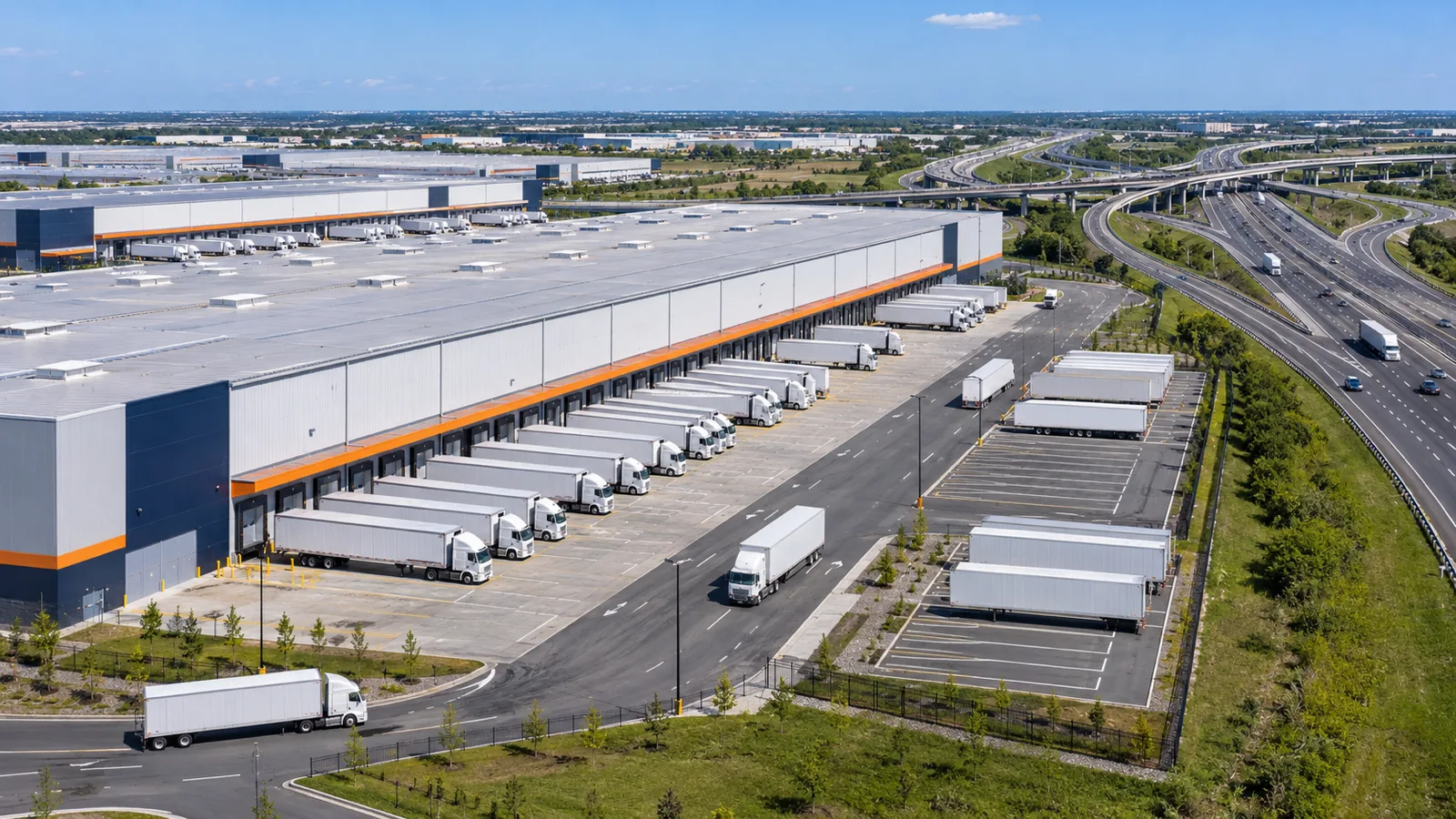
For a long time, the supply chain playbook for many manufacturers was simple: produce wherever unit costs were lowest, ship in full containers across the ocean, and hold inventory as close to the factory as possible. The disruptions of the past several years changed a lot of minds. Port congestion, container shortages, sudden tariff changes and long, unpredictable lead times made that model feel fragile. A component that used to arrive in six weeks might take twelve, and a retailer in Ohio or Quebec didn't want to hear why.
Nearshoring is the response. It means moving production, final assembly or at least inventory closer to the customers who buy it. For companies selling into Canada and the northeastern United States, Mississauga keeps coming up in those conversations. It sits at the heart of one of North America's largest manufacturing and distribution regions, next to Canada's busiest airport, within a day's drive of a huge share of the U.S. and Canadian population.
This article looks at what nearshoring really means in practice, why manufacturers are choosing to position inventory in Mississauga, what the trade-offs are, and how to plan the move without creating new problems.
What Nearshoring Actually Looks Like
Nearshoring is not one decision. Companies adopt it in degrees:
- Relocating production. Moving manufacturing from overseas to Canada, the U.S. or Mexico. This is the most dramatic version and the most capital-intensive.
- Regional final assembly. Keeping component manufacturing overseas but doing final assembly, configuration or kitting in North America, closer to demand.
- Forward inventory positioning. Leaving production where it is but holding finished goods in a North American distribution hub rather than shipping each order from the factory or a distant warehouse.
- Dual sourcing. Adding a North American supplier alongside an overseas one, so that a disruption in one region doesn't halt supply.
For many mid-sized manufacturers, the third and fourth options are the practical starting points. They don't require building a factory, but they dramatically shorten the time between a customer order and a delivery.
Why Mississauga Keeps Making the Shortlist
Highway access in every direction
Mississauga is crossed by Highway 401, Canada's busiest highway, along with the 403, 407, 410, 427 and the QEW. From an industrial park in the Gateway area or near the Airport Corporate Centre, a truck can head east to Montreal, west to Windsor and the Ambassador Bridge into Detroit, or south along the QEW to the Peace Bridge and Lewiston-Queenston crossings into New York State. That makes it possible to serve Ontario, Quebec and a wide swath of the U.S. Midwest and Northeast from a single location, often within one or two days by truck.
Air cargo at Toronto Pearson
Pearson handles a large share of Canada's air cargo. For high-value, time-sensitive or low-weight items, such as electronics, medical devices or replacement parts, being minutes from the airport opens up options that a more remote warehouse doesn't have.
Rail and ports within reach
Intermodal rail terminals in the GTA connect to the ports of Montreal, Halifax, Vancouver and Prince Rupert, so ocean freight can still feed a Mississauga hub efficiently. Many importers bring containers in by rail, truck them the short distance from the rail terminal to a local warehouse, and distribute from there. That first short-haul leg, known as drayage, is easy to overlook in planning but needs to be booked and budgeted like any other move.
An established manufacturing ecosystem
The Greater Toronto and Hamilton Area has a deep base of automotive, food processing, pharmaceutical, aerospace and consumer goods manufacturing. That means suppliers, packaging companies, contract manufacturers and skilled labour are close by, which makes regional assembly and dual sourcing more realistic.
Trade agreements
Goods that qualify under the Canada-United States-Mexico Agreement (CUSMA) can move between the three countries with preferential tariff treatment. Qualification depends on rules of origin, which vary by product, so manufacturers need to check carefully rather than assume. Canada also has trade agreements with the European Union (CETA) and many Pacific Rim countries (CPTPP), which can make a Canadian hub attractive for companies serving several markets.
The Benefits Manufacturers Are Chasing
- Shorter, more predictable lead times. When stock is a day's drive from customers, delivery promises become easier to keep.
- Lower safety stock in some cases. Shorter replenishment cycles can mean less buffer inventory is needed, though this depends on how replenishment from the source is managed.
- Faster response to demand changes. If a product suddenly takes off in Quebec or Michigan, a nearby hub can respond within days rather than waiting for another ocean shipment.
- Better customer service for B2B accounts. Retailers and distributors increasingly expect short order-to-delivery windows, accurate advance shipping notices and compliance with their routing guides.
- Reduced exposure to single points of failure. Holding inventory in North America insulates customers from overseas port closures or shipping lane disruptions, at least for a while.
The Trade-Offs to Be Honest About
Nearshoring isn't free, and a good plan accounts for the costs as well as the benefits.
Higher holding costs
Warehouse space in the GTA is in high demand, and storage costs reflect that. Holding finished goods in North America means paying for that space, and inventory that sits longer than planned becomes expensive. Good forecasting matters more, not less.
Working capital tied up earlier
If you used to ship goods directly from the factory as orders came in, positioning inventory forward means paying for it, shipping it and clearing customs before it's sold. That changes cash flow, and it's worth modelling before committing.
Import duties and border complexity
Goods imported into Canada for storage and later export to the U.S. may be subject to Canadian duties and taxes on entry, unless they're held in a bonded facility or another duty relief program applies. Our article on bonded warehouses explains one option. Importers also need to be set up properly in CBSA's CARM portal, and U.S.-bound shipments require their own documentation and broker arrangements.
Labour and operational capacity
Running a North American distribution operation needs people and systems. Many manufacturers find it's more practical to partner with a third-party logistics provider than to lease space and hire a team from scratch.
Planning a Move to a Mississauga Hub: Step by Step
- Map your demand. Where are your customers, by province and state, and how much do they buy? A Mississauga hub makes the most sense when a large share of demand is in Ontario, Quebec, and the northeastern and midwestern U.S.
- Segment your SKUs. Not every product needs to be held forward. Fast movers and items with high service expectations benefit most. Slow movers might stay at origin.
- Model landed cost. Include ocean or air freight, drayage, duties, brokerage, storage, handling and outbound shipping. Compare that to your current model. Our guide to landed cost per unit walks through the calculation.
- Check trade rules. Confirm tariff classifications and whether CUSMA or other agreements apply. Work with a licensed customs broker on anything uncertain.
- Choose your operating model. Dedicated space, shared warehousing, or a 3PL. Think about whether you need value-added work like labelling, kitting or light assembly.
- Integrate systems. Your ERP or order system needs to send orders to the warehouse and receive inventory and shipment data back. EDI may be required for retail accounts.
- Plan the transition. Phase it in. Start with a subset of SKUs or customers, prove the process, then expand.
Serving U.S. Customers From a Mississauga Hub
For many manufacturers, the real prize of a Mississauga location is access to American buyers. The three main southern Ontario crossings each serve different markets. The Ambassador Bridge at Windsor-Detroit connects to Michigan, Ohio and the broader Midwest. The Peace Bridge at Fort Erie-Buffalo and the Lewiston-Queenston Bridge in Niagara connect to New York, Pennsylvania and the Northeast. From Mississauga, a truck can typically reach any of these crossings within a few hours, depending on traffic and the time of day.
Shipping south regularly works best when a few things are in place:
- A U.S. customs broker who understands your products and can clear shipments efficiently.
- Accurate commercial invoices with correct tariff classifications, values and country of origin.
- CUSMA documentation, where goods qualify, so that preferential treatment can be claimed.
- Carriers experienced with border crossings, including the advance electronic manifest requirements on both sides.
- A plan for delays. Border wait times vary, and inspections happen. Building a little slack into delivery commitments for U.S. customers avoids disappointment.
Some manufacturers ultimately decide to hold a second stock point inside the U.S. as volume grows. Others find that a well-run Mississauga hub serves both countries comfortably. The answer depends on volumes, customer expectations and the duty implications of moving goods back and forth.
How a 3PL Supports Nearshoring
A third-party logistics partner in Mississauga can take on many of the moving parts. ShipCarte works with manufacturers on distribution warehousing, inbound container receiving, and outbound freight through LTL and full truckload services. For businesses shipping regularly into the United States, cross-border shipping support helps keep paperwork and carrier coordination organized.
Some manufacturers also use a 3PL for the light assembly or configuration steps that make regional final assembly possible, such as bundling components, applying country-specific labelling or preparing retail-ready displays. ShipCarte's kitting and assembly service covers that kind of work.
A Scenario Worth Considering
Consider a hypothetical maker of commercial kitchen equipment parts. Its products are manufactured overseas and shipped directly to distributors across Canada and the U.S. Lead times run to many weeks, and a missing part can leave a restaurant's equipment out of service. By positioning its fastest-moving replacement parts in a Mississauga warehouse, the company could offer next-day delivery to much of Ontario and short transit times to Quebec and parts of the U.S., while continuing to ship slower-moving parts from origin. Inventory investment rises, but so does service quality, and the company gains a stronger position with distributors who value reliability.
Whether that trade works for any particular business depends on margins, customer expectations and how stable demand is. The point is that nearshoring doesn't have to be all-or-nothing.
Explore Nearshoring With ShipCarte
If you're weighing whether to move inventory closer to your customers, ShipCarte can help you think through the logistics, from receiving containers to shipping orders across Canada and into the U.S. Learn more about how we support manufacturers, or schedule a consultation to discuss your product mix, customer locations and goals.