
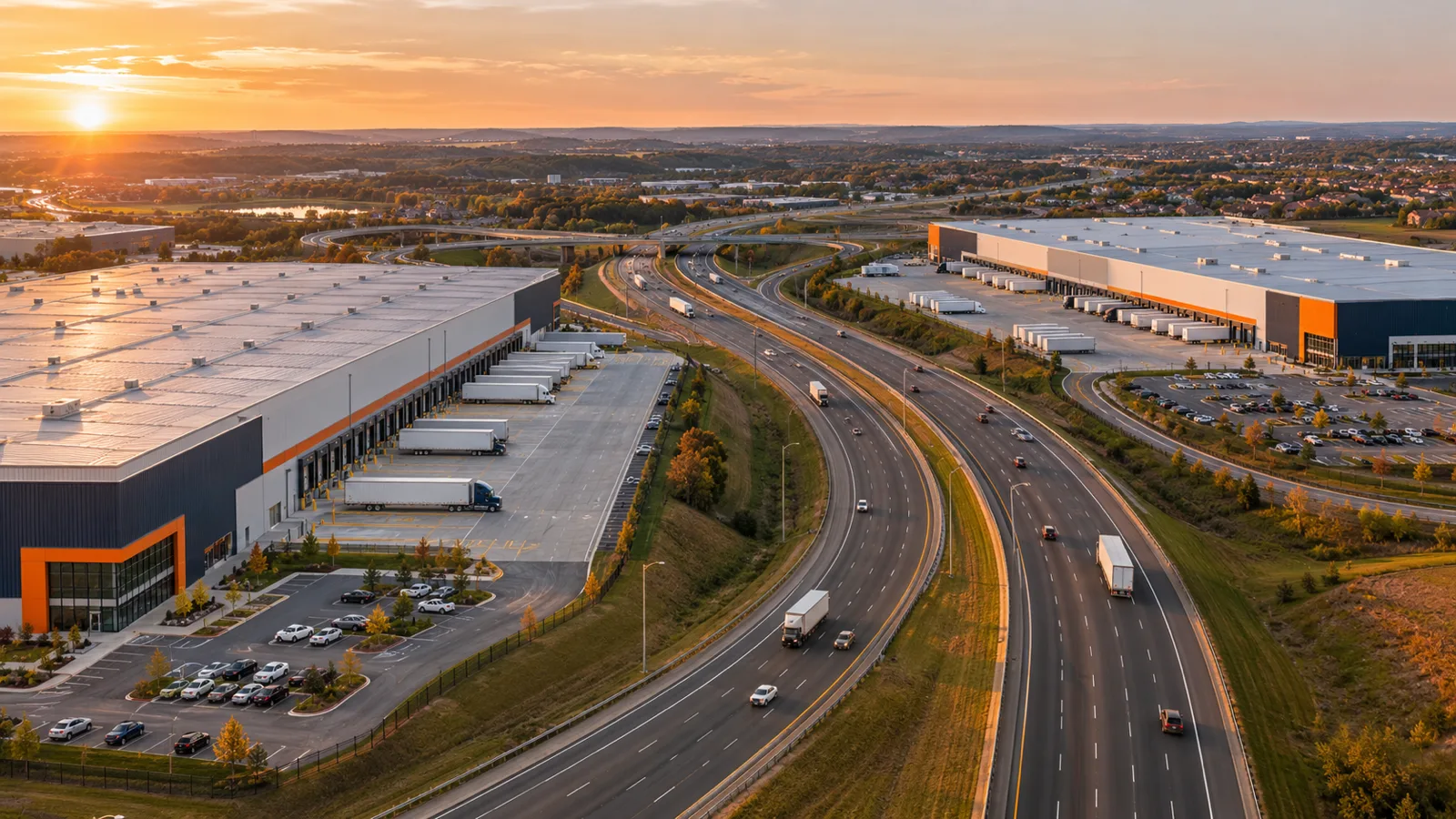
A housewares importer has outgrown its first warehouse and has two shortlisted buildings. One is a mid-sized unit in Mississauga's Gateway area, a few minutes from Highway 401 and Toronto Pearson. The other is a newer building in east Brampton with higher clear height and more dock doors. On paper they are only about 20 minutes apart. In practice, the choice will shape freight costs, hiring, delivery promises and even how often the owner sits in traffic on Highway 410.
Mississauga and Brampton are neighbours inside Peel Region and together form one of the largest concentrations of warehousing and distribution space in Canada. Many businesses treat them as interchangeable. They are not. Each has its own mix of building stock, transport links, labour pool and municipal costs, and the right answer depends heavily on what you ship and where it goes.
This comparison walks through the factors that matter most, without pretending there is one winner. We will avoid quoting rent figures because market rates move quickly and vary building by building; instead, we will focus on what drives the cost and value in each city.
The Short Version
If you want a quick orientation before the detail:
- Mississauga tends to suit businesses that value proximity to Toronto Pearson, the 401/403/427/QEW network, Toronto customers and the US border via the QEW. It has a deep stock of mid-sized and older industrial buildings mixed with newer distribution space.
- Brampton tends to suit businesses that need large modern footprints, rail intermodal access, and quick reach north and west via Highways 410 and 407. It has seen significant newer large-format distribution construction.
- Both draw on a large Peel Region labour pool, and many workers commute between the two cities, so labour is less of a differentiator than people assume.
Factor 1: Highway Access and Delivery Reach
Transportation is usually the biggest driver of total logistics cost, so start here.
Mississauga
Mississauga is crossed or bordered by Highways 401, 403, 407, 410 and 427 and the QEW. That gives it unusually flexible routing: east to Toronto via the 401 or Gardiner/QEW, west to Hamilton and Niagara via the 403 and QEW, and north via the 410 and 427. For a business delivering into downtown Toronto, Etobicoke, Oakville and Burlington, a Mississauga location often shortens routes. The QEW also gives a direct line toward the Peace Bridge and Lewiston-Queenston crossings into New York State.
The catch is congestion. The 401 between the 410 and 427 interchanges is one of the busiest stretches of highway in North America, and delivery schedules need to account for rush hour. Locations near Highway 407 can bypass some of that, though the 407 is a toll highway and the tolls add to per-trip costs.
Brampton
Brampton is served by Highway 410 running north-south through the city and the 407 across its southern edge, with Highway 427, now extended north through Vaughan, running just east of the city. For deliveries to Vaughan, Caledon, Orangeville or northbound via Highway 400 and Highway 10, Brampton can be closer. Getting to downtown Toronto or the Niagara crossings generally means more time on the 410 and 401 or paying for the 407.
The Ontario government has also been advancing the proposed Highway 413 corridor across the north of Peel Region. Whatever your view of the project, if it proceeds it may change travel patterns in north Brampton and Caledon over the coming years, which is worth watching for long-term leases.
Factor 2: Air and Rail Connections
Toronto Pearson International Airport sits on Mississauga's northeast edge, bordering Malton and the Airport Corporate Centre. It is one of the most important air cargo hubs in Canada, and businesses that move air freight regularly, such as electronics, pharmaceuticals, fashion samples or urgent replacement parts, often benefit from being close to the cargo terminals. Brampton is not far away, but shaving 15 to 25 minutes off airport runs can matter for late cut-offs.
For rail, Brampton has a clear advantage. CN's Brampton Intermodal Terminal is located in the city, and CPKC's Vaughan intermodal facility is a short drive to the east. Importers whose ocean containers arrive by rail from the ports of Vancouver, Prince Rupert, Montreal or Halifax may find a Brampton warehouse reduces drayage distance and cost per container.
Factor 3: Building Stock and Specifications
Rent per square foot is only part of the picture. What you get for that rent matters just as much.
| Consideration | Mississauga | Brampton |
|---|---|---|
| Typical building mix | Wide range, including many older and mid-sized multi-tenant buildings alongside newer distribution centres | Higher share of newer, large-format distribution buildings, plus older industrial pockets |
| Clear height | Varies widely; older buildings may have lower ceilings that limit racking | Newer builds commonly offer higher clear heights suited to tall racking |
| Small units | Good availability of smaller units for growing businesses | Available, but newer stock skews larger |
| Trailer parking | Often tighter on older sites | Newer sites frequently designed with more trailer storage |
These are general tendencies, not rules. There are excellent modern buildings and dated ones in both cities. The point is to compare the specific buildings on the metrics that affect your operation: clear height, dock doors, door-to-square-foot ratio, column spacing, floor load, sprinklers, power and truck court depth. A cheaper building with low clear height can cost more per pallet position than a pricier one with tall racking.
Factor 4: Labour
Peel Region has a large logistics workforce, and many warehouse employees live in one city and work in the other. Transit options differ, though. Mississauga's MiWay network and the Hurontario LRT project are oriented toward the city's centre and main corridors, while Brampton Transit's Züm routes run along major arterials such as Queen Street and Steeles Avenue. A warehouse near a frequent bus route will generally find recruiting easier for shift workers who do not drive.
Wage levels for warehouse roles tend to be broadly similar across Peel, but competition for workers can be intense near clusters of large distribution centres, especially in peak season. Ask any landlord or broker which major operators are nearby, because a neighbour hiring hundreds of seasonal workers in November will affect your ability to staff up.
Factor 5: Taxes, Fees and Occupancy Costs
Beyond base rent, industrial leases in Ontario are commonly net leases, meaning tenants pay a share of property taxes, insurance and maintenance (often called TMI or additional rent). Property tax rates and development charges are set by each municipality and Peel Region, and they differ between Mississauga and Brampton. They also change over time.
Rather than assuming one city is cheaper, ask for the current additional rent estimate on each specific building, and compare total occupancy cost per usable pallet position or per order shipped. That number tells you far more than headline rent.
Factor 6: Customer Location
The single most useful exercise is to map your actual customers. Pull a year of order data and plot destinations by postal code. If most volume goes to Toronto, Hamilton, Niagara and the US Northeast, Mississauga's position on the 401, 403 and QEW is likely to save transit time. If you serve big-box distribution centres in Brampton, Vaughan and Bolton, or ship heavily north into cottage country and Northern Ontario, Brampton may come out ahead.
For e-commerce shippers, the difference between the two cities is usually small for parcel delivery because carrier hubs serve both. Pickup cut-off times and the location of the nearest carrier sort facility can matter more than the city name on the lease.
Three Example Profiles
The Toronto-focused e-commerce brand
Ships thousands of parcels a week, mostly within Ontario, with occasional air shipments. Needs a mid-sized space and late carrier pickups. Mississauga is often a natural fit because of proximity to Toronto and Pearson.
The container importer
Receives several 40-foot containers a week by rail and distributes pallets to retailers across Ontario and Quebec. Brampton's proximity to intermodal terminals and larger modern buildings can be attractive here.
The cross-border manufacturer
Ships LTL and truckload freight to customers in New York, Pennsylvania and Ohio. A location in west or south Mississauga near the QEW and 403 shortens the run to the Niagara crossings.
The Third Option: Don't Lease at All
Many businesses comparing buildings in these two cities are really asking whether to take on a lease at all. A lease means committing to space for several years, fitting it out with racking and equipment, hiring a team, and managing peaks and troughs on your own. For businesses whose volume is growing or seasonal, outsourcing to a 3PL can be the more flexible choice.
With a shared or dedicated warehousing arrangement, you pay for the space and labour you use, and you gain access to a warehouse management system, carrier contracts and staff who already know how to run a dock. Our article on why businesses need warehousing and distribution services covers the decision in more detail.
A Checklist Before You Decide
- Map 12 months of customer destinations and inbound origins.
- Calculate total occupancy cost, including TMI, per pallet position.
- Check clear height, dock doors, trailer parking and power against your plan.
- Test drive times at the hours your trucks actually run, not at noon on a Sunday.
- Confirm transit access for shift workers.
- Ask which large employers are nearby and when they hire.
- Compare the lease commitment against a 3PL quote for the same volume.
Get a Second Opinion From ShipCarte
Choosing between Mississauga and Brampton is a big commitment, and the right answer depends on your freight, your customers and your growth plan. ShipCarte provides distribution warehousing and fulfillment for businesses across the GTA, so you can compare the cost of running your own building with an outsourced model. Schedule a consultation to talk through your network, or request a quote for warehousing in Mississauga.