
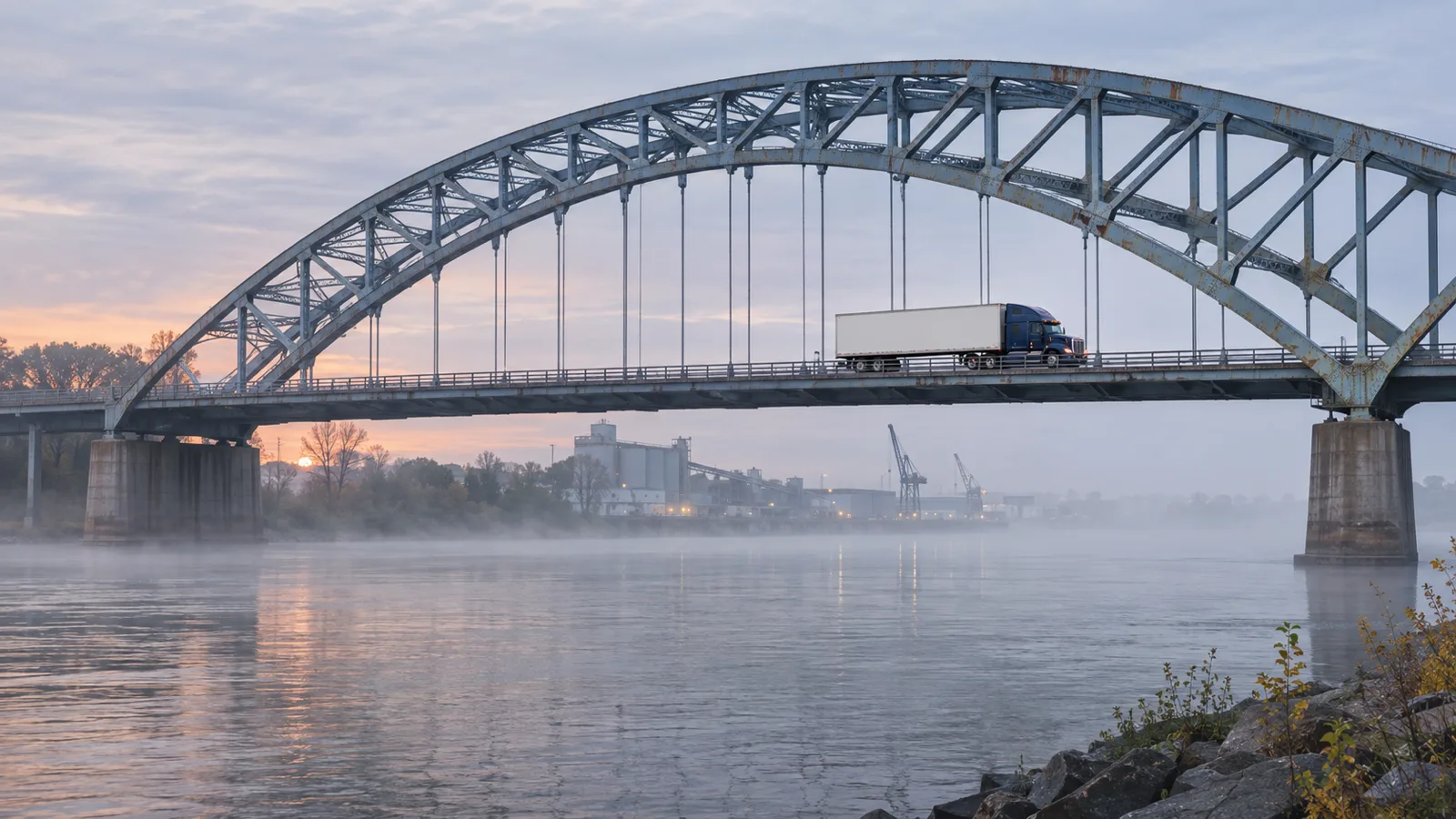
At 5:30 a.m., a dry van pulls away from a dock in west Mississauga loaded with 18 pallets of packaged building products. It merges onto the QEW toward Hamilton, swings around Lake Ontario through St. Catharines, and by mid-morning it is in the commercial lanes approaching the Peace Bridge at Fort Erie. Whether that truck rolls into Buffalo within the hour or sits at the border for half a day has very little to do with the driver and almost everything to do with paperwork completed the day before.
For Mississauga manufacturers, distributors and e-commerce brands, the Niagara corridor is the natural gateway to the United States. Buffalo sits roughly two hours away in normal traffic, and from there Interstate 90 runs east to Rochester, Syracuse and Albany and west to Erie and Cleveland, while other routes lead south into Pennsylvania. Upstate New York, Pennsylvania, Ohio and New England become reachable within a day or two.
This guide follows a shipment from a local dock to a US consignee, step by step, and explains the decisions that make cross-border freight predictable rather than stressful.
Choosing Your Crossing
Three bridges connect the Niagara region with New York State, but only two handle commercial trucks:
- Peace Bridge between Fort Erie and Buffalo, the most direct crossing for freight heading into Buffalo itself and west along I-90 toward Erie and Cleveland.
- Lewiston-Queenston Bridge between Queenston (Niagara-on-the-Lake) and Lewiston, a major commercial crossing that connects to I-190 and is often used for freight heading east toward Rochester or for loads where the carrier prefers it based on wait times.
- Rainbow Bridge in Niagara Falls, which does not accept commercial trucks.
Carriers often choose between the Peace Bridge and Lewiston-Queenston on the day based on posted wait times, the consignee's location and where their US customs broker is set up to work. As a shipper, you rarely need to dictate the bridge, but you should know which one your carrier plans to use so the paperwork and broker notifications match.
For destinations in Michigan or the US Midwest, the Ambassador Bridge at Windsor-Detroit or the Blue Water Bridge at Sarnia-Port Huron may be more direct. The Niagara crossings make the most sense for New York, Pennsylvania, New England, New Jersey and much of Ohio.
The Shipment Journey, Step by Step
Step 1: Confirm the commercial terms
Before anything moves, you and your buyer need to agree on Incoterms or equivalent terms. Who is the importer of record in the US? Who pays freight, duties and brokerage? If you are selling on a delivered duty paid basis, you are taking on US import obligations yourself; our guide to what DDP means explains the implications. Many B2B shipments to the US are sold on terms where the US buyer acts as importer and uses their own broker, which simplifies your side.
Step 2: Prepare the commercial documents
A typical cross-border truck shipment needs:
- A commercial invoice (or Canada Customs Invoice equivalent for US purposes) with full shipper and consignee details, product descriptions, quantities, values, currency and country of origin.
- Harmonized System classification for each product. The first six digits are shared internationally, but the US uses its own ten-digit HTS codes. See our article on HS codes for Mississauga exporters.
- A bill of lading listing pieces, weight, freight class or description, and any special handling.
- Proof of origin under CUSMA (known in the US as USMCA) if the goods qualify and preferential treatment is being claimed.
- Any permits or agency documents required for regulated goods, such as food, which may need FDA prior notice, or products under other US agency jurisdiction.
Step 3: Engage the US customs broker
Most cross-border freight is cleared by a licensed US customs broker acting for the importer. The broker needs the commercial invoice and supporting documents in advance so they can prepare the entry. The carrier provides the broker with a pre-arrival reference, commonly a PAPS number shown as a barcode on the paperwork, which links the truck's electronic manifest to the customs entry.
Step 4: The carrier files the electronic manifest
US Customs and Border Protection requires truck carriers to submit an ACE e-Manifest before arrival at the border, with lead times depending on the program the carrier participates in. This is the carrier's responsibility, but it only works if your information is accurate and delivered on time. A late or incomplete invoice from the shipper is one of the most common reasons trucks get held.
Step 5: Pickup and the drive to Niagara
From Mississauga, the usual route is the QEW west and south around the lake, or the 403 to connect with the QEW at Burlington. Traffic through Burlington and the Burlington Skyway can add delays, so carriers plan departures around peak periods. An early start often means the truck reaches the border before the late-morning build-up.
Step 6: Primary inspection at the US port of entry
At the booth, the CBP officer has already seen the electronic manifest and the broker's entry. If everything matches and there are no flags, the truck is released. If something is missing or the shipment is selected for examination, it goes to secondary inspection, which can add hours. Accurate descriptions, correct classification and complete documents reduce the chance of avoidable holds, though random examinations happen regardless.
Step 7: Delivery or transload in Buffalo
Once released, the truck delivers to the consignee or to a Buffalo-area facility where freight is cross-docked onto US domestic carriers. Many Canadian shippers use this model for LTL: consolidate in Mississauga, cross as a full load, then break it down in Buffalo for delivery across the Northeast.
LTL, Truckload or Parcel?
The right mode depends on volume and urgency.
- Full truckload suits shipments that fill most of a 53-foot trailer, or time-sensitive loads that should not be handled at terminals. It gives you the most control over timing.
- LTL freight suits a few pallets at a time. Many Canadian LTL carriers run regular cross-border service through Niagara, often with interline partners on the US side. Transit can be longer because freight moves through terminals.
- Parcel suits individual cartons and e-commerce orders, typically cleared under the carrier's own brokerage program.
For e-commerce shippers, note that the US suspended duty-free de minimis treatment for low-value shipments in 2025, which changed the economics of shipping individual orders from Canada. Rules in this area have shifted repeatedly, so confirm the current position before planning a program. Our posts on Section 321 and tariffs on e-commerce sellers provide background.
Tariffs, CUSMA and Origin
Trade relations between Canada and the US have seen significant tariff changes in recent years, with different treatment depending on product type and whether goods qualify under CUSMA rules of origin. Because the landscape can change quickly, treat any tariff assumption as something to verify with your customs broker at the time of shipment.
What stays constant is the value of getting origin right. A product made in Ontario is not automatically CUSMA-originating; it depends on where its components come from and how they were transformed, according to product-specific rules. Keep supplier declarations and bills of materials organized so you can support origin claims if asked.
Coming Back the Other Way
Many Mississauga businesses also import from the US through the same corridor. Northbound freight is cleared by the Canada Border Services Agency. Since the CBSA Assessment and Revenue Management system (CARM) became the system of record, importers need to be registered in the CARM Client Portal and manage their accounts there, including release prior to payment arrangements. If your company imports regularly, make sure your registration and any required financial security are in place, and that your Canadian broker is properly delegated.
Returns are worth planning too. US customers sending goods back to Canada creates an import into Canada, and handling it without a plan can lead to duties being charged on your own returned product. A returns management process that consolidates US returns before bringing them home can simplify things.
Common Reasons Trucks Get Held
- Commercial invoice not sent to the broker before the truck arrives.
- Vague product descriptions such as "parts" or "samples" instead of specific descriptions.
- Quantities or weights on the invoice that do not match the bill of lading.
- Missing agency documents for regulated products, such as food or certain consumer goods.
- Wrong or missing importer of record information.
- Values stated in the wrong currency or without the currency noted.
Almost all of these are preventable at the shipper's desk, long before the truck reaches the QEW.
Frequently Asked Questions
How long does freight take from Mississauga to Buffalo?
The drive itself is typically around two hours in normal conditions. Total transit, including border processing and any terminal handling, can range from same-day for a direct truckload to a few days for LTL moving through terminals on both sides.
Do I need my own US customs broker?
Not necessarily. If your US customer is the importer of record, they often use their own broker. If you sell DDP, you will need a broker acting on your behalf, and possibly a US importer number.
Is the Peace Bridge or Lewiston-Queenston better?
Neither is better in general. It depends on the final destination, the carrier's broker arrangements and the day's wait times.
Can I use a Buffalo warehouse to serve US customers?
Yes, many businesses do. Shipping bulk across the border and fulfilling orders from a US-side facility can reduce per-order clearance complexity, though it adds inventory planning and US tax considerations.
Ship Across the Border With Confidence
The Peace Bridge corridor puts much of the US Northeast within easy reach of Mississauga, but only if the paperwork, carrier and broker are lined up before the truck leaves. ShipCarte helps businesses plan cross-border shipping, compare carriers and keep shipments moving. Request a quote for your next US load, or schedule a consultation to map out a cross-border program that fits your volume.