
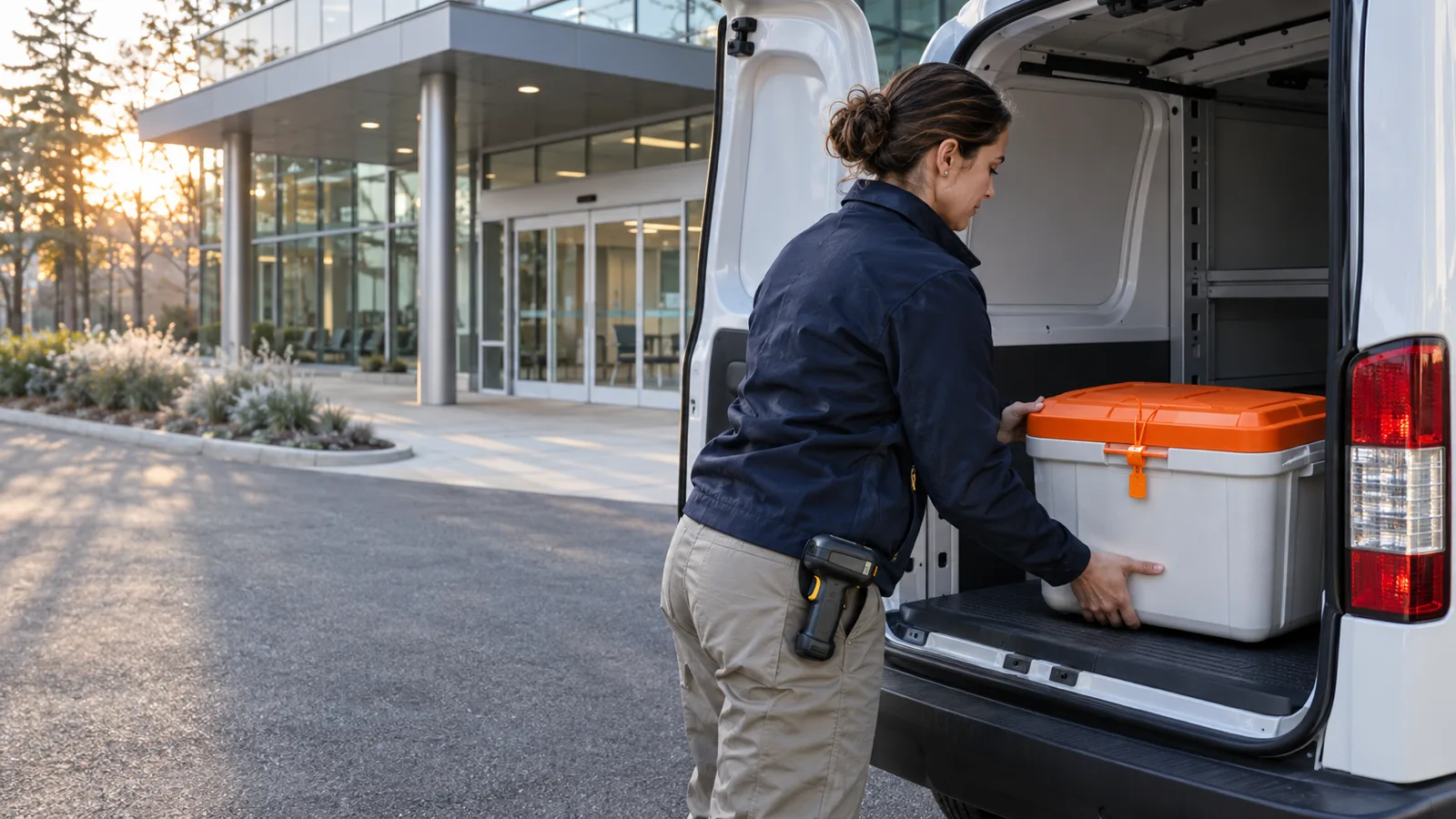
It is 4:40 on a Friday afternoon at a walk-in clinic near Hurontario Street. A tray of blood samples needs to reach a lab before its receiving cut-off, a pharmacy down the road is waiting on a refrigerated insulin order, and a physiotherapy office in Streetsville has asked for a replacement brace to be delivered to a patient's home. For the clinic manager, none of these is "just a delivery". Each one carries clinical, legal and privacy consequences if it goes wrong.
That is the gap between a general courier and a medical courier. The vehicle may look the same, but the handling, packaging, paperwork and accountability are different. Mississauga has a large concentration of hospitals, clinics, labs, pharmacies and medical device distributors, and they rely on couriers who understand those differences.
This guide is written for clinic administrators, pharmacy owners, lab coordinators and medical device suppliers. It explains what a medical courier actually does, the Canadian rules that shape the work, and how to judge whether a provider has a real chain of custody or just a tracking number.
What counts as medical courier work
Medical courier services in the Mississauga area typically cover several categories of item, each with its own requirements:
- Diagnostic specimens such as blood, urine and tissue samples moving from clinics and collection centres to laboratories.
- Prescriptions and pharmacy orders, including home delivery to patients and transfers between pharmacy locations.
- Temperature-sensitive medications like vaccines, biologics and insulin that must stay in a defined range, often 2 to 8°C.
- Medical devices and supplies, from surgical instruments and implants on loan to hospitals, to mobility aids and home-care equipment.
- Records and documents, although much of this has moved to secure digital transfer, some physical files and signed forms still travel by hand.
The common thread is that the item is either clinically important, legally regulated, privacy-sensitive, or all three. A delay or a mix-up is not an inconvenience; it can mean a recollected sample, a missed treatment or a reportable privacy breach.
The rules that shape the work
Several layers of Canadian and Ontario regulation apply, depending on what is being moved.
Transportation of Dangerous Goods for specimens
Under the federal Transportation of Dangerous Goods (TDG) Regulations, many patient specimens are classified as Class 6.2 infectious substances. Most routine diagnostic samples fall under "Biological Substance, Category B" (UN3373), which requires triple packaging: a leak-proof primary receptacle, a leak-proof secondary container with absorbent material, and a rigid outer package marked with the UN3373 diamond. Some specimens are exempt when the likelihood of pathogens is minimal, but that judgement belongs to the shipper, not the driver. Anyone who handles, offers or transports dangerous goods needs appropriate TDG training and a valid training certificate.
Health Canada and drug handling
Health Canada's guidance on storage and transportation of temperature-sensitive health products (often referred to as GUI-0069) sets out expectations for keeping drugs within their labelled storage conditions throughout distribution. Controlled substances and narcotics carry additional requirements around security, record-keeping and who may receive them.
Privacy under PHIPA
In Ontario, the Personal Health Information Protection Act governs how health information custodians handle patient information. A courier carrying a requisition form or a prescription bag with a patient's name on it is handling personal health information on the custodian's behalf. The clinic or pharmacy remains responsible, so it needs to know how the courier protects that information: closed and sealed packaging, no unnecessary details on external labels, and drivers who understand not to leave items with neighbours or in unsecured locations.
Chain of custody, step by step
"Chain of custody" gets used loosely, so it helps to define it. It is a continuous, documented record of who had a shipment, when, and in what condition, from the moment it leaves the sender until it is accepted by the recipient. A solid chain of custody for a specimen run in Mississauga looks something like this:
- Preparation and manifest. The clinic packages specimens and lists them on a manifest or requisition, with counts and any temperature requirements.
- Pickup verification. The driver checks the count against the manifest, scans each item or bag, and records the time. Both parties sign or confirm electronically.
- Transit conditions. Specimens and medications travel in appropriate containers, with temperature data logged where required. Ideally the run is direct or on a planned route with no unattended stops.
- Handoff. At the lab or pharmacy, the receiver confirms the count, the condition and the temperature reading, and signs. Any discrepancy is noted on the spot.
- Record retention. The full record, including timestamps, signatures and temperature logs, is stored and retrievable if the sender or an auditor needs it later.
If a provider can show you each of those steps in a sample report, that is a good sign. If all you get is a "delivered" status and a time, the chain has gaps.
Temperature control in a Mississauga climate
Southern Ontario swings from humid summer heat to deep winter cold, and both extremes are hard on medications and specimens. A vehicle parked outside a clinic in July can heat up quickly, while an uninsulated box left on a January doorstep in Meadowvale can freeze. Good practice includes:
- Validated insulated shippers or active refrigerated containers rated for the expected duration of the trip.
- Pre-conditioned gel packs or phase-change materials, with packing configurations that differ between summer and winter.
- Data loggers or temperature indicators that travel with the shipment and are read at delivery.
- Clear rules about what happens if a reading is out of range: who is told, and whether the product is quarantined.
For larger or recurring volumes of cold product, a courier run is only one link. Our overview of temperature-sensitive product handling explains how storage and transport fit together, and our article on shipping temperature-sensitive products goes deeper into packaging choices.
Common medical courier questions
Can a regular same-day courier move lab specimens?
Only if the people and processes meet TDG requirements and the specimens are correctly packaged. Many general couriers are not trained for Class 6.2 or prefer not to accept it. Ask directly, and ask to see evidence of training.
How fast is a typical run?
Within Mississauga, and between Mississauga and nearby cities like Brampton, Oakville and Toronto, same-day and scheduled routes are common. Actual times depend on traffic on the 401, 403 and QEW, the number of stops on a route, and how lab receiving windows are set. Scheduled daily routes are often more reliable than on-demand calls for routine specimen pickups.
What about deliveries to patients' homes?
Home delivery of prescriptions and medical supplies needs clear rules: whether a signature is required, whether ID must be checked, what happens if nobody is home, and whether the item can ever be left. Cold products should never be left unattended. These rules should be agreed in writing with the pharmacy or supplier before the first run.
How are medical devices different from medications?
Devices often have serial numbers or lot numbers that must be recorded, and some, such as loaner surgical kits, move on tight schedules tied to procedure dates. Devices also tend to be returned, so the courier is often managing two-way flows. Our medical device fulfillment service is built around this kind of traceability.
What if a product needs to be pulled back?
When a manufacturer or Health Canada initiates a recall, distributors need to know quickly where every affected lot went. Couriers and warehouses that capture lot data at each handoff make that far easier. See our recall management page for how that process works.
How to evaluate a medical courier
When you are comparing providers for a clinic, pharmacy, lab or device business in Mississauga, these are the questions worth asking:
- Are your drivers TDG-trained for Class 6.2, and can you show current training records?
- What does your chain-of-custody record contain, and can I see an example?
- How do you monitor and document temperature during transit?
- What are your privacy practices for personal health information, and do drivers receive privacy training?
- What is your procedure for a missed pickup, a delayed run, or a temperature excursion, and how quickly will I be told?
- Can you handle both scheduled routes and urgent, on-demand calls?
- Do you offer storage and fulfillment as well, so stock and delivery are managed together?
The last question matters more as you grow. Many healthcare businesses start with a courier for local runs, then realise their inventory, picking and distribution would benefit from being under the same roof. A combined approach that pairs healthcare warehousing with scheduled delivery can reduce handoffs, and every handoff removed is one less point where custody can break.
Mistakes that cause problems
Experience across the sector points to a handful of recurring issues:
- Outer labels showing patient names or diagnoses, which creates avoidable privacy exposure.
- Using the same cooler configuration year-round regardless of outside temperature.
- No agreed procedure when a recipient is closed, leading to improvised decisions by drivers.
- Manifests that list bag counts but not individual specimen counts, making discrepancies hard to trace.
- Relying on verbal handoffs at busy lab receiving desks instead of signed or scanned confirmation.
Each of these is easy to fix once it is written into a standard operating procedure shared by the sender and the courier.
Talk to ShipCarte about healthcare deliveries
ShipCarte supports healthcare businesses with distribution, warehousing, medical device fulfillment and temperature-sensitive handling across the GTA. If you run a clinic, pharmacy, lab or medical supply business in Mississauga and want a clearer chain of custody for your deliveries, schedule a consultation with our team. We'll map your current flows, highlight gaps, and suggest a setup that fits your volume and your compliance obligations.