
A young meal kit company in Mississauga has a winning menu: South Asian and Caribbean home cooking, portioned for weeknight dinners, with spice blends that customers rave about. Subscriptions are growing across Peel and Halton. Then July arrives. A heat wave settles over the GTA, a delivery van gets stuck on the QEW for an extra hour, and a batch of boxes arrives on doorsteps with gel packs gone soft and chicken that is no longer cold. The refunds are expensive. The one-star reviews are worse.
Meal kits are one of the hardest things to ship well. Each box combines raw proteins, dairy, fresh produce and dry pantry items, all of which have different needs, and the whole thing has to stay safely chilled for hours outside any refrigerator. Unlike a restaurant meal, the customer may not open the box right away. It might sit on a porch in Churchill Meadows while they finish a shift, or in a condo lobby near Square One until the concierge calls.
This guide is about the logistics behind a meal kit that arrives fresh: how to design the pack-out, how to plan the delivery day, what changes with the seasons, and what food safety rules apply in Canada. It is written for meal kit startups, prepared meal companies and grocery brands shipping chilled boxes from Mississauga to customers across the GTA and beyond.
Start with the target: what "fresh on arrival" means
Health Canada advises keeping cold foods at or below 4°C, and the range between 4°C and 60°C is the temperature danger zone where bacteria grow quickly. That gives a meal kit a simple goal: the perishable components should stay at or below 4°C from the moment the box is sealed until the customer puts them in the fridge, with a buffer for delays.
The time you need to cover is longer than the delivery itself. Add together:
- Time from packing to dispatch
- Time on the vehicle, including every earlier stop on the route
- Time sitting at the door until the customer gets home
- A safety buffer for traffic, weather or a missed delivery
For local delivery within Mississauga and nearby cities, many brands design for a total of 24 hours or more. For boxes shipped further by courier, 36 to 48 hours is a common design target. Your own target should come from testing, not guesswork.
Designing the pack-out, layer by layer
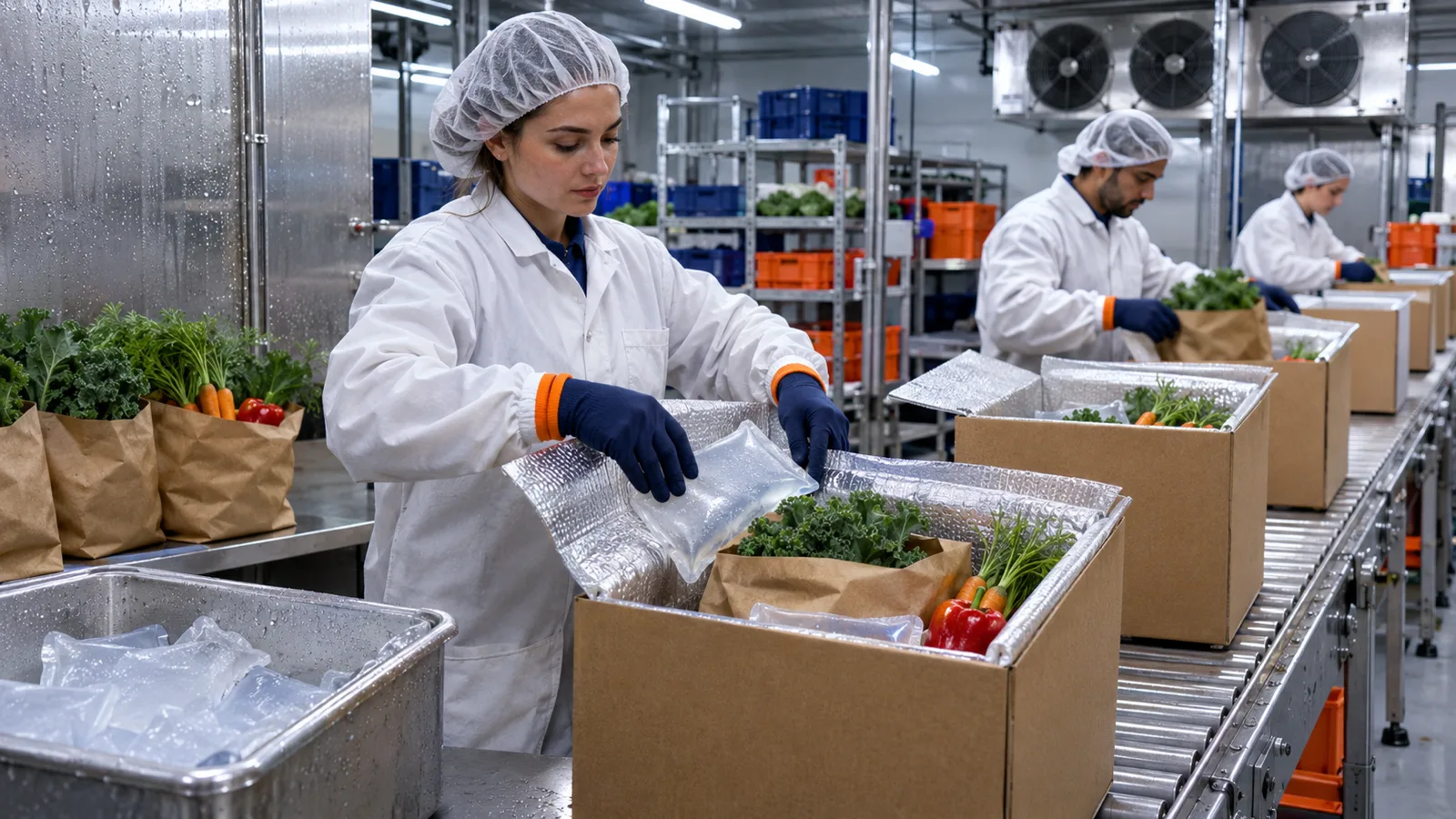
A meal kit pack-out is the specific combination of box, insulation, coolant and arrangement that keeps food cold. Think of it as a recipe. Change one ingredient and the result changes.
Step 1: The outer box
A sturdy corrugated box protects the contents and holds everything together. Size matters. A box that is too large leaves air space that warms faster and costs more to ship. A box that is too small crushes produce. Many brands use two or three box sizes for different plan sizes.
Step 2: The insulation
Common options include expanded polystyrene coolers, insulated liners made from recycled cotton or other fibres, and paper-based insulation designed to be curbside recyclable. Foam usually offers strong thermal performance but is bulkier and less popular with environmentally minded customers. Fibre and paper liners can be more appealing but may need more coolant or a smaller box to match performance. Whatever you choose, liners should cover all six sides, including the lid.
Step 3: The coolant
Gel packs are the most common coolant for chilled meal kits. They should be fully frozen before use, which means freezer capacity at the packing site is a real constraint. Placement matters: cold air sinks, so packs placed on top of the proteins often outperform packs on the bottom. Some brands use packs on top and bottom for hot weather.
Dry ice is used for frozen products, but it is generally too cold for fresh produce and is regulated as a dangerous good in some transport modes, with labelling and quantity rules. It needs careful handling and is not usually the right choice for chilled kits. For frozen items, our guide on shipping frozen foods covers the options.
Step 4: The arrangement
Raw proteins go at the bottom or in a sealed tray, sitting closest to the coolant and well away from produce, so any leak cannot contaminate ready-to-eat items. Dairy and delicate items sit next to them. Hardy produce and dry pantry items go higher in the box, where it is slightly warmer. Each meal's ingredients can be grouped in a bag, but the cold-sensitive parts often go in the cold zone rather than with their recipe bag.
Step 5: Test it
Before launching a pack-out, put temperature data loggers in sample boxes and run them through realistic conditions: a hot day, a long route, a few hours on a doorstep. Check when the coldest and warmest items cross 4°C. Repeat for winter conditions too. This testing is the foundation of a reliable meal kit operation, and it is far cheaper than discovering problems through customer complaints.
Seasonal pack-outs for a GTA climate
Mississauga sees hot, humid summers and cold winters, sometimes well below freezing. One pack-out will not suit all twelve months. Many meal kit operators run at least two or three seasonal configurations:
- Summer: more coolant, coolant on top and bottom, possibly thicker insulation, and earlier delivery windows to avoid afternoon heat.
- Spring and fall: a standard configuration.
- Winter: less coolant, and attention to protecting produce from freezing. Lettuce and herbs can be ruined by sub-zero temperatures just as easily as chicken can be ruined by heat.
Switching configurations by weather forecast, not just by calendar date, gives the best results. A warm spell in October or a cold snap in April can catch out a schedule-based approach. Our article on shipping temperature-sensitive products has more on planning around weather.
Planning the delivery day
Pack close to dispatch
The less time a sealed box sits before it leaves, the more of its cold capacity is left for the trip. Many operations pack overnight or early morning for same-day delivery, and keep packed boxes in a cooler until the vehicle is loaded.
Route by geography and traffic
Delivery routes should be built to minimize time in the vehicle for each box. For Mississauga deliveries, that often means grouping by area: Meadowvale and Streetsville, Erin Mills and Churchill Meadows, City Centre and Cooksville, Port Credit and Lakeview. Routes into Toronto or Oakville should account for congestion on the 401, 403 and QEW. A van that leaves early can cover a lot of ground before rush hour.
Delivery days that avoid weekends in transit
If you ship meal kits by courier rather than your own delivery, avoid any day where a box could be held over a weekend in a depot. Most brands ship early in the week for this reason.
Communication with customers
Send a delivery-day notification with an estimated window, and a message when the box is dropped off. Encourage customers to refrigerate perishables right away. Clear instructions on the box itself help too.
Food safety and labelling in Canada
Meal kit businesses work within Canadian food safety rules. Depending on what you do, the Safe Food for Canadians Regulations may require a licence from the Canadian Food Inspection Agency, a preventive control plan and traceability records. Provincial and municipal health requirements can also apply to food preparation sites. Prepackaged foods generally need bilingual labelling in English and French, ingredient lists and allergen information. Because rules depend on your exact activities, confirm requirements with CFIA guidance or a food regulatory advisor.
Operationally, that translates into clean, temperature-controlled packing rooms, staff hygiene practices, allergen controls to prevent cross-contact, lot tracking for ingredients and a plan for recalls. If a supplier recalls an ingredient, you need to know which boxes it went into.
Common problems and their usual causes
- Warm proteins on arrival: not enough coolant, packs not fully frozen, or long dwell time before dispatch.
- Frozen or damaged produce: coolant placed directly against produce, or a summer pack-out used in cold weather.
- Crushed ingredients: box too small or poor arrangement, with heavy items placed on soft ones.
- Leaks: proteins not double-bagged or sealed, or gel packs punctured.
- Missing items: picking without scan verification. A pick and pack process with scanning helps.
Building it in-house or with a partner
Many meal kit companies start by packing in a commercial kitchen. As volume grows, they run into limits on cold storage space, freezer capacity for gel packs, packing labour and delivery coverage. A partner offering cold chain fulfillment can take on storage and packing for some or all components, while the brand focuses on recipes and marketing. For subscription models, our subscription box fulfillment service and guide to subscription fulfillment are useful reading.
Ship meal kits that arrive cold
ShipCarte supports food brands in Mississauga with food and beverage logistics, temperature-controlled storage and cold chain packing. If you are launching a meal kit or struggling with warm boxes, request a quote and we can help you design a pack-out and delivery plan that holds up in every season.